

The best history EE ideas are not the biggest or most dramatic. They are focused historical problems that can be investigated through accessible evidence, competing interpretations, and a research question narrow enough for a 4,000-word essay.
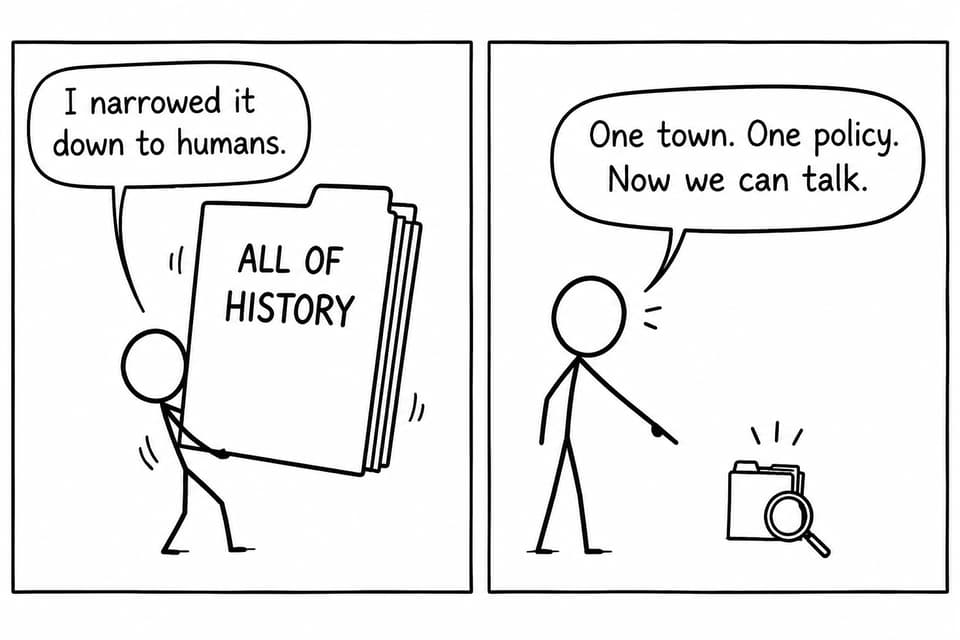
That distinction matters in DP1. A topic such as “the Cold War” can feel exciting until you try to turn several decades, dozens of countries, and thousands of sources into one argument. A smaller question may initially seem less impressive, but it usually creates more room for genuine analysis.
The ideas below are starting points, not questions to copy unchanged. Adapt the place, period, historical factor, and source base to match your interests. Before committing, discuss the proposal with your supervisor and check the current IB guidance for your assessment session.
What makes a strong History EE topic?
A promising topic normally passes five tests:
- It investigates the past. For a History EE, the subject matter must satisfy the IB's historical time requirements. Because the exclusion period for recent events moves over time, confirm the applicable cut-off with your coordinator.
- It is narrow. One community, policy, institution, campaign, or debate is usually more manageable than an entire war or political movement.
- It invites argument. The question should support a defensible judgement rather than a chronological narrative.
- It has accessible evidence. You need relevant primary and secondary sources that you can obtain, understand, and evaluate.
- It belongs to history. Your investigation should use historical methods and engage with context, causation, significance, change, continuity, or differing interpretations.
The IB Extended Essay remains an independent research project culminating in a paper of up to 4,000 words. Under the model first assessed in May 2027, students follow either a subject-focused or interdisciplinary pathway. A conventional History EE belongs to the subject-focused pathway. If your proposed question genuinely integrates history with another discipline, ask whether the interdisciplinary pathway is more appropriate rather than quietly mixing methods.
For a broader orientation, read the guide to what changed in the 2027 Extended Essay before choosing your topic.
History EE ideas by area of interest
These examples show the level of focus you should aim for. They still require a preliminary source search and your supervisor's approval.
Political power and leadership
- To what extent did unemployment contribute to increased NSDAP electoral support in Berlin between 1928 and 1932?
- How significant was the 1945 general election campaign to Labour's victory in Britain?
- To what extent did divisions within the Hungarian leadership contribute to the outcome of the 1956 uprising?
Leadership topics become weak when they turn into biographies. Instead of asking whether a leader was “good,” isolate one decision, crisis, reform, or explanation and assess it against alternatives.
War, diplomacy, and international relations
- How significant was intelligence failure in the United States government's response to the Cuban Revolution between 1958 and 1961?
- To what extent did logistical limitations shape the outcome of the Gallipoli campaign in 1915?
- How important was the Suez Crisis in changing British relations with the United States between 1956 and 1960?
Military history should not become a catalogue of battles. A strong question investigates why an outcome occurred, why a strategy changed, or how an event altered a relationship.
Social and cultural history
- To what extent did British Ministry of Information posters reinforce traditional gender roles between 1939 and 1945?
- How did the Notting Hill disturbances of 1958 affect public debate about race and immigration in Britain?
- To what extent did television coverage influence public understanding of the US civil rights movement between 1963 and 1965?
Cultural evidence can include newspapers, posters, speeches, broadcasts, memoirs, photographs, and organisational records. The difficult part is separating what a source represented from what audiences actually believed.
Empire, independence, and decolonisation
- How significant was the Salt March to the development of the Indian independence movement between 1930 and 1931?
- To what extent did veterans influence political mobilisation in the Gold Coast between 1945 and 1951?
- How important was international pressure to the end of Dutch colonial rule in Indonesia between 1945 and 1949?
Questions about independence movements improve when you compare causes instead of attributing everything to one famous individual. Local archives and newspapers may also reveal perspectives missing from broad textbook accounts.
Economic and local history
- To what extent did railway expansion transform employment in a selected town between 1880 and 1910?
- How significant was wartime rationing in changing household consumption in a selected community between 1939 and 1945?
- To what extent did one municipal housing programme improve living conditions between two clearly defined dates?
Local history is often overlooked. That can be an advantage. Municipal minutes, regional newspapers, census records, school archives, oral histories, and local museum collections can support an original investigation, provided you can access enough evidence and evaluate its limitations.
You can explore further possibilities in History EE topics worth researching and review high-scoring approaches through the History EE Coursework Library. Use exemplars to understand method and structure, never as templates to imitate.
Strong versus weak EE research questions
A broad topic tells you where to look. An effective EE research question tells you what to investigate.
| Weak question | Stronger version | Why it improves |
|---|---|---|
| Why did Hitler rise to power? | To what extent did unemployment contribute to increased NSDAP electoral support in Berlin, 1928-32? | It defines a factor, place, period, and measurable outcome. |
| How did propaganda affect the Second World War? | To what extent did British Ministry of Information posters reinforce traditional gender roles, 1939-45? | It identifies a source set and a specific historical debate. |
| Was the Cuban Missile Crisis important? | How significant was the Cuban Missile Crisis in changing US policy toward Cuba, 1962-65? | It replaces vague importance with a defined consequence. |
| What happened during Indian independence? | How significant was the Salt March to Congress mobilisation in Gujarat, 1930-31? | It turns a narrative topic into an evaluative investigation. |
| How did railways change society? | To what extent did railway expansion alter employment patterns in a selected town, 1880-1910? | It makes change investigable through local evidence. |
Notice that a strong question does not guarantee a strong essay. “To what extent” can still produce weak work if evidence is scarce or the proposed factor cannot be separated from other causes. The wording creates an analytical opportunity; your research must fulfil it.
For help refining the wording, use RevisionDojo's guide to choosing an Extended Essay topic you will still value later and its explanation of a focused EE introduction and research question.
Run a source test before committing
A topic is only as workable as its evidence. Spend 45-60 minutes conducting a source test before asking for final approval.
Create a simple record with four columns: source, author or creator, perspective, and possible use. Try to find:
- two scholarly secondary works offering different interpretations;
- three or more relevant primary sources;
- enough contextual material to understand the period;
- evidence that could challenge your initial assumption;
- sources you can access legally and read confidently.
Then ask whether the evidence actually addresses your question. A collection of speeches can reveal how a government presented a policy, but it may not demonstrate how citizens received it. Memoirs can illuminate experience, but memory, hindsight, and self-justification require evaluation.
RevisionDojo's guide to the best sources for Extended Essay research can help you distinguish useful evidence from material that merely mentions your topic. The Study Notes and Coursework Library can establish context, while your final argument should rest on the sources you independently investigate.
Turn an idea into a workable proposal
Once a topic survives the source test, write a one-page proposal containing:
- your provisional EE research question;
- a short explanation of its historical significance;
- the place and dates covered;
- the main factor or debate being investigated;
- three promising primary sources;
- two competing scholarly interpretations;
- one likely limitation;
- a provisional answer in one sentence.
That last sentence is not a permanent conclusion. It is a hypothesis that gives your reading direction. Change it when the evidence demands a better answer. That willingness to revise is not indecision; it is historical thinking.
As research develops, organise sections around claims rather than source summaries. The History EE structure guide and 2027 EE structure blueprint explain how context, evidence, interpretation, and evaluation can form a sustained line of argument.
Choose the question you can investigate well
The ideal History EE is rarely the topic that sounds most sophisticated in conversation. It is the one that keeps producing useful questions when you encounter new evidence.
RevisionDojo brings the planning process into one workspace. You can consult Study Notes, examine approaches in the Coursework Library, use grading tools to review clarity, and seek guidance from experienced Tutors. Its Questionbank, Flashcards, Predicted Papers, and Mock Exams can support your subjects while you protect regular time for the essay.
When you have two or three candidate questions, save each draft in RevisionDojo and ask Jojo AI Chat for feedback on scope, assumptions, and missing variables. Treat that feedback as a structured second look, not a substitute for your supervisor's judgement. The genuinely useful outcome is not an instant perfect question. It is a visible trail showing how a broad interest became a historical problem you can answer.