
A half-finished document is open on the laptop. The deadline is getting closer. Your child says they are working on it, but you cannot tell whether to step in, step back, or quietly make another cup of tea.
That uncertainty is normal. Helping with extended essay work does not mean researching, editing, or shaping the argument for your child. The most useful parental role is to provide calm structure, ask questions that preserve independent thinking, protect time for focused work, and direct the student toward appropriate academic support when they become stuck.
The Extended Essay is deliberately student-led. It is an externally assessed IB Diploma Programme core component built around a focused research question and formal academic writing. The essay has an upper limit of 4,000 words, while the precise reflection requirements and assessment criteria depend on the student's examination session. Your child's school guidance should therefore be the final authority.
You do not need to become an expert in the topic. You need to help create the conditions in which your child can become one.
A quick checklist for IB Diploma parents
A supportive parent can:
- Ask the student to explain their research question in plain language
- Help place school deadlines and smaller milestones on a calendar
- Protect regular, realistic blocks of uninterrupted working time
- Encourage early communication with the assigned supervisor
- Ask reflective questions without suggesting arguments or conclusions
- Support sleep, meals, movement, and time away from the screen
- Direct the student to ethical, criterion-aware IB support
- Check the school's academic integrity and AI-use policies together
A supportive parent should not:
- Choose or rewrite the research question
- Find evidence that the student presents as their own research
- Write, restructure, or heavily edit any section
- Interpret results or construct the argument
- Produce reflection responses for the student
- Use an AI tool or third party to generate submission-ready text
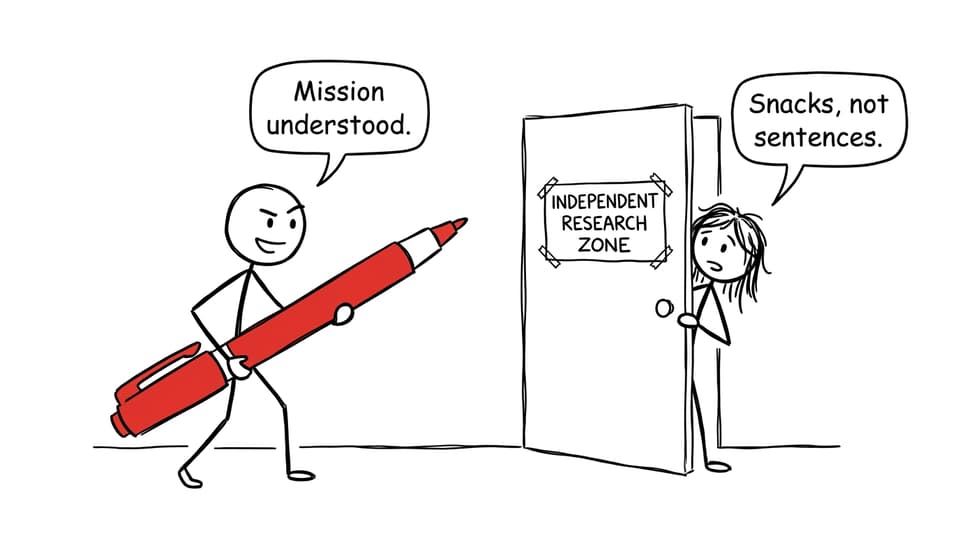
That boundary may feel restrictive. In reality, it makes your role clearer.
Understand what your child is being asked to do
The Extended Essay is not simply a long school essay. It is an independent research project requiring the student to narrow a topic, formulate a focused question, choose suitable methods and sources, develop a reasoned argument, evaluate findings, and communicate everything through appropriate academic conventions.
For students first assessed in 2027, the IB identifies five areas: framework, knowledge and understanding, analysis and line of argument, discussion and evaluation, and reflection. The updated process retains three mandatory formal reflection sessions, ending with a short viva voce, and uses a final reflective statement of no more than 500 words on the Reflection and Progress Form.
Students assessed under an earlier specification may use different criterion names and reflection paperwork. Before following online advice, confirm the examination session and read the material supplied by the school. RevisionDojo's overview of the 2027 Extended Essay changes can help families understand the newer model, while the supervisor and IB coordinator remain responsible for school-specific instructions.
Help turn one intimidating project into visible steps
A distant deadline encourages a comforting illusion: there is still plenty of time. Then research expands, other IB deadlines arrive, and the essay becomes an emergency.
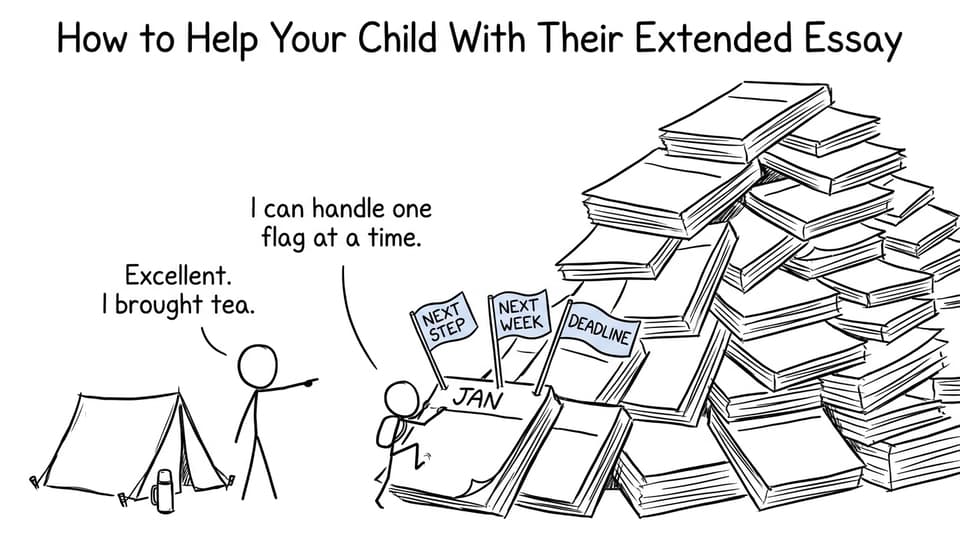
The parent can help with the system without controlling the work. Sit down together once, let your child lead, and divide the project into milestones such as:
- Confirm the subject, pathway, and provisional topic
- Complete preliminary reading
- Refine the research question
- Decide on an appropriate research method
- Build a source and citation system
- Create a provisional outline
- Produce a complete working draft
- Revise the argument and evaluation
- Check references and formal presentation
- Prepare for the final reflection process
The dates should come from the school calendar. Add a small buffer before each internal deadline, particularly during exam preparation and other coursework periods.
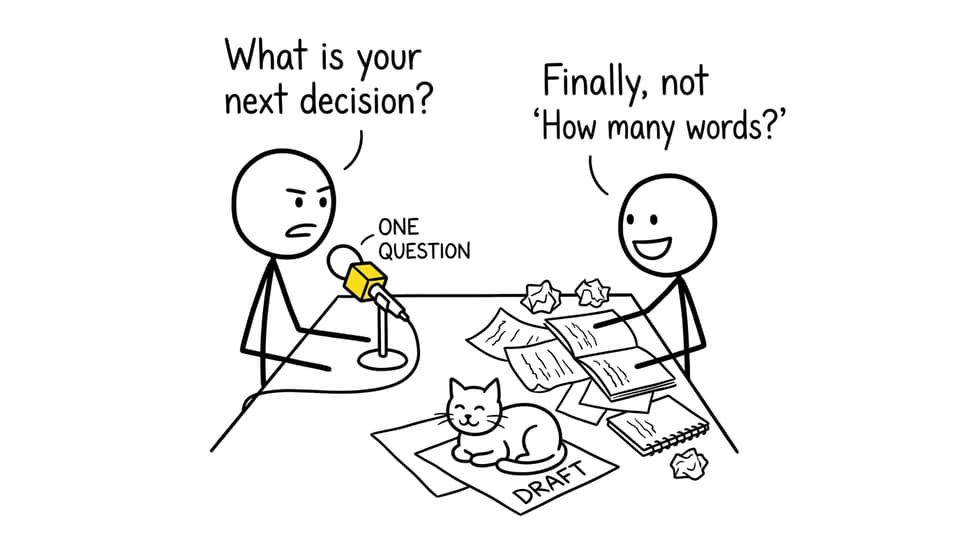
Keep weekly check-ins brief. Ask, "What is the next concrete task?" rather than, "Have you finished the essay?" The first question can produce an action. The second often produces anxiety.
Ask questions that return ownership to the student
Good questions create movement without supplying content. They help a student hear gaps in their own reasoning.
Try asking:
- What exactly does your research question ask you to establish?
- Is the scope manageable within 4,000 words?
- What evidence would make you reconsider your current view?
- Which source is most important, and why is it credible?
- Where does the essay analyse rather than merely describe?
- What is the strongest limitation in your method or evidence?
- What decision do you need to discuss with your supervisor?
Avoid questions that contain a hidden answer, such as, "Shouldn't your second section compare these two theories?" Even when the suggestion is sensible, it starts transferring intellectual ownership from the student to the parent.
If the research question remains vague, your child can use this guide to developing an Extended Essay research question. Your role is not to select the final wording. Ask your child to explain why the question is focused, feasible, debatable, and suited to the chosen subject.
Support research habits without doing the research
Many students mistake collecting information for building an argument. Twenty open browser tabs can feel productive while leaving the central question unanswered.
Encourage your child to record each source when they find it, including the author, title, publication details, page numbers, relevant ideas, and an evaluation of credibility or limitations. They should distinguish quotations, paraphrases, and their own observations in their notes. RevisionDojo's guide to finding suitable Extended Essay research sources provides a practical starting point.
Parents can help with logistics, such as arranging library access, creating quiet working conditions, or helping the student identify who at school can explain a database. The child must still choose, read, evaluate, and use the material.
A research log is especially valuable. It preserves changes to the question, rejected methods, source evaluations, obstacles, and decisions. These records can later help the student discuss the process honestly. The Researcher's Reflection Space guide explains how to maintain that trail without turning it into unnecessary administration.
Protect academic integrity while offering support
The IB expects submitted work to be authentic. Its academic integrity policy specifically warns against non-permitted assistance from relatives, tutors, editing services, and other third parties. Parents are expected to understand school procedures, help students manage their workload, and refrain from assisting in the completion of assessed work.
The safest family rule is simple: support the process, never supply the product.
Before commenting on a draft, ask the supervisor or IB coordinator what outside feedback the school permits. Rules governing proofreading and external tools can be more restrictive than families expect. When in doubt, do not rewrite. Encourage your child to consult the supervisor instead.
AI requires the same caution. School policies may specify permitted uses, disclosure, and citation requirements. An AI response can also invent sources or produce confident but inaccurate material. Review the school's policy together and use the RevisionDojo guide to ethical AI use in IB coursework as a conversation starter, not as a replacement for official instructions.
Know when ordinary procrastination has become a support issue
Avoidance often looks like laziness from the outside. Sometimes the actual problem is uncertainty: the question is too broad, the student cannot access evidence, the method has failed, or they do not know how to turn notes into analysis.
Ask what is blocking the next step. Then match the problem to the right person:
- Unclear requirements: supervisor or IB coordinator
- Weak subject knowledge: subject teacher
- Research access problem: school librarian
- Persistent structural confusion: authorized academic support or tutor
- Overwhelming stress: school counsellor or an appropriate health professional
If distress is affecting sleep, eating, attendance, concentration, or ordinary daily life, treat wellbeing as the priority rather than trying to extract more working hours. RevisionDojo's guidance on supporting an overwhelmed Extended Essay student and protecting IB student mental health can help parents begin that conversation calmly.
Make feedback useful rather than personal
A draft is evidence of thinking in progress, not a verdict on ability. When every comment feels like correction, students may defend weak sections rather than reconsider them.
Encourage your child to separate feedback into three categories:
| Feedback type | Useful next action |
|---|---|
| Research or method | Discuss it with the supervisor and revisit subject guidance |
| Argument and analysis | Identify the exact claim, evidence, and reasoning that need attention |
| Presentation and citations | Build a checklist and correct issues systematically |
The student should decide how to respond and preserve earlier versions. RevisionDojo's Extended Essay draft improvement guide shows how a complete draft can be reviewed for focus, coherence, and depth without replacing the student's work.
When you do not know how to help, use structured IB support
Most parents are not trained IB supervisors. They should not have to decode subject conventions or assessment language alone.
RevisionDojo offers a practical bridge between parental reassurance and appropriate academic support. Students can examine structure through IB coursework guides, learn from the Coursework Library, and use AI Chat to ask questions about concepts and organization while retaining responsibility for every decision and sentence. The Grading tools provide criterion-aware feedback that students can evaluate and act upon rather than blindly accept. For support requiring human judgment, experienced Tutors can help students understand expectations without becoming authors of the work.
The wider RevisionDojo platform also keeps exam preparation from disappearing beneath coursework. Questionbank practice, Study Notes, Flashcards, Predicted Papers, and Mock Exams allow students to maintain subject revision while the Extended Essay advances in scheduled blocks.
This is what helpful support ultimately does: it reduces confusion without removing ownership.
The best parental help is steady, not spectacular
Your child probably does not need you to rescue the essay. They need a home environment in which the project becomes manageable: a calendar, a quiet hour, an honest question, a reminder to contact the supervisor, and confidence that difficulty is part of independent research rather than proof of failure.
Stay close to the process and away from the prose. If your child needs more than you can appropriately provide, guide them toward RevisionDojo's Extended Essay structuring, feedback, coursework, and tutoring support. You can remain the parent while they remain the researcher, exactly as the task intends.