


Introduction
A theatre tradition is never “just a style.” It’s a living answer to a place, a time, a set of beliefs, and a particular audience. That’s why IB Theatre research feels deceptively hard at first: you can describe what you see in a performance, but examiners are listening for the quieter question underneath it all: why did it become this way here?
If you’re preparing for exams and coursework, connecting culture and context is one of the most reliable ways to move from competent to compelling in IB Theatre. It turns your work into analysis rather than a museum label.
Quick checklist: culture-to-performance link (use this every time)
Use this mini workflow whenever you study a world theatre tradition for IB Theatre:
-
Identify where and when the tradition formed (and what pressures shaped it).
-
Name 2-3 cultural values the society prized (community, hierarchy, ritual, satire, restraint, etc.).
-
Link each value to a performance convention (movement, music, masks, space, actor-audience relationship).
-
Explain how an audience would read those conventions inside that culture.
-
Reflect on your own viewpoint and what you might be misreading.
-
Apply one discovery to an assessment choice (staging, performer training, design, or evaluative writing).
For assessment-specific structure, pair this with How to Prepare for the IB Theatre Research Presentation.
Why culture and context matter in IB Theatre (and what examiners reward)
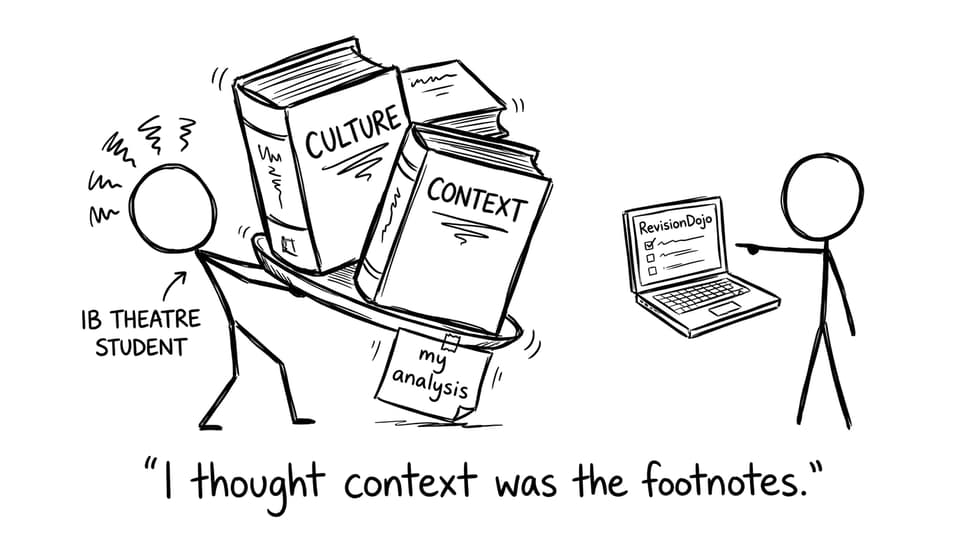
In IB Theatre, “context” isn’t background decoration. It’s the engine.
When you connect culture and context, you show you can:
-
interpret conventions as meaningful choices, not quirky habits
-
evaluate audience impact (not just list features)
-
make ethical, informed adaptations rather than surface-level borrowing
-
justify your creative decisions in clear academic language
This is especially important in tasks that demand research plus application. If you’re aiming high overall, keep How to Score a Level 7 in IB Theatre: Complete Guide nearby while you plan.
How to connect culture and context in IB Theatre research
Start with a “pressure” question, not a “definition” question
A useful habit in IB Theatre is to begin with what a society needed theatre to do.
Ask:
-
What social role did performance serve: ritual, entertainment, education, resistance, spiritual contact?
-
Who had power, and who was being watched?
-
What was considered sacred, shameful, comic, or dangerous?
Then your research stops being a timeline and becomes an explanation.
Turn cultural values into performance conventions
Choose a few values you can defend with evidence, then connect them to conventions.
Examples students often use effectively in IB Theatre research:
-
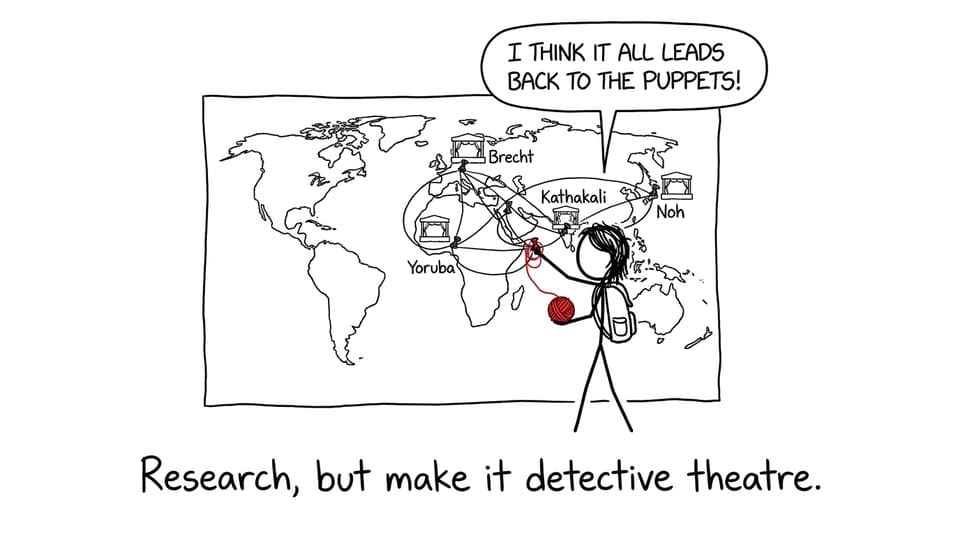
Noh Theatre (Japan): restraint, spiritual reflection, and an elite court setting help explain slow pacing and controlled physicality.
-
Kathakali (India): mythic storytelling and moral instruction help explain codified gesture, makeup, and heightened characterization.
-
Yoruba performance (Nigeria): community and spirituality help explain music, rhythm, and participatory audience energy.
Notice the pattern: you’re not claiming “this culture equals this one thing.” You’re showing a reasonable link between a context and a convention.
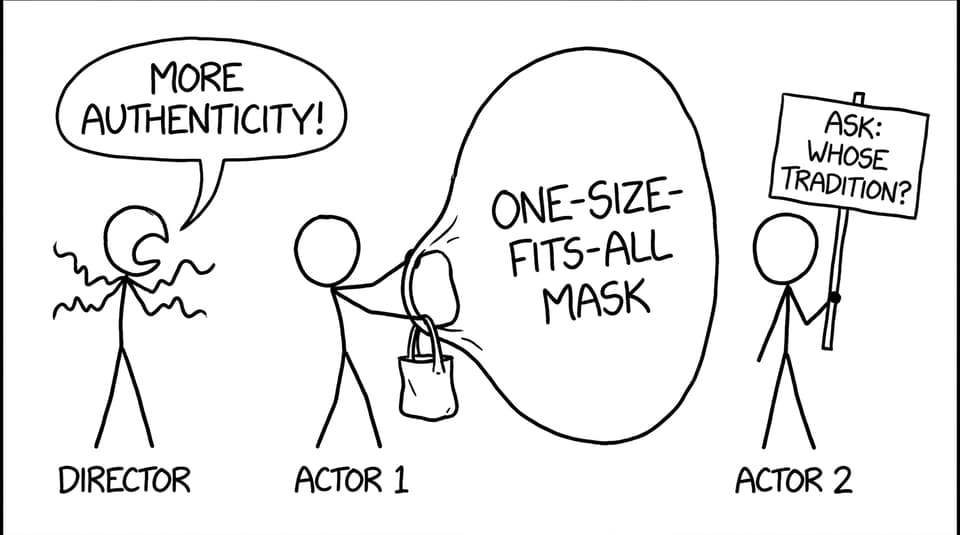
Treat the audience like part of the design
In IB Theatre, audience relationship is often where marks hide.
Compare questions like:
-
Is the audience meant to be emotionally absorbed, intellectually distanced, spiritually included, or socially provoked?
-
Are they observers, witnesses, participants, judges?
For instance, Brechtian approaches often train audiences to notice systems and question outcomes, while ritual-based forms may invite collective participation or shared spiritual focus. Your job is to explain how context shapes those expectations.
Do at least one piece of physical exploration (then reflect)
A strong IB Theatre portfolio rarely stays purely theoretical. Even small experiments help you write better evaluation.
Try a short workshop: one movement pattern, one vocal rhythm, one spatial rule. Then reflect on what felt natural, what felt culturally “coded,” and what you couldn’t authentically access without deeper understanding.
If you need a practical framework, use How to Apply Physical Exploration in World Theatre Studies alongside your research notes.
Applying culture and context to IB Theatre assessments
You can plug culture-context links into every major IB Theatre component:
-
Research Presentation: build your central argument around context shaping convention, then demonstrate one applied experiment. Combine with Best Ways to Organize Your Research for the IB Theatre Research Presentation.
-
Collaborative Project: when you borrow or blend influences, explain what the original convention meant and what it means after your adaptation.
-
Solo Theatre Piece (HL): connect your theorist to their social moment and show how that context influences method. See How to Approach the IB Theatre Solo Theatre Piece (HL Only).
-
Production Proposal: justify design and direction choices through cultural logic, not personal preference.
For a bigger picture refresher, review Dive into the World of IB Theatre: An In-Depth Syllabus Overview.
Common mistakes (and the simple fix)
-
Mistake: treating culture as a paragraph at the start. Fix: make culture the reason behind every convention you mention.
-
Mistake: calling traditions “exotic” or “weird.” Fix: describe function and meaning, not novelty.
-
Mistake: adapting without ethics. Fix: explain what you changed, what you kept, and why that choice is respectful.
-
Mistake: overgeneralizing. Fix: use precise scope (“in this region/period,” “in this documented practice”).
Conclusion: make context do work
The fastest way to strengthen IB Theatre research is to treat culture and context as cause, not decoration. When you can say, “This convention exists because this society needed theatre to do this,” your writing gains depth, your practical experiments gain purpose, and your assessments start to feel coherent.
If you want that process to feel less overwhelming, build it inside RevisionDojo: use the Study Notes to anchor the tradition, Flashcards to retain key conventions, AI Chat to test your interpretations, and the Grading tools to check your writing against rubric language. Then pressure-test your understanding with Mock Exams, Predicted Papers, and targeted practice in the Questionbank. When you’re stuck, the Coursework Library and Tutors help you move forward with confidence, and with context that actually earns marks.
To keep exploring, browse all IB Theatre posts on RevisionDojo.