




A closed bedroom door, unfamiliar music, and a teenager testing three ways to move a chair across the floor can leave a parent wondering whether serious studying is happening at all.
It probably is.
So, what is IB Theatre like in practical terms? It is a rigorous, project-based Group 6 arts subject combining performance, design, directing, research, collaboration, and critical reflection. Students do not simply learn lines or appear in school productions. They investigate theatre traditions, turn theory into creative decisions, document their processes, and explain why their work communicates meaning.
The current IB Theatre course, first assessed in 2024, has no conventional final written examination in its published assessment model. Instead, students build substantial assessed projects over time. That can make the subject look less exam-heavy from the outside, but it does not make it academically light.
IB Theatre at a Glance
Here is the short version for parents and students considering the course:
- It is a two-year, practical and academic theatre-making course.
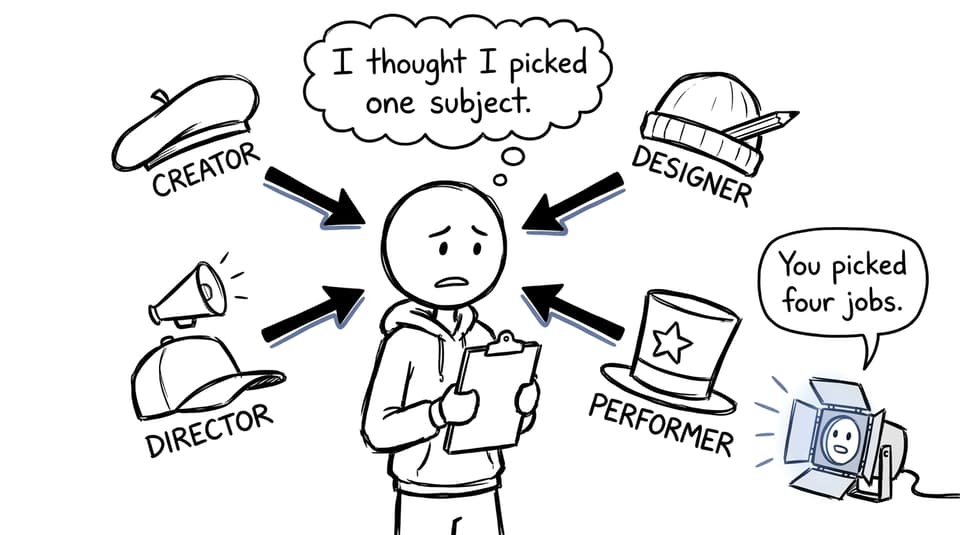
- Students work as creators, designers, directors, performers, and spectators.
- Both SL and HL include individual research, production planning, and collaborative performance.
- HL adds a major solo theatre task connecting a theorist's ideas to performance.
- Assessment rewards inquiry, development, presentation, and evaluation.
- Written and visual documentation matters alongside the work seen on stage.
- Success depends more on curiosity, consistency, and reflection than on being the loudest performer in the room.
For a broader map of the subject, students can read RevisionDojo's IB Theatre syllabus guide.
What Students Actually Do in IB Theatre
IB Theatre moves repeatedly between thinking and making. A student might research a performance convention, test it physically in rehearsal, record what happened, revise the idea, and then evaluate whether the result matched the original intention.
That cycle matters. Creative choices are not treated as self-explanatory. If a student uses an empty stage, fragmented movement, or harsh lighting, the assessment asks for more than "it looked effective." The student needs to connect the choice to an intention, describe its development, and evaluate what it communicated to an audience.
The work generally falls into four experiences:
Staging a Published Play
Students at both levels choose a published play they have not previously studied and develop a feasible vision for staging the entire work. They submit a production proposal of up to 12 pages, combining writing and images, with written text capped at 4,000 words.
They are not required to produce the complete play. The challenge is to think like a theatre-maker: interpreting the text, identifying an intended audience, and making coherent performance and production decisions.
Exploring a World Theatre Tradition
The research presentation asks students to investigate a world theatre tradition they have not studied before. They undertake academic and practical exploration, then communicate their learning through a recorded presentation lasting no more than 15 minutes.
This is where the course's international character becomes visible. Students must approach cultural practices with context and care rather than borrowing an isolated technique because it appears visually interesting. RevisionDojo's guide to the IB Theatre research presentation explains how research, experimentation, and reflection fit together.
Creating Theatre Collaboratively
At both SL and HL, students create and perform an original piece as an ensemble. The final performance lasts 7 to 10 minutes, but the assessed work also includes an individual project report of up to 10 pages and 4,000 words.
The group shares the production, yet each student must make their own contribution visible. That makes collaboration more sophisticated than dividing jobs and hoping everything works on the night. Students need to negotiate, experiment, respond to feedback, and explain their individual artistic decisions.
The performance may be brief. The process is not. This guide to evaluating the Collaborative Project shows why honest analysis is more valuable than simply declaring the final piece successful.
How IB Theatre HL and SL Differ
Both levels are demanding, but the distinction is substantial. The IB recommends 150 teaching hours for SL and 240 for HL. Students and parents comparing IB HL and SL subjects should look beyond lesson hours and consider the assessment structure.
| Assessment | SL weighting | HL weighting |
|---|---|---|
| Production proposal | 30% | 20% |
| Research presentation | 30% | 20% |
| Collaborative project | 40% | 25% |
| Solo theatre piece | Not required | 35% |
HL students complete an additional solo theatre piece. They research a theatre theorist, select aspects of that theory, and apply them in a 4-to-7-minute performance for an audience. They also submit a report of up to 2,500 words and a continuous, unedited recording of the complete piece.
That extra task changes the character of HL. Students must sustain an independent line of inquiry and carry responsibility for the creative result. HL may suit a student who is self-directed, interested in theory, and prepared to rehearse consistently without the momentum of an ensemble.
SL still requires research, artistic judgment, public presentation, and disciplined documentation. It should not be treated as an effortless arts option. When considering the wider diploma, parents may find it useful to discuss subject choices and future plans before deciding whether Theatre belongs at HL or SL.
Is IB Theatre Mainly Acting?
No. Acting is one route through the course, not its entire identity.
A student can develop through directing, set and costume design, sound, lighting, movement, dramaturgical research, or collaborative creation. They will still need to engage practically and present theatrical work, but previous experience as a confident lead performer is not a formal prerequisite in the IB course description.
In fact, a technically minded student may enjoy discovering how sound changes rhythm or how spatial arrangements shape an audience's attention. A strong writer may find that visual proposals and reflective analysis give structure to creative instincts. A quieter student may contribute careful observation and precise design thinking.
The more useful question is not, "Is my child already a brilliant actor?" It is, "Are they willing to experiment, receive feedback, work with others, and explain their decisions?"
What the Workload Feels Like
Theatre workload is uneven. Research and planning can happen quietly for weeks, followed by periods when rehearsals, recording, redrafting, and group coordination converge.
Three pressures deserve attention:
- Documentation: Students need evidence of development, not just memories reconstructed near submission.
- Coordination: Collaborative work depends on shared availability and dependable communication.
- Creative uncertainty: Unlike a worksheet with one answer, rehearsal often produces failed ideas before it produces a useful one.
The best protection is a regular routine. Students should capture decisions after rehearsals, save sketches and research details, and connect each entry to intention, experimentation, feedback, or evaluation. RevisionDojo's study strategies for IB Theatre students offer a practical way to balance theory and rehearsal.
How Parents Can Support Without Directing the Project
The most helpful parent is usually not an unofficial director. Assessment work must remain the student's own, and creative ownership is part of what the course develops.
Support can be simpler:
- Ask what the student intended an audience to experience.
- Encourage short, regular documentation rather than deadline-week reconstruction.
- Help protect rehearsal time while preserving sleep and balance.
- Treat unsuccessful experiments as evidence that development is happening.
- Ask whether feedback changed a specific artistic decision.
- Encourage early communication when a group problem affects progress.
Avoid rewriting reports, supplying interpretations, or deciding how the performance should look. A productive question opens the student's thinking. An instruction replaces it.
What Strong IB Theatre Preparation Looks Like
Theatre revision is not primarily about memorizing a large content list before an exam. It is about retaining usable knowledge and applying it to creative and analytical decisions.
A sensible weekly pattern might include:
- reviewing theatre terminology and theorist concepts with flashcards;
- reading concise notes on staging, performance, and production elements;
- answering practice questions that require justification or evaluation;
- revisiting the relevant assessment criteria;
- recording one meaningful lesson after each practical session;
- using teacher feedback to revise the next experiment.
Students aiming high should read the complete guide to scoring a 7 in IB Theatre, while remembering that grade boundaries can vary by examination session.
See What IB Theatre Support Looks Like
For a parent, the easiest way to judge academic support is to see the learning process rather than hear a list of promises. Start with RevisionDojo's IB Theatre resource collection, where subject-specific guidance makes the assessments less abstract.
A student can use Study Notes to clarify a concept, Flashcards to retrieve terminology or theoretical ideas, and the RevisionDojo Questionbank to practise explaining and applying knowledge. That preview lets families see how structured support works before committing to a larger study plan.
RevisionDojo is built as the ultimate IB resource around the complete learning cycle: Questionbank, Study Notes, Flashcards, AI Chat, Grading tools, Predicted Papers, Mock Exams, Coursework Library, and Tutors. In Theatre, the most useful tools are those that help students turn an interesting idea into documented, criterion-aware work without taking creative ownership away from them.
A Subject Where Process Becomes Visible
IB Theatre is creative, but it is not vague. Its structure asks students to research responsibly, make intentional choices, collaborate seriously, present work publicly, and evaluate what actually happened.
For the right student, that combination can be deeply engaging. They do not need to arrive as a polished actor. They need curiosity, resilience, and a willingness to turn reflection into better work.
The natural next step is to compare SL and HL against the student's full diploma workload, then explore RevisionDojo's Theatre guidance together. Once a parent can see the notes, recall tools, practice questions, and assessment support, the subject often stops looking mysterious. It begins to look like what it is: disciplined learning conducted through theatre.