
Choosing an English Extended Essay topic can feel strangely difficult. You have spent years being given texts and questions. Now the IB asks you to choose both.
The most promising English EE ideas are not necessarily the most original or ambitious. They are the ones that give you a focused set of texts, a debatable question, and enough evidence for sustained analysis. For most DP1 students, that means starting with a literary or non-literary feature you genuinely notice, then narrowing the material until close analysis becomes possible.
Students submitting from May 2027 will follow the updated Extended Essay model. Language A categories have been removed, while students choose between subject-focused and interdisciplinary pathways. This guide concentrates on a subject-focused English A essay. You can review the broader changes in RevisionDojo's guide to the 2027 Extended Essay model and compare the two Extended Essay pathways.
Your English EE idea checklist
Before committing to an idea, check whether it passes these six tests:
- Textual: The question can be answered through detailed analysis of language, form, structure, style, or representation.
- Focused: The selected text or corpus is manageable within an essay of up to 4,000 words.
- Debatable: The answer requires an argument, not a plot summary or list of techniques.
- Researchable: Relevant academic criticism and contextual sources are available.
- Specific: Key terms such as identity, power, or alienation have been defined more precisely.
- Eligible: Your supervisor has confirmed that the texts, pathway, and approach comply with the current guide and do not duplicate other assessed work.
A question does not need to sound complicated. It needs to make careful analysis possible.
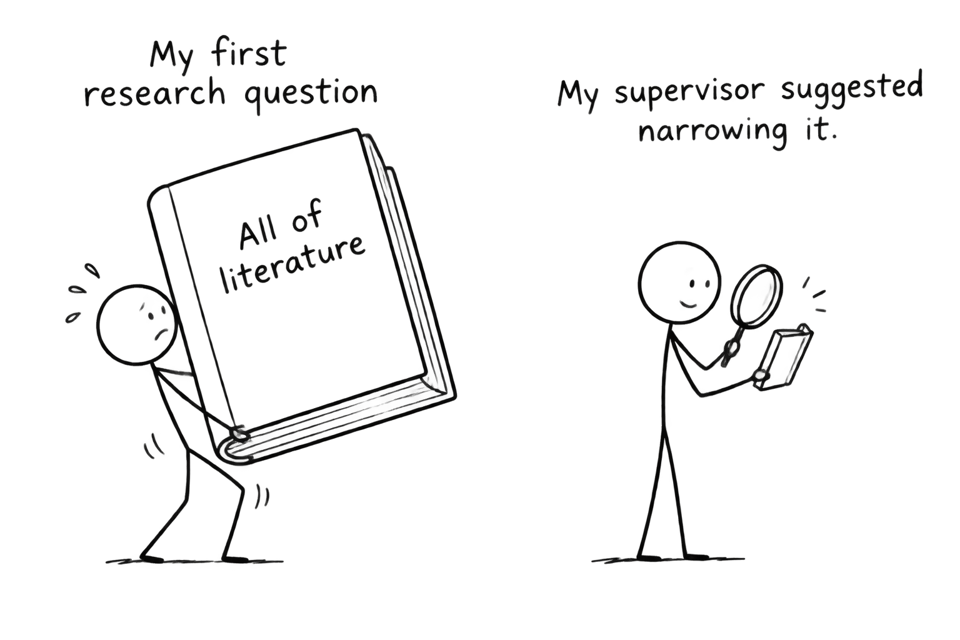
An ambitious subject becomes useful only after it becomes manageable.
English EE ideas for literary analysis
Treat the following as starting directions, not questions to copy unchanged. Your final wording should reflect the exact edition, textual evidence, and interpretive problem you intend to investigate.
Narrative voice and perspective
Narration gives you something concrete to examine while opening larger questions about truth, memory, and authority.
Possible directions include:
- Unreliable narration and suppressed memory in Kazuo Ishiguro's Never Let Me Go
- Second-person narration and fractured identity in N. K. Jemisin's The Fifth Season
- Shifting perspectives and communal judgment in William Faulkner's As I Lay Dying
- Child narration as a means of representing political violence in a selected novel
Form, structure, and time
Structure is often more manageable than a broad theme because it directs your attention toward identifiable authorial choices.
You might investigate:
- Fragmented chronology as a representation of traumatic memory
- Repetition and circular structure in a selected play
- Epistolary form and the construction of intimacy or surveillance
- Chapter divisions as a means of controlling reader sympathy
Space, setting, and symbolism
Setting becomes analytically valuable when you ask how it works, rather than merely what it represents.
Potential topics include:
- Domestic spaces as instruments of control in a Gothic novel
- Borders and liminal spaces in Mohsin Hamid's Exit West
- Natural imagery and psychological isolation in selected poetry
- Clothing imagery as a marker of unstable authority in Macbeth
Comparative possibilities
Comparison works best when the texts share a precise point of contact. Comparing two works simply because both concern gender, conflict, or identity usually produces an essay that is too broad.
More focused possibilities include:
- Fragmented narration and cultural memory in two novels
- The dramatic function of silence in two plays
- Competing representations of surveillance in two dystopian works
- How two poets adapt a shared myth for different political purposes
Check translations, original languages, text selection, and pathway expectations with your supervisor before settling on a comparison.
English EE ideas for language and non-literary texts
English A analysis can extend beyond conventional literary works, but the material still needs to support sustained textual analysis. A useful corpus is deliberately bounded by creator, campaign, platform, genre, or period.
Possible directions include:
- Visual and verbal constructions of athletic identity in a defined advertising campaign
- Pronoun use and collective identity in selected political speeches
- Metaphor and responsibility in newspaper coverage of one environmental event
- The construction of authenticity in a defined set of influencer posts
- Humour and institutional voice in selected public-information campaigns
- Typography, image composition, and gender representation on magazine covers
Digital media can look conveniently small while becoming methodologically enormous. Ten posts may involve captions, images, comments, platform conventions, and changing publication contexts. Define exactly which elements belong to your corpus and explain why that selection is defensible.
For more starting points, explore RevisionDojo's collection of English EE topics, then reshape any promising direction around texts you can access and analyse independently.
Strong versus weak EE research questions
A topic names an area. An EE research question identifies the relationship you will investigate within that area.
| Weak starting question | Stronger analytical version |
|---|---|
| How does Shakespeare show power in Macbeth? | How does Shakespeare use recurring clothing imagery to construct the instability of Macbeth's political authority? |
| How are women represented in dystopian fiction? | How does restricted focalization shape the reader's understanding of regulated female speech in two selected dystopian novels? |
| Are sports advertisements persuasive? | How does a defined advertising campaign combine imperative language and visual framing to construct athletic self-discipline? |
| What role does memory play in Never Let Me Go? | How does Kathy's retrospective narration use omission and euphemism to normalize institutional control in Never Let Me Go? |
The stronger versions are not better because they are longer. Each identifies a technique, a bounded text or corpus, and an interpretive consequence.
Words such as “how” and “in what ways” often encourage analysis, but no opening phrase guarantees a strong question. “To what extent” can be useful when genuine evaluation is possible, yet it can also produce a forced yes-or-no argument. The RevisionDojo research question guide offers additional tests for focus and feasibility.
How to test an idea before committing
Write a provisional claim
Complete this sentence: “Through its use of ___, the text constructs ___.” If you cannot fill both gaps precisely, the idea may still be too broad. If your answer merely repeats the question, you may not yet have an argument.
Collect evidence before writing an outline
Find 8-12 passages, frames, or textual moments that appear relevant. Annotate what each example does and how it complicates your emerging interpretation. If every example makes exactly the same point, your argument may lack development. If you cannot find enough evidence, revise the question before investing more time.
Check the scholarship
Academic sources should help you enter a conversation, not replace your own reading. Search library databases for work on the author, genre, technique, and relevant theoretical concepts. Keep a record of search terms and full citation details from the beginning.
Stress-test the scope
Ask what you can remove without weakening the inquiry. One novel may be better than three. Six campaign images may be better than an entire brand history. Narrowness is not a failure of ambition; it is what allows an argument to become precise.
RevisionDojo's complete Extended Essay guides can help you move from selection to planning. When drafting begins, use the 2027 EE introduction guide to establish the question, significance, and method without turning the opening into a miniature conclusion.
Common mistakes new English EE students make
The first is choosing a theme instead of a problem. “Identity in modern literature” sounds serious, but it gives neither the writer nor the reader a clear analytical direction.
The second is selecting too much material. A large corpus creates the appearance of research while leaving little room for close reading. Depth usually matters more than the number of texts mentioned.
The third is deciding the conclusion in advance. Research should refine or complicate your interpretation. A question designed only to prove an existing opinion tends to produce selective evidence.
The fourth is allowing context to overwhelm analysis. Historical and biographical information can illuminate a text, but an English A essay should remain anchored in how meaning is constructed through textual choices.
Finally, do not treat presentation as an end-stage chore. Maintain citations, bibliographic records, headings, and word-count awareness as you work. Before submission, check the current requirements using RevisionDojo's 2027 Extended Essay title page guide.
Turn your idea into a question you can defend
A good English EE rarely begins with a perfect question. It begins with a useful observation: a repeated image, an unusual silence, a change in voice, or a pattern that refuses to feel accidental. The student then narrows, tests, reads, and rewrites.
RevisionDojo brings that process into one workspace. You can consult Study Notes, examine models in the Coursework Library, work with a Tutor, and use grading tools to identify weaknesses in a developing draft. Its Questionbank, Flashcards, Predicted Papers, and Mock Exams can support the rest of your IB workload while the essay develops over time.
Most importantly, save several research question drafts rather than trusting the first version. Create a RevisionDojo account, place those alternatives side by side, and ask Jojo AI Chat for focused feedback on scope, wording, and analytical potential. The goal is not to let AI choose your question. It is to make your own decision with clearer evidence about which question you can genuinely sustain.