
EE Extended Essay Title Page: Exactly What to Include (2027)
A friend once told me their EE was "basically done". They had the argument. They had the sources. They even had a conclusion that sounded like an examiner wrote it.
And then they lost an afternoon to the one page no one thinks about until the end: the EE title page.
It sounds small. It feels administrative. But the EE title page is where students accidentally break rules (especially anonymity) or forget details that your school needs for clean submission. In 2027, the safest approach is still the simplest one: a minimal, compliant title page that gives the IB exactly what it asks for, and nothing it doesn’t.
This guide gives you an examiner-friendly checklist for your EE title page, plus common mistakes, quick templates, and a few calm ways to verify you are done.
EE title page checklist (2027): the non-negotiables
Your EE title page must clearly show:
- Research question (RQ)
- The subject the essay is registered in
- Or, for an interdisciplinary essay: the two subjects and the interdisciplinary framework
- Word count
- Examination session (for example, May 2027 or November 2027)
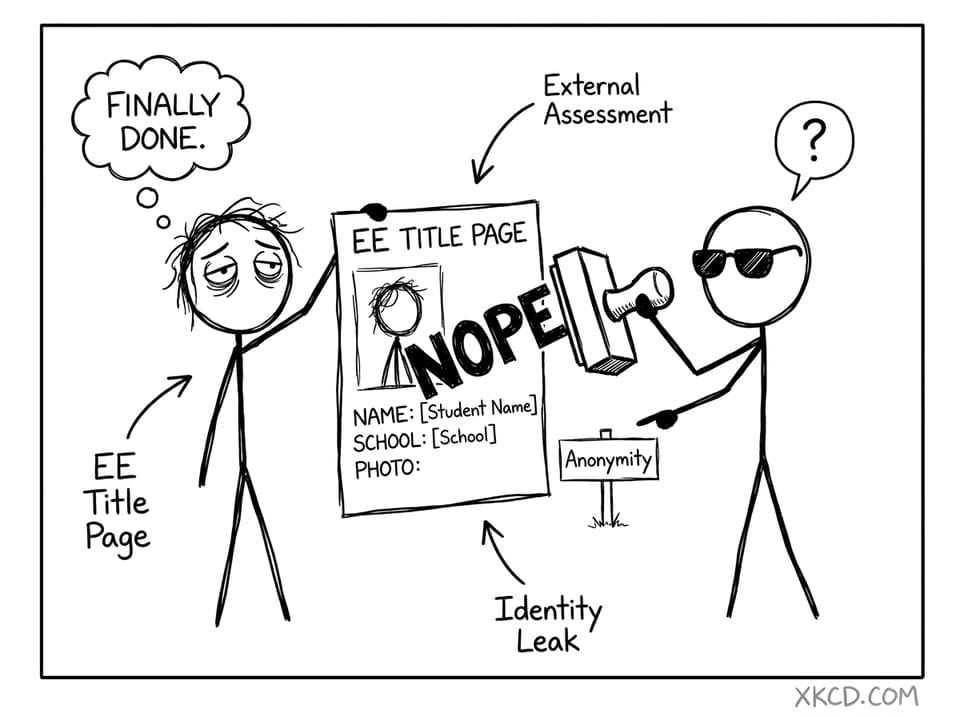
And your EE title page must not contain:
- Your name
- Your school name
- Your candidate number
- Teacher or supervisor names
- Any logos, watermarks, or identifying headers/footers
That anonymity rule matters because the EE is externally assessed. The goal is to keep marking as fair and blind as possible.
If you want a bigger picture of where the title page sits in the full document order, see How to Format Your EE According to IB Guidelines.
What to include on the EE title page (with exact wording guidance)
The best title pages feel boring in a comforting way. They read like a form. That’s the point.
Your research question (put it in full, as a question)
Put your research question exactly as you will answer it in the essay. Avoid shortening it into a theme.
Good: “To what extent did X influence Y in Z context between 1990 and 2005?”
Not great: “Globalization and inequality”
If you are still refining your wording, use How to Craft the Perfect IB Extended Essay Research Question to stress-test clarity, scope, and analysis.
Your registered subject (and interdisciplinary details if relevant)
Write the registered subject clearly (for example: History, Biology, Economics, English A: Language and Literature).
If your school has you add level (SL/HL), you can include it, but the requirement you gave is the subject registration, so prioritize that.
For interdisciplinary EEs, list:
- Subject 1
- Subject 2
- The interdisciplinary framework
If you are unsure whether your topic truly fits the subject you registered, it is worth checking before submission. Topic-subject mismatch creates downstream problems in Criterion A. See How Do You Know If Your EE Topic Is Good Enough?.
Word count (be precise, be honest)
Your EE title page must state the word count. Two quiet but important details:
- Use the word count your school requires (often from your word processor).
- Don’t try to game it. Examiners treat word limits seriously.
For a clear breakdown of what counts and what doesn’t, read Mastering the IB Extended Essay Word Count and IB IA and Extended Essay Word Counts: Rules, Tips and Risks.
Examination session (state it plainly)
This is usually just:
- May 2027 or November 2027
Don’t bury it in a date format that looks like a submission date. The EE is tied to a session, and the title page should be explicit.
A simple EE title page template you can copy
Keep spacing clean. Centered text is common, but left-aligned is usually fine if your school prefers it. No images. No borders.
Template (minimal):
- Research Question: [Your full RQ]
- Subject: [Registered subject]
(If interdisciplinary: Subject 1 + Subject 2; Framework: [name]) - Word Count: [number]
- Examination Session: [May 2027 / November 2027]
That is enough.
If you want to sanity-check overall structure beyond the title page, How to Structure an Extended Essay (EE) is a useful reference point.
What not to include: common EE title page mistakes
Most EE title page errors come from good intentions: students try to make it "complete". The IB rewards clarity, not decoration.
Identifiers (the biggest risk)
Avoid anything that points back to you or your school. That includes:
- Your name (even initials)
- School name, school crest, or branded cover sheet
- Candidate number
- Supervisor name
- Class or cohort labels unique to your school
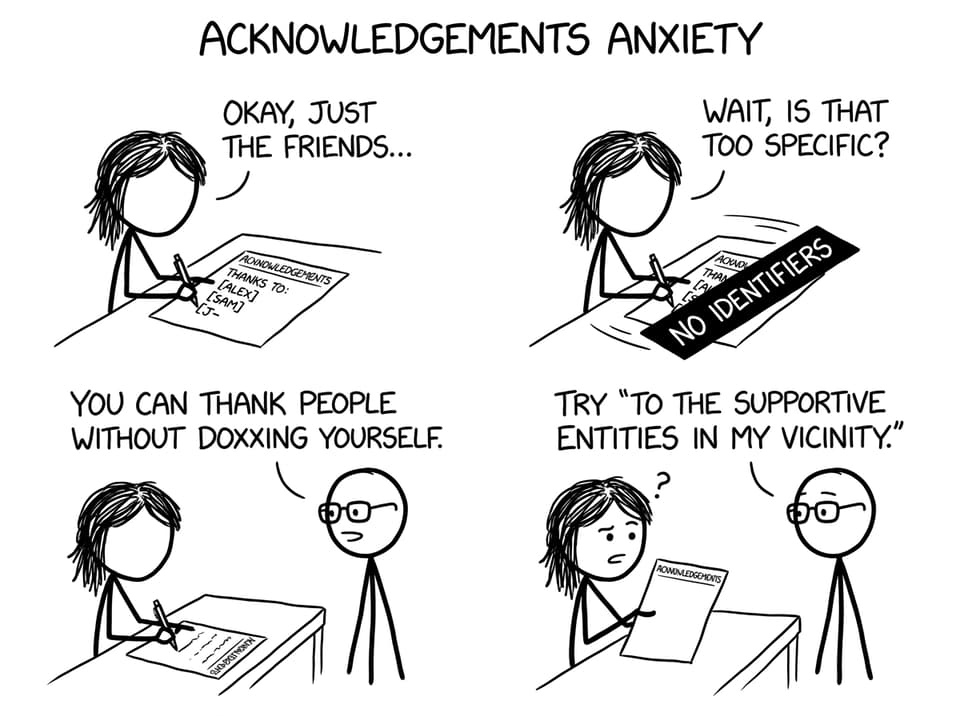
If you need a place to express gratitude, put it in acknowledgements (more on that below) without identifiers.
Overstuffing the page
Don’t add:
- Abstract (if your school uses one elsewhere)
- Table of contents
- Thesis statement
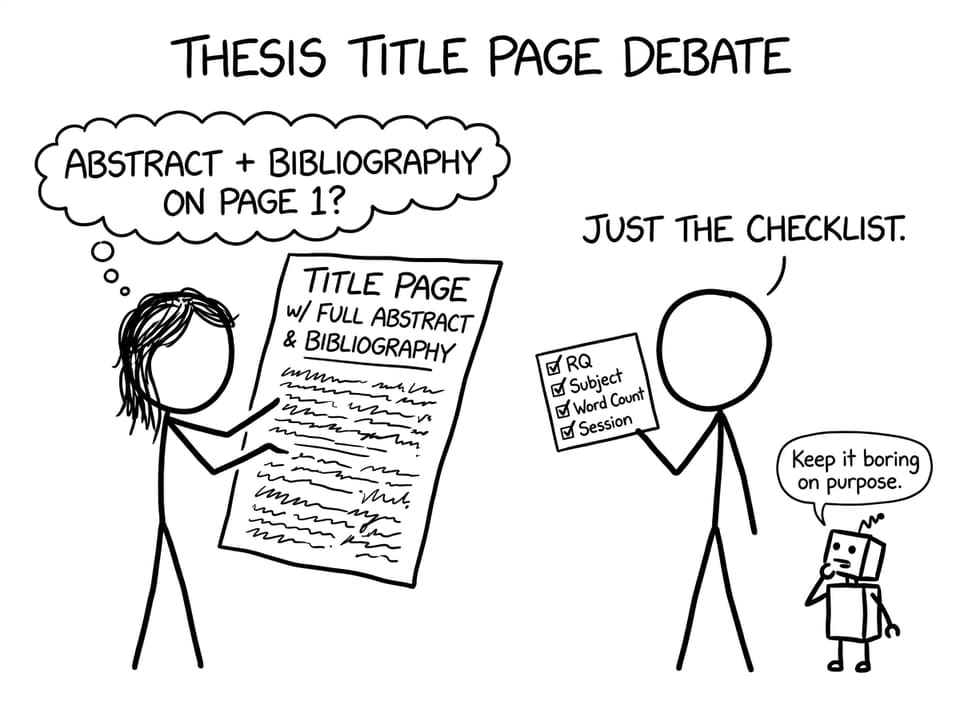
- Quotes, epigraphs, or images
- Bibliography preview
Save the intellectual work for the introduction and analysis, where it earns marks. If you are worried your writing is drifting into summary, How to Make Your IB Extended Essay Analytical, Not Descriptive helps you course-correct quickly.
Confusing title vs research question
Some students put a “cool title” and hide the RQ inside the introduction. Your instruction is clear: the title page must clearly show the research question.
If you want a title too, you can include it, but don’t let it replace the RQ.
Acknowledgements or dedications: allowed, optional, and still anonymous
An acknowledgements or dedications page is permitted but not required. It does not count toward the word count.
However, it must also not contain identifiers. That means:
- Don’t name your school
- Don’t name your supervisor
- Don’t name friends in a way that identifies you
You can write something like: “I would like to thank those who supported me during the research process.” Keep it general.
The “calm verification” routine before you submit your EE
When you’re tired, you miss obvious things. A short routine helps you catch them.
A 2-minute EE title page audit
- Can I point to my RQ in one glance?
- Is my subject registration written exactly?
- Is my word count present?
- Is my exam session present?
- Is there any identifier on the page? (Names, school, candidate number, logos)
If you can do that without scrolling, you are close.
Use RevisionDojo to reduce last-minute doubt
A title page is one page, but it sits at the front of a 4,000-word project that has to survive external assessment pressure. When students feel shaky, it’s usually because they don’t have a clear "system" for checking quality.
RevisionDojo works well as that system:
- Use the Coursework Library to compare structure choices against real exemplars (especially how RQs are phrased and how formal conventions are followed).
- Use Grading tools like the IB History EE Grader or the IB Economics EE Grader to see if your draft aligns with criteria language.
- Use AI Chat to quickly spot compliance issues (like missing session details) and to pressure-test whether your RQ is analytical.
- Use Study Notes to refresh subject content when your argument feels thin.
- Use Flashcards for definitions and key theorists so the essay stays precise.
- Use the Questionbank to keep exam prep moving while the EE takes up headspace.
- Use Mock Exams and Predicted Papers to keep your exam performance steady during coursework season.
- If you need human guidance, Tutors can help you tighten the RQ and align method to the registered subject.
If you are coordinating feedback with your supervisor, Streamlining IB Extended Essay Supervision with RevisionDojo shows how to keep the process clean and trackable.
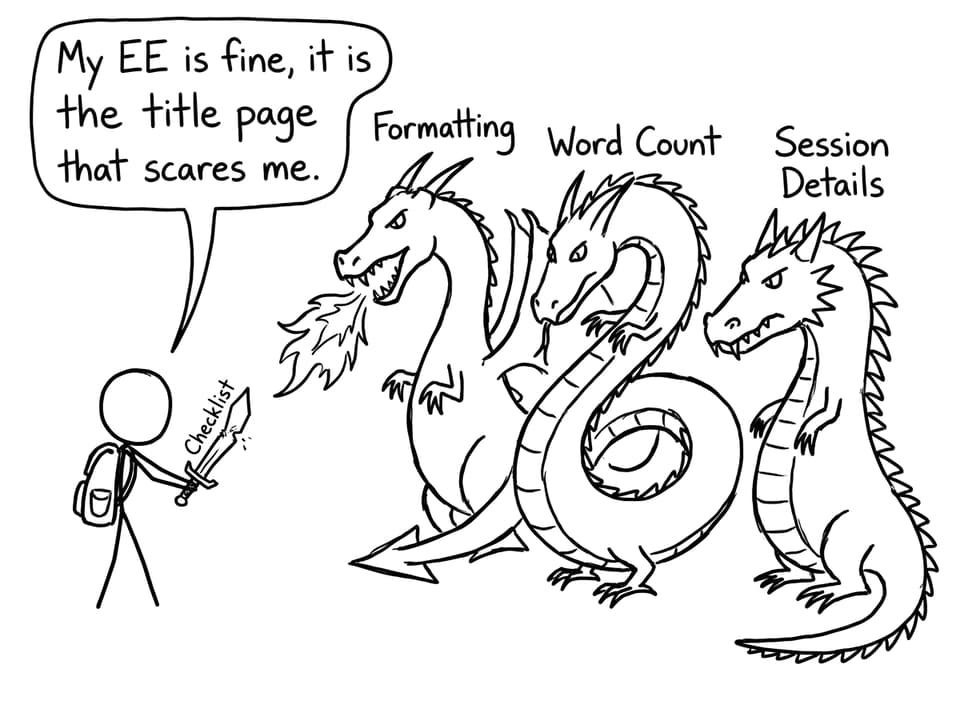
EE title page formatting: simple choices that look professional
The IB is not grading typography. But presentation signals control.
- Use a readable font (your school often suggests one). Consistency matters more than style.
- Keep spacing generous.
- Avoid bolding everything. Use bold only to label items (RQ, Subject, Word Count, Session).
- Keep it one page.
If you want a full formatting walkthrough for the entire EE (page numbers, contents, references), revisit How to Format Your EE According to IB Guidelines.
Closing: make the first page the calmest page
Your EE will be judged on thinking, structure, evidence, and reflection. But the EE title page is where you prove you can follow the rules that protect fairness: clear information, clean formatting, and anonymity.
So keep it simple. Put the research question, registered subject (or interdisciplinary details), word count, and examination session. Remove identifiers. Then move on to the work that actually earns marks.
If you want a single place to tighten your EE from front page to final reflection while still preparing for exams, RevisionDojo is built for that exact reality: Coursework Library for models, Grading tools for criteria alignment, AI Chat for quick checks, and Questionbank, Study Notes, Flashcards, Mock Exams, and Predicted Papers to keep your exam prep steady.
Your EE title page should take five minutes. The confidence it buys you lasts much longer.