




There’s a quiet moment most IB students know well.
You walk out of a lesson thinking, I understand this… I think. Then you try a question at home and discover your brain was politely nodding, not actually learning.
In that gap between “I attended” and “I can do,” the best teachers do something that looks almost invisible: they get curious on purpose. They ask what worked, what didn’t, and why. When an IB department turns that curiosity into a shared habit, classrooms get sharper, feedback gets clearer, and revision becomes less of a guessing game.
That habit has a name: professional inquiry. And even though it’s a teacher-facing idea, it directly affects you as an IB student preparing for exams.
A quick student-friendly checklist for IB inquiry
If you want the benefits of departmental growth to show up in your grades, look for (or nudge your classes toward) these:
-
One clear department goal that actually connects to exam performance in IB
-
A shared question teachers are investigating (not ten unrelated “initiatives”)
-
Evidence from student work, not just opinions
-
A mid-cycle check-in where teaching adjusts while there’s still time
-
A simple way teachers share what they learned across classes
-
Feedback language tied to criteria, command terms, and skills
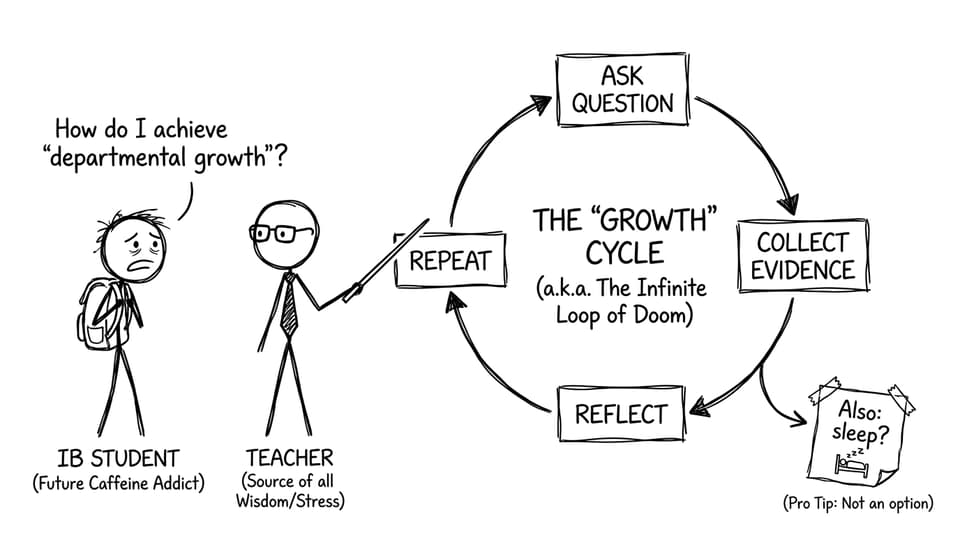
As a student, you can mirror the same cycle in your own revision: question, evidence, reflection, adjustment, repeat. That’s why this matters for IB exams.
What “professional inquiry” really means in IB departments
Professional inquiry is a structured cycle where teachers investigate their practice the same way IB expects students to investigate ideas: with questions, evidence, reflection, and action.
A typical inquiry cycle looks like this:
-
Ask a focused question: “Why are students losing marks on evaluation?”
-
Collect evidence: samples of responses, annotation of mark loss, student reflections, timing data
-
Interpret patterns: Are errors conceptual, command-term, structure, or time-management?
-
Try a change: new modeling, new scaffolds, better formative checks
-
Share results: so the whole department improves, not just one class
When done well, professional inquiry is not extra paperwork. It’s a way to make teaching decisions more reliable, which makes your learning more reliable -- a big deal in IB.
For a deeper look at how schools build reflective systems, see Embedding Professional Inquiry into Departmental Growth.
Why departmental growth shows up in your IB exam results
Students often think exam success is mainly about “how hard I study.” Effort matters, but environment matters too.
When a department commits to inquiry, you tend to notice:
-
Cleaner explanations: fewer contradictions between teachers and classes
-
More consistent marking: the criteria starts to feel predictable
-
Better feedback loops: you’re told what to fix and how to fix it
-
Less random revision: practice tasks align with what examiners reward
This is especially powerful in IB, where performance depends on understanding command terms, building arguments, and demonstrating skills under time pressure.
If you want to see what strong feedback systems look like, read Building Feedback Loops That Drive Continuous Improvement.
How IB inquiry questions translate into better revision for you
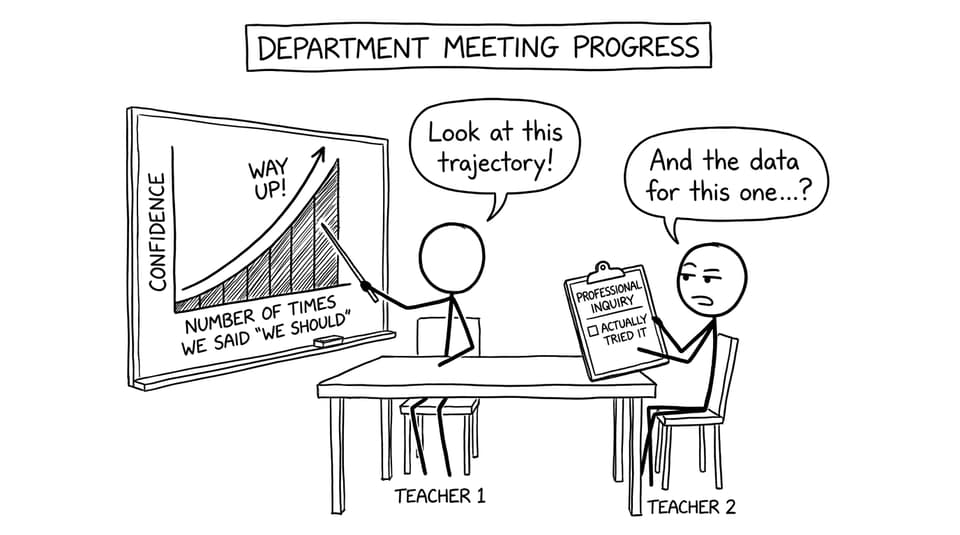
The most useful inquiry questions are the ones that point to a bottleneck students repeatedly hit.
Here are examples of department inquiry questions and the student-side revision benefit.
“How can we improve students’ use of criteria-based language?”
If your teachers are investigating this, you’ll likely get:
-
clearer exemplar answers
-
tighter “what a 7 looks like” explanations
-
feedback that names the exact criterion skill you missed
Your move: use a platform that makes criteria practice concrete. On RevisionDojo, you can pair Grading tools with targeted practice so you learn what earns marks, not just what sounds smart.
“Which misconceptions keep returning after we teach Topic X?”
This kind of inquiry tends to produce:
-
better mini-quizzes
-
more diagnostic questions
-
less time wasted re-teaching the wrong thing
Your move: copy the same logic by using the Questionbank to drill weak subtopics, then patch gaps with Study Notes.
A good place to start building that loop is the RevisionDojo home hub: RevisionDojo | IB & MYP Resources.
“How can we strengthen ATL self-management under exam conditions?”
When departments investigate self-management, you may see:
-
structured timing drills
-
reflection prompts after timed practice
-
explicit routines for planning and checking work
Your move: borrow an IB-friendly routine. Try How to Study for IB Mocks (Without Burning Out) and adapt it into a weekly plan.
For a teacher perspective on ATL integration, there’s also Embedding ATL Skills Seamlessly in Daily Lessons.
The inquiry cycle you can run as an IB student (in 30 minutes)
Departments use inquiry because it produces change. You can do the same thing in your revision, quickly, without making it dramatic.
Ask one specific question
Not “How do I get better at Biology?” Try:
-
“Why do I lose marks on data-based questions?”
-
“Why are my evaluations vague?”
-
“Which command terms do I misread?”
Gather evidence from your own work
Use one timed set or short quiz and collect:
-
the questions you missed
-
what you wrote vs what was needed
-
what type of mistake it was
Reflect in a mistake log
Keep it small. Three bullets:
-
what happened
-
why it happened
-
the fix you’ll test next
Implement one change and retest
This is the part most students skip. Retest within 48 hours.
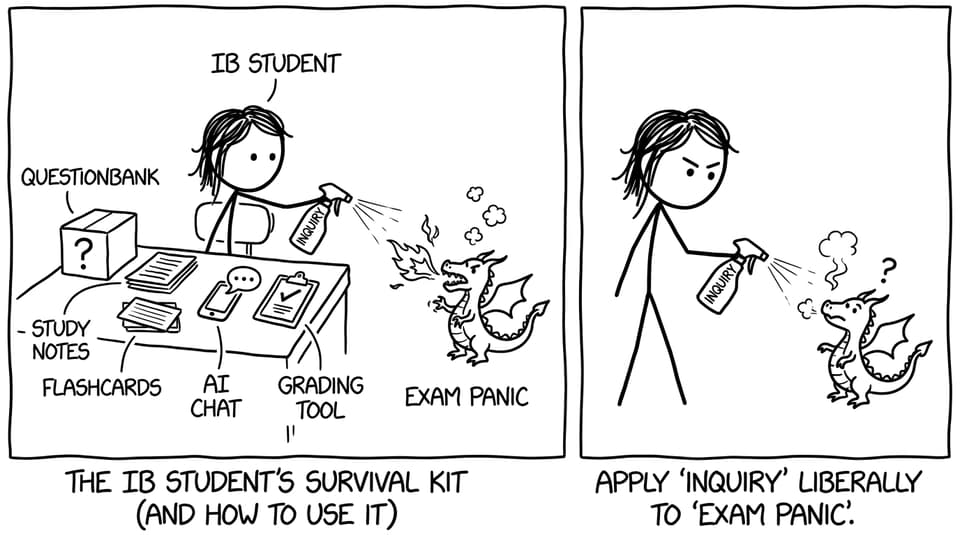
RevisionDojo is built around that retest loop: Study Notes to fix one gap, Flashcards to keep it alive, Questionbank to prove you can apply it, plus AI Chat when you get stuck mid-session.
If you’re in the final stretch, IB: The Last 2 Weeks Before Exams (What Matters) shows how to structure that cycle under pressure.
Making departmental growth visible (what to notice in class)
Sometimes inquiry is happening, but students can’t see it. Here are “tells” that an IB department is growing through professional inquiry:
-
Teachers reference common language and common routines across classes
-
You get feedback that sounds similar across teachers (in a good way)
-
Unit plans evolve, not just repeat
-
You see more opportunities to reflect on your own process
If your school uses reflective planning structures, you might recognize ideas from Turning Unit Planners Into Living Reflection Tools.
And if meetings drive better classroom decisions, that usually comes from a culture like the one described in How to Make Departmental Meetings Reflective and Purposeful.
How RevisionDojo supports IB inquiry (and your exam prep)
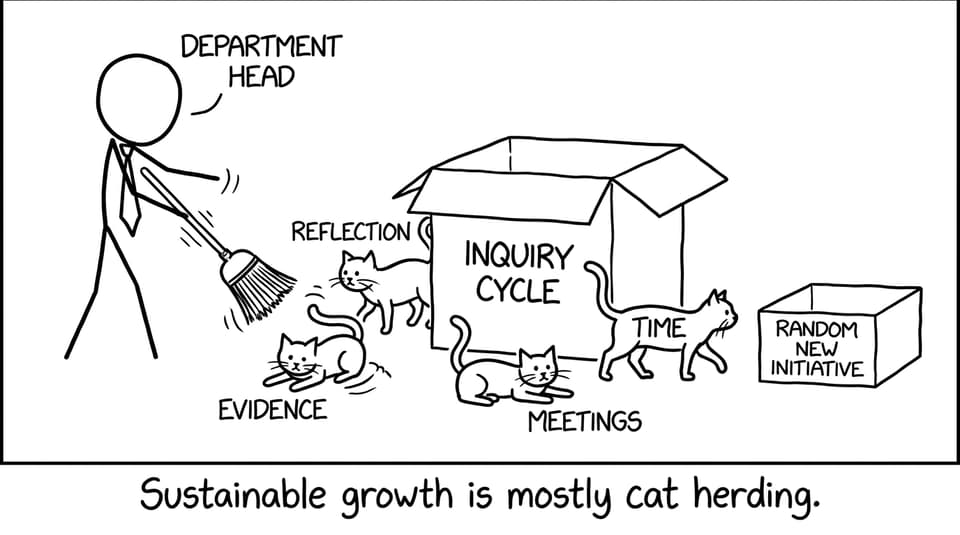
A department’s inquiry is only as good as what it can see: patterns, misconceptions, growth over time. Students need the same visibility.
RevisionDojo supports the full IB workflow in one place:
-
Questionbank for targeted, exam-style practice
-
Study Notes for fast clarity when you’re stuck
-
Flashcards for daily retrieval that doesn’t rely on mood
-
AI Chat to unblock confusion without derailing your session
-
Grading tools to learn what marks are actually awarded for
-
Predicted Papers and Mock Exams to train timing and stamina
-
Coursework Library to keep long tasks organized
-
Tutors when you need human strategy, not just motivation
When teachers use inquiry to refine instruction and you use inquiry to refine revision, the IB stops feeling like a mystery and starts feeling like a system.
Closing: make IB growth a shared habit
The departments that improve fastest aren’t the ones with the fanciest slogans. They’re the ones that keep returning to the same quiet discipline: ask a good question, collect real evidence, change one thing, and check if it worked.
That’s professional inquiry. It grows teachers. It strengthens departments. And for IB students preparing for exams, it delivers something even more valuable than motivation: a clearer path from effort to marks.
If you want your revision to feel just as structured, build your own inquiry loop inside RevisionDojo: start with Questionbank practice, patch gaps with Study Notes, retain with Flashcards, use AI Chat to get unstuck, then rehearse with Mock Exams and Predicted Papers. Your next step can be small -- but make it evidence-based, and make it IB.