

You can feel it in the week before mocks: you sit down to revise, you work hard, and somehow the same mistakes show up again.
That isn’t laziness. It’s a missing system.
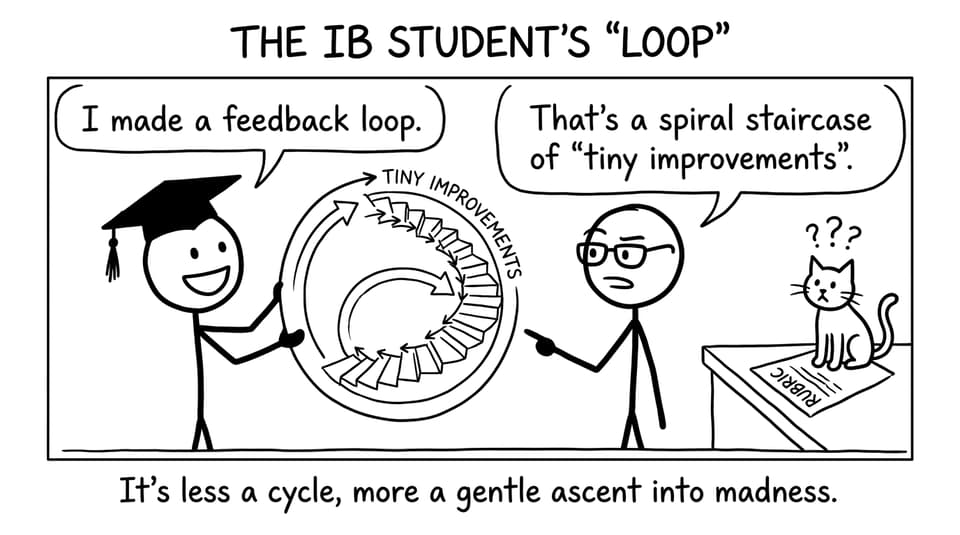
In the IB, progress rarely comes from doing more. It comes from closing the loop between what you attempted, what went wrong, and what you’ll change next time. A feedback loop is that loop: practice, feedback, adjustment, reflection, repeat. When you build it on purpose, “continuous improvement” stops being a slogan and starts becoming a quiet advantage.
A quick IB feedback loop checklist (steal this)
If you want a simple IB routine that actually improves scores, run this loop:
-
Collect evidence: do a short set of exam-style questions (or a timed mini-section).
-
Get criterion-aligned feedback: link mistakes to the skill the examiner rewards.
-
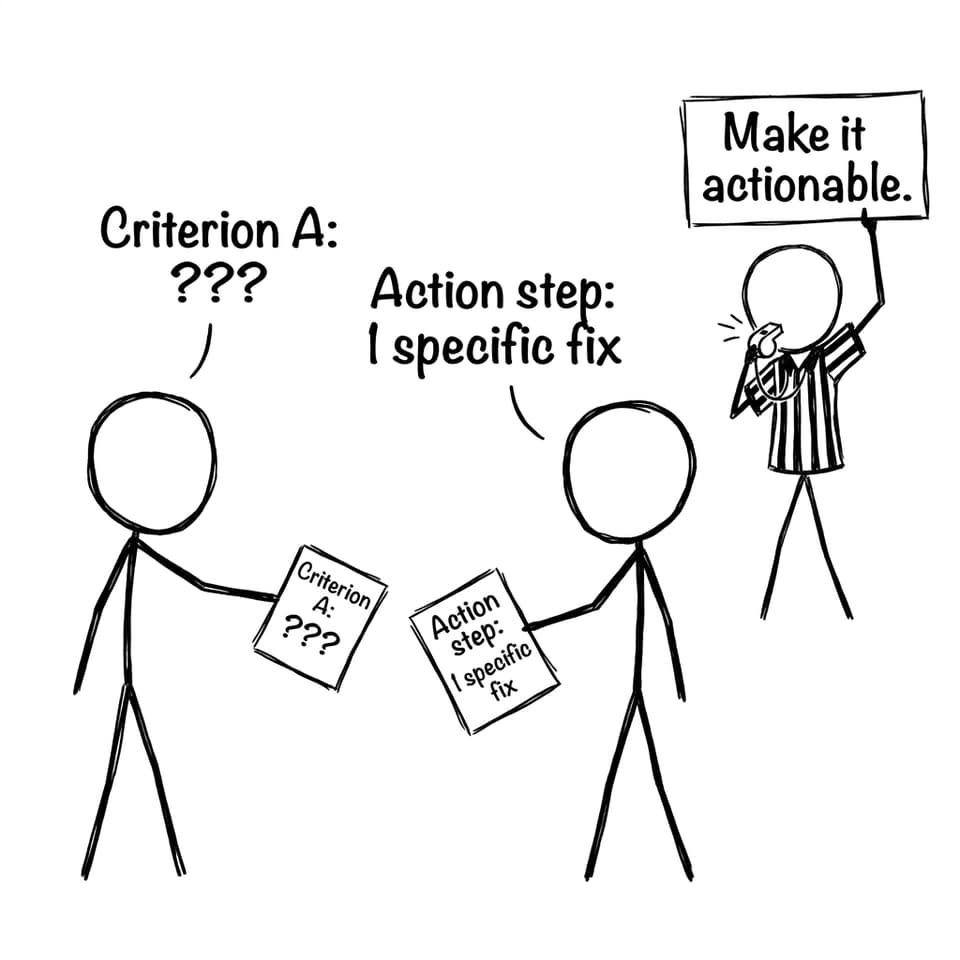
Choose one priority fix: not fifteen comments, one high-impact change.
-
Rewrite an action step: “Next time I will…” plus a concrete method.
-
Re-attempt quickly: within 24--72 hours, on a similar question.
-
Reflect briefly: what pattern changed, what pattern didn’t.
RevisionDojo is designed to make this loop easy to repeat: Study Notes for clarity, Flashcards for recall, the Questionbank for practice, AI Chat and Grading tools for fast feedback, and Mock Exams plus Predicted Papers for realistic timing.
What a feedback loop really is in IB exam prep
A feedback loop isn’t “teacher writes comments, student reads them once.” In IB exam prep, a feedback loop is a conversation with your future self.
You do something under constraints (time, command terms, mark allocation). You compare it to the standard (criteria, markscheme logic, model answers). Then you change your approach and test it again.
This is why high scorers look calm: they aren’t guessing what to improve. They have a process that tells them.
If you want a platform-built version of that process, the RevisionDojo app for IB exam prep connects practice to feedback to next steps, so each session naturally feeds the next.
The 4-stage IB feedback cycle you can run every week
Here’s a structure that works across subjects (Essay subjects, Sciences, Maths, Humanities). It’s the same IB loop, just wearing different clothes.
Evidence gathering (make it specific)
Evidence should be mark-relevant. Not “I studied Chapter 7,” but “I missed 3/7 marks on evaluation,” or “I lost method marks because I skipped units.”
Use the RevisionDojo Questionbank to pull questions by topic and difficulty, so your evidence isn’t random. Random practice feels productive. Targeted evidence changes grades.
Feedback delivery (criterion language, not vibes)
The most useful feedback sounds like the examiner, not a motivational poster.
Instead of: “Be clearer.”
Try: “Define the key term, then link it to the question’s command term, then add one piece of subject-specific evidence.”
If you want examples of feedback that directly builds exam readiness, keep this nearby: Providing feedback that builds exam readiness.
Action and revision (one fix, immediately applied)
This is where most students lose the IB game: they collect feedback like it’s a hobby, then never convert it into a new behavior.
Your rule: no feedback without a re-attempt.
-
Rewrite one paragraph.
-
Re-do one question.
-
Redraw one diagram.
-
Re-plan one response using the correct structure.
On RevisionDojo, this is where AI Chat can help you diagnose patterns fast: “Grade this 6-mark response and tell me the single change most likely to gain 2 marks.” That’s a loop-closing prompt.
Reflection and goal setting (small, measurable, repeatable)
Reflection in the IB should be short enough that you’ll actually do it.
Use a 60-second template:
-
Pattern: What mistake type repeats?
-
Cause: Content gap, command term misunderstanding, or time pressure?
-
Fix: One rule for next time.
-
Retest date: When will you re-attempt?
If your revision feels like hours of work but little retention, you’ll relate to IB: I study all day but remember nothing. It’s basically a feedback loop problem in disguise.
How to embed IB feedback loops into daily revision (not just big tests)
The easiest way to sustain continuous improvement is to build micro-loops.
Micro-loop: 30 minutes (perfect for busy weeks)
-
5 min: skim Study Notes on one weak subtopic
-
15 min: Questionbank set on that subtopic
-
7 min: review mistakes and write 2 “error rules”
-
3 min: add one rule into Flashcards
Use RevisionDojo Flashcards to keep your fixes alive. In the IB, forgetting is not a character flaw. It’s the default setting.
Weekly loop: one timed block (where marks jump)
Once a week, simulate pressure:
-
Do a timed section using Mock Exams.
-
Mark it using Grading tools or your teacher’s rubric.
-
Write 3 action steps.
-
Re-attempt one weak question type within 48 hours.
If you’re in the final stretch, IB: the last 2 weeks before exams shows how to run these loops daily without burning out.
Common pitfalls that break IB feedback loops
Most IB feedback loops fail for predictable reasons:
-
Feedback arrives too late: you’ve moved on, so you never apply it.
-
Too many comments: you feel crushed, then do nothing.
-
No re-attempt: you “understand” the correction but can’t perform it.
-
Reflection is optional: optional means skipped, especially under stress.
A good loop feels almost boring: small, specific, repeatable.
Closing the loop: make IB improvement inevitable
In the IB, the students who improve fastest aren’t the ones who feel motivated every day. They’re the ones who built a feedback loop that keeps working even when motivation disappears.
Make the loop small. Make it honest. Make it repeatable.
If you want a single system that connects practice, feedback, retesting, and reflection, use RevisionDojo as your loop: Questionbank for evidence, Study Notes for clarity, Flashcards for memory, AI Chat and Grading tools for next steps, and Mock Exams plus Predicted Papers to pressure-test the whole thing. Continuous improvement stops being a hope, and becomes a routine.