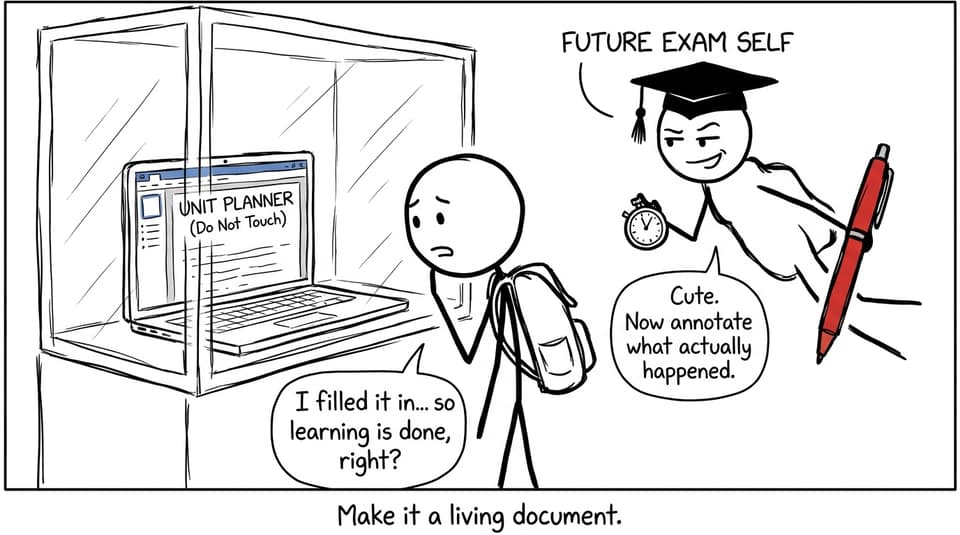
When most people hear “unit planner,” they picture a form that gets completed, saved, and quietly forgotten.
But if you are an IB student preparing for exams, that mindset is expensive.
Because the weeks you spend inside a unit are exactly where your future exam performance is shaped. Not by the neatness of your notes. Not by how many pages you highlight. But by whether you can look back at what you tried, what failed, what finally clicked, and what you should do next.
A unit planner can be that memory. Not a museum label. A living record.
The quick shift: from “planner” to “score-improver” in IB
Use this checklist to turn any unit planner into a living reflection tool for IB exams:
-
Add two reflection checkpoints (mid-unit and end-of-unit)
-
Capture evidence, not vibes (a question you missed, a paragraph you rewrote, a concept you finally understood)
-
Always write one next step (small enough to do in 20 minutes)
-
Convert reflections into a weekly loop: Learn -> Practice -> Feedback -> Adjust
-
Keep everything connected to your exam training tools (Questionbank, Flashcards, timed sets)
If you want the exam version of this workflow, it pairs well with How to Study for IB Exams: Step-by-Step Guide.
Why “living reflection” matters more than “perfect planning” for IB
The hidden problem in IB revision is that students often treat learning like storage.
You “cover” a topic, file away the notes, and assume you will retrieve it later. Then exam questions arrive like strangers, and your brain realizes it stored facts without storing decisions: how to approach a command term, how to structure the response, how to avoid the mistake you keep repeating.
A living unit planner fixes that because it captures decisions in real time.
It turns a unit into a story with plot points:
-
What the unit asked you to understand
-
Where you got stuck
-
What strategy worked
-
What exam-style questions exposed gaps
-
What you will do differently next week
That is reflection, but it is also exam technique.
If you want a practical timeline for when to run this loop during the year, see How Long in Advance Should I Study for My IB Exams?.
How to build an IB unit planner that updates itself (in 10 minutes a week)
A “living” unit planner does not mean rewriting your planner every day. It means adding small, high-value updates that your future self can actually use.
Add two reflection boxes you will actually fill in
Place these two prompts directly into your planner (or notes doc):
-
Mid-unit reflection (Week 2 or 3): What is one concept I still cannot explain clearly, and what is the fastest way to test it?
-
End-of-unit reflection: What would an examiner reward in this unit, and where do I still lose marks?
Then make your answers measurable. Mention a specific skill: definitions, evaluation, data analysis, essay structure, timing.
Use evidence: one question, one error, one rule
Here is the format that makes reflection useful for IB exams:
-
Evidence: “I missed 4 out of 10 questions on equilibrium because I mixed up shift vs rate.”
-
Error type: “Command term confusion + concept gap.”
-
Rule: “Next time I see ‘predict the shift,’ I write the stress first, then the direction, then the justification.”
This pairs naturally with RevisionDojo’s practice loop: do targeted practice in the Questionbank feature, then log the rule that would prevent the same error.
Turn your unit planner into an exam loop (the part most IB students skip)
Reflection is only powerful when it creates action.
A clean way to do this is to structure each unit like a weekly feedback system:
Learn (clarify)
Use a short, syllabus-aligned explanation to patch the gap quickly, then stop.
RevisionDojo is designed for this “patch then practice” approach with Study Notes, Flashcards, and AI Chat that keeps you moving rather than rereading.
If you want a full walkthrough of the loop, bookmark RevisionDojo App: The Smarter Way to Prep for IB Exams.
Practice (prove)
Do a small, focused set of exam-style questions on the exact subtopic.
If you are not sure how to structure practice blocks, What’s the Best Way to Revise for IB Exams? is a helpful reference.
Feedback (see)
Feedback is where living planners come alive.
RevisionDojo can speed this up with AI Chat for fast explanations, plus grading tools that make your next attempt clearer. The point is not to be judged. The point is to shorten the time between “wrong” and “I know what to do next.”
To see what actionable feedback looks like in practice, read How RevisionDojo Makes IB Feedback More Actionable for Students.
Adjust (decide)
Write one next step in your unit planner. One. Not twelve.
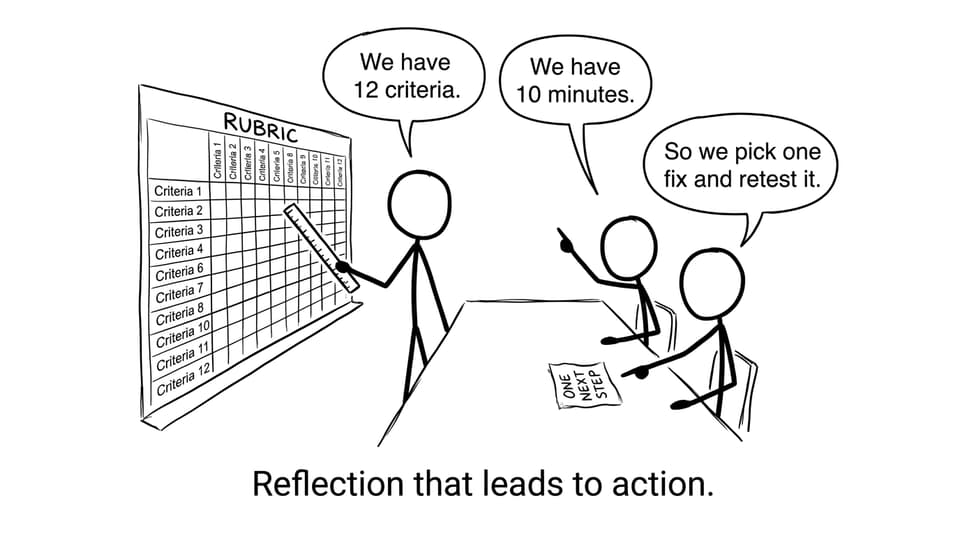
That next step should be something you can schedule:
-
“10 Flashcards on key definitions for tomorrow”
-
“One timed 25-minute set in Questionbank on this subtopic”
-
“Rewrite one response to top-band quality using feedback”
This is how a unit planner becomes a living reflection tool for IB exams: it turns reflection into a calendar item.
Make your IB unit planner collaborative (even if you study alone)
“Collaboration” does not require a committee. It requires another perspective.
Three easy ways to add it:
-
Swap one reflection with a friend and ask: “What would you do next week?”
-
Ask a teacher a single question: “What is the most common way students lose marks here?”
-
Use a tutor for a short reset when you are looping the same mistakes
RevisionDojo supports this kind of structured support through analytics, Tutors, and tools that make your practice data visible rather than vague. If you want the teacher-facing view of what good analytics can do for students, see Empowering Teachers with RevisionDojo’s Analytics and Insights.
A simple template you can paste into your IB unit planner
Copy this into your unit doc and keep it “alive”:
Unit focus (1 sentence):
Exam skills this unit trains (pick 2):
-
Command terms
-
Data/graph analysis
-
Structured essay responses
-
Definitions and models
-
Timing and pacing
Mid-unit reflection (evidence + rule):
-
Evidence:
-
Error pattern:
-
Rule:
-
Next step (20 minutes):
End-of-unit reflection (marks thinking):
-
Where do I reliably score?
-
Where do I leak marks?
-
Which RevisionDojo tool will I use first next unit (Study Notes, Flashcards, Questionbank, AI Chat, Grading tools, Mock Exams, Predicted Papers, Coursework Library, Tutors)?
Closing: your unit planner is your quiet advantage in IB
In IB, small habits compound. Not because they are dramatic, but because they are repeatable.
If your unit planner becomes a living reflection tool, you stop relying on motivation and start relying on a system: evidence, rule, next step. Week after week, that system turns units into exam performance.
When you are ready to run that loop faster, RevisionDojo gives you the connected tools to do it in one place: Study Notes, Flashcards, Questionbank, AI Chat, Grading tools, Predicted Papers, Mock Exams, Coursework Library, and Tutors.
Start with one unit. Write one rule. Schedule one retest. That is how IB preparation becomes calm, concrete, and effective.

