
You can feel it when an EE starts to drift.
The introduction sounds confident. The research question (RQ) looks neat. The paragraphs are full of information. And yet, halfway through, you can’t quite tell what the essay is doing. It’s like watching someone walk quickly with a map… but no destination.
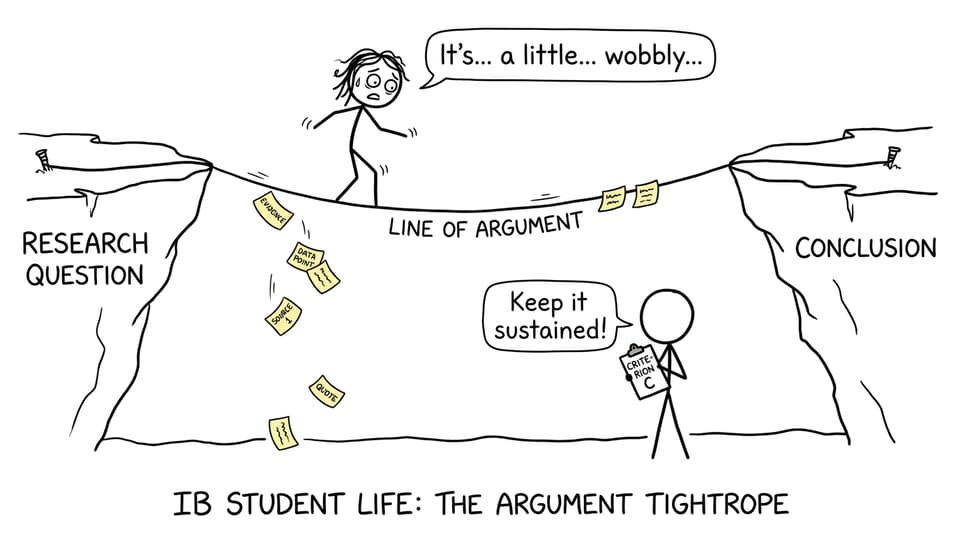
In the new EE criteria language, that destination is often captured by one phrase: line of argument. It isn’t a fancy extra layer you add at the end. It’s the reasoned thread already running through the essay, linking your RQ, your evidence, your findings, and your conclusion into one continuous chain.
This matters because Criterion C assesses whether your line of argument is clear, sustained, and logically connected. So if your essay feels like “good points in the same document,” Criterion C is usually where the marks leak.
What “line of argument” means in the new EE criteria
A line of argument in an EE is a reasoned pathway that connects:
- your research question (what you’re trying to answer),
- your research findings (what your evidence shows), and
- your conclusions (what you can justifiably claim because of those findings).
The key word is reasoned. A line of argument isn’t “I included sources and then I concluded something.” It’s “Because of X and Y, it follows that Z, and here’s why that matters for the RQ.”
In other words, your EE should read like a chain, not a pile.
If you want the official-feeling phrasing in plain English: Criterion C is checking whether your essay’s thinking is connected on purpose, not connected by luck.
To see how RevisionDojo frames it inside subject-specific guidance, start with IB Extended Essay Guides and then zoom into Criterion C examples like Criterion C: Analysis and line of argument (English).
Quick checklist: can an examiner “follow the thread” in your EE?
Use this before you submit (or before you ask for supervisor feedback):
- Does the EE introduce a clear answer-direction in the first page (not just topic background)?
- Does every body section begin with a claim that answers part of the RQ?
- Do you explain how each piece of evidence supports, challenges, or complicates that claim?
- Do your paragraph endings reconnect to the RQ using new wording (not copy-paste)?
- Do transitions show progression (therefore, however, building on this) rather than list-making (also, another)?
- Does the conclusion feel inevitable given what you argued, not not like a summary stapled on top?
If even two of these feel shaky, your line of argument probably isn’t sustained yet.
For structure support, use How to Create an Effective EE Outline for a Logical Flow and How to Structure an Extended Essay (EE).
The most common misunderstanding: treating “line of argument” like an extra block
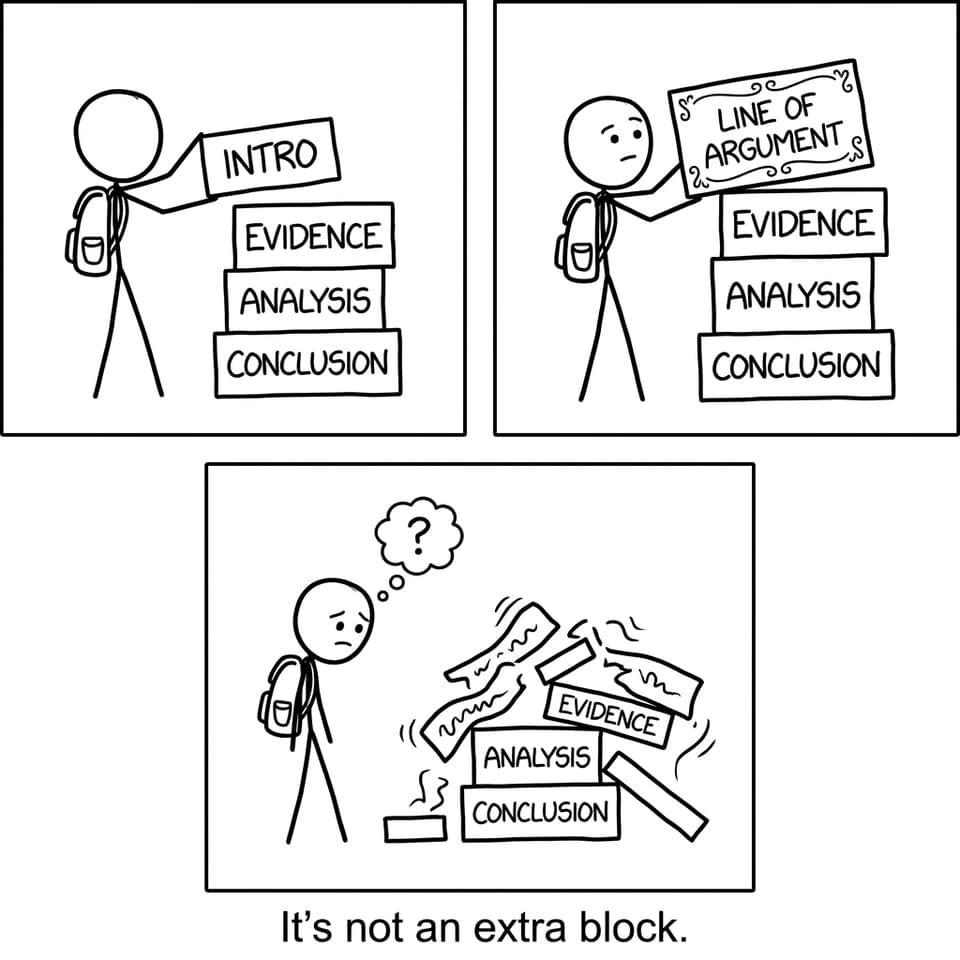
A lot of students hear “line of argument” and try to add something new: a special paragraph, a more dramatic thesis, a bigger conclusion.
But a line of argument is not an extra section of your EE. It’s the explicit connection between sections you already have to write.
- Intro: sets the question and the direction.
- Body: produces findings through analysis.
- Conclusion: answers the question based on findings.
The line of argument is simply what makes those parts depend on each other.
How Criterion C “sees” your line of argument
Criterion C is where the EE stops being a research scrapbook and becomes an academic argument.
Even when your sources are strong, Criterion C will drop if:
- analysis is replaced by description,
- paragraphs don’t build on each other,
- evidence appears without interpretation,
- claims don’t clearly respond to the RQ,
- the conclusion introduces ideas you didn’t earn.
RevisionDojo’s breakdown in What Are the Assessment Criteria for the IB Extended Essay? makes this clear: top essays show progression of thinking across the whole EE.
If you’re in subjects where analysis is easily confused with summary, keep How to Make Your IB Extended Essay Analytical, Not Descriptive open while you edit.
A practical model: the “RQtofindingtoclaimtoso what?” loop
Here’s a simple way to build a line of argument in any EE, regardless of subject.
Start each section with a mini-answer
Instead of “This section will discuss…” write a claim that could be wrong.
- Weak: “This section will explore consumer behavior.”
- Strong: “Consumer behavior in this case suggests price was less influential than social proof, because…”
Now you’ve forced yourself to argue, not just present.
Turn evidence into findings, not ornaments
Evidence should lead to a finding (a pattern, relationship, contrast, limitation). The finding is what you actually use to argue.
Ask:
- What does this show?
- What does it suggest?
- What does it rule out?
Then write the “so what?” sentence
A sustained line of argument depends on meaning. You’re constantly telling the reader why a finding matters for the RQ.
A reliable move is to end paragraphs with:
This matters because it indicates ______, which answers the RQ by ______.
This is not childish. It’s examiner-friendly.
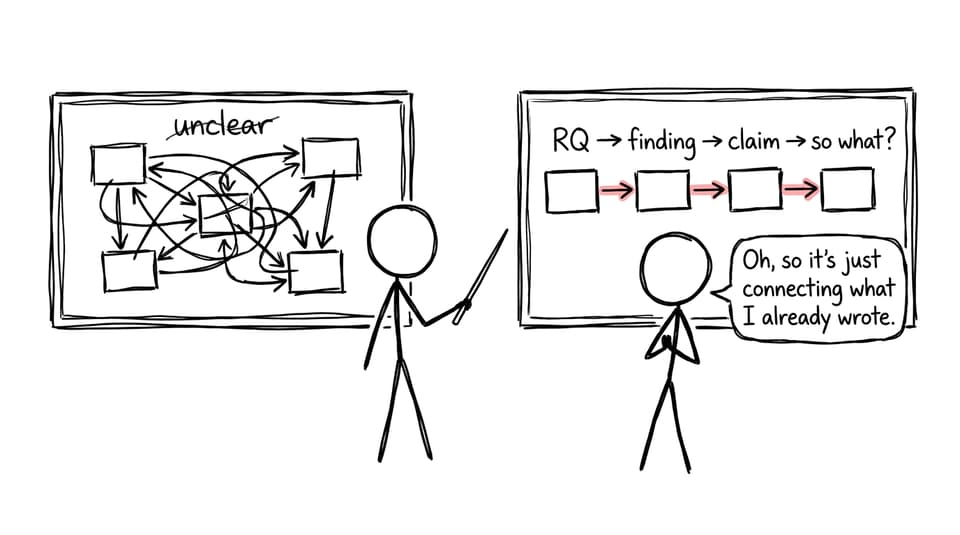
What a “clear, sustained, logically connected” line of argument looks like
Think of your EE like a documentary. Each scene has a purpose. It doesn’t just add facts. It changes what the viewer believes.
Clear
The reader can state your main claim after reading the introduction.
- Your RQ is specific.
- Your thesis is an answer-direction.
- Your headings match the argument (not vague topics).
If you’re still refining the RQ, use The Importance of Research Question Revision During the EE Process.
Sustained
The argument doesn’t disappear in the middle.
- Each paragraph begins with a claim that relates to the RQ.
- Each paragraph ends by reconnecting to the RQ.
- Transitions show development: “However, this limitation suggests…”
Logically connected
Your sections build on each other instead of repeating.
- You define key terms once, then deepen them.
- You group evidence by theme or mechanism (not source-by-source listing).
- Your conclusion is a synthesis of the chain, not a recap of paragraphs.
For a broader “thinking skills” view that supports Criterion C, see 8 Key Strategies to Demonstrate Critical Thinking in IB EE and IA.
Editing your EE for line of argument (a fast, exam-focused method)
If you’re preparing for exams, time is tight. So here’s an editing method that gives you the biggest Criterion C return per minute.
Do the “topic sentence audit”
Copy every topic sentence from your EE into a separate document.
Now read them in order.
- Do they answer the RQ in steps?
- Or do they read like a list of themes?
If they don’t form a logical staircase, your line of argument isn’t visible enough.
Add connective tissue, not more content
Most students fix argument problems by adding more research. That usually makes the problem worse.
Instead, add:
- one linking sentence at the end of each paragraph,
- one transition sentence at the start of each new section,
- one “therefore” moment per section where you state the implication.
Use RevisionDojo tools to make it less painful
This is where RevisionDojo becomes more than just “study resources.” It becomes a drafting partner.
- Use AI Chat to paste a paragraph and ask: “What is my claim? What is my evidence? What is my link to the RQ?”
- Use Study Notes and Flashcards to keep subject terminology precise so your argument sounds like the discipline.
- Use the Coursework Library to compare how strong exemplars maintain a line of argument.
- Use Grading tools to self-check Criterion C language before feedback.
- Use Tutors when you need a human to challenge your logic and push clarity.
And if you want criterion-style feedback support, see IB EE Feedback Tool: Improve Your Extended Essay Score.
Closing: treat the EE line of argument like a promise you keep
A good EE doesn’t impress because it contains a lot of research. It impresses because it keeps a promise.
The promise is: I will ask a focused question, investigate it carefully, and lead you, step by step, to a conclusion that follows from what I found. That promise is your line of argument.
If you want to raise your Criterion C score, don’t bolt a “line of argument” onto the essay. Make the connections you already know are there, but haven’t made explicit yet.
When you’re ready to tighten the thread, RevisionDojo is built for this exact work: use the EE guides, run self-checks with Grading tools, stress-test paragraphs with AI Chat, and strengthen subject understanding through Study Notes, Flashcards, and targeted practice in the Questionbank. Then, if you need a second set of eyes, tap the Tutors or the Coursework Library to see what “sustained” really looks like in real student writing.
Your EE doesn’t need more words. It needs a clearer path.