
The question every tired IB student asks
At some point in the Diploma Programme, you look at your calendar and it looks back like a threat.
Your EE needs 4,000 words. Your IA needs rigor. TOK wants a mind palace. Your exams want everything.
So you do the most human thing possible: you try to save time.
You open your IA folder, stare at your best paragraphs, and wonder: Can I use the same material for my Extended Essay and my Internal Assessment?
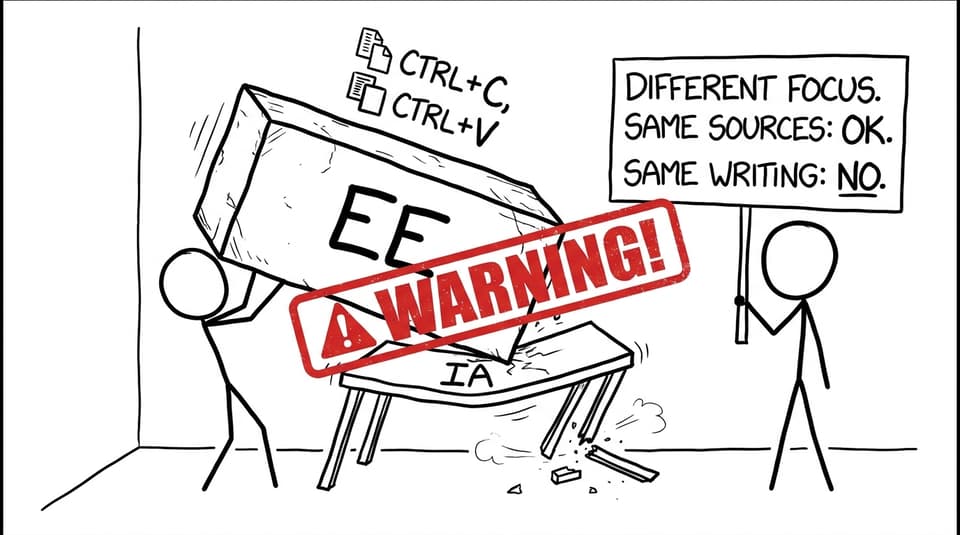
No. The guide explicitly warns against double-dipping. While resources can be shared between assessment components, none of the student’s content from one submission may be duplicated in another. Your EE must have a substantially different angle and focus from any IA. If you reuse writing, analysis, or substantial structure across both, it can be treated as academic misconduct and could result in not being awarded the diploma.
This article breaks down what “same material” really means, what you can reuse safely, what you cannot reuse, and how to design an EE and IA that cooperate without colliding.
Quick checklist: EE and IA overlap rules
Use this as your fast decision filter before you reuse anything.
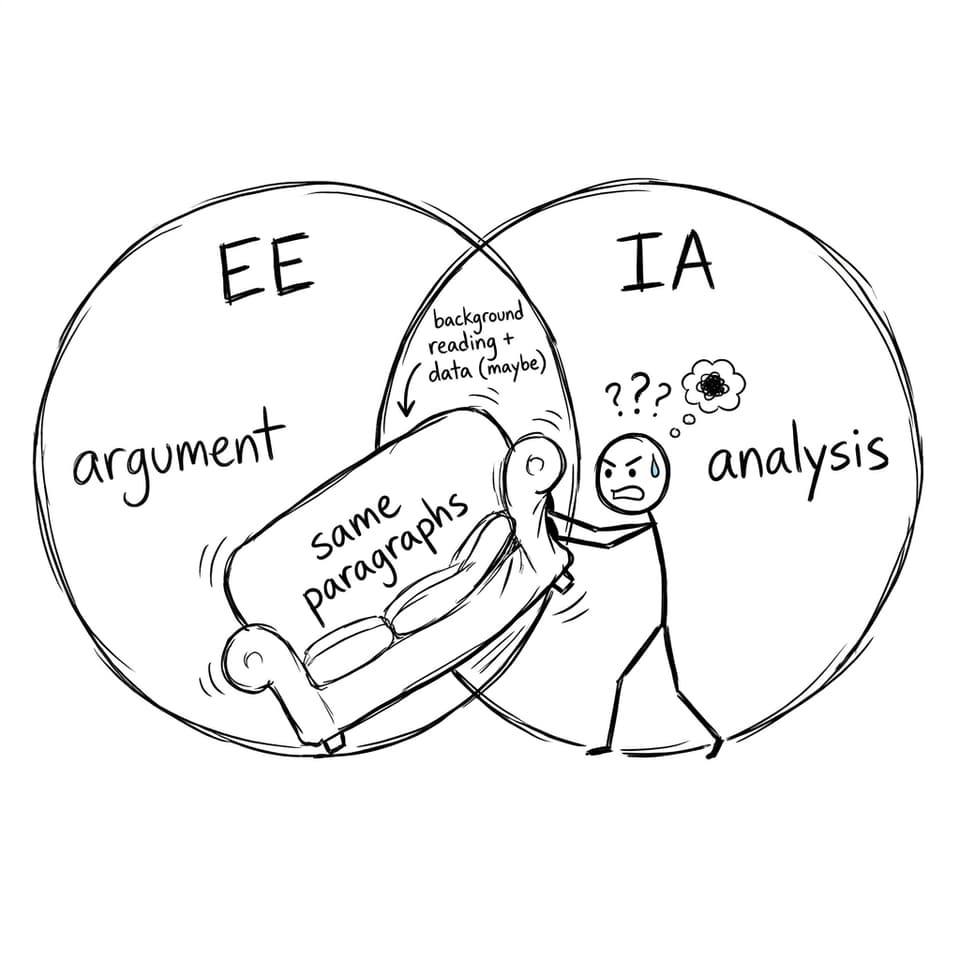
- Same topic area? Usually OK.
- Same sources (books, studies, datasets)? Often OK (as long as both are cited properly).
- Same raw data you personally collected? Sometimes OK, but risky and must be justified and reframed.
- Same paragraphs, analysis, or conclusions? Not OK.
- Same structure (same headings, same argument sequence)? Not OK.
- Same images, graphs, or tables with the same interpretation? Not OK.
If you want official-style clarity on what counts as misconduct, read IB Academic Misconduct Explained. It spells out duplication and why “I didn’t know” rarely helps.
What “double-dipping” actually looks like (and why it happens)
Most duplication isn’t a villain story. It’s a fatigue story.
A student writes a strong IA. It goes well. They know the topic. The sources are already organized. The argument is half-built. So for the EE, they:
- reuse the literature review almost verbatim,
- keep the same research question but “make it bigger,”
- copy their analysis section and add more paragraphs,
- recycle the same table and write the same conclusion in different words.
From the student’s perspective, it feels efficient.
From the IB’s perspective, it can look like self-plagiarism/duplication: submitting substantially the same work for two separate assessment components.
If you want a grounding reference, RevisionDojo’s guide on academic honesty in the EE is clear about expectations: What Are IB’s Expectations for Academic Honesty in the Extended Essay (EE)?
Your EE is assessed as a standalone piece of independent research with its own purpose, method, and argument. Your IA is assessed as a subject-specific investigation with its own criteria and constraints. They can live in the same neighborhood, but they can’t be the same house.
What you can reuse between your EE and IA (the safe list)
Let’s protect your time without putting your diploma at risk.
You can reuse sources (if you cite them properly)
Reusing a journal article, book, theory, or historical source is usually fine. Scholars reuse sources all the time. What matters is that your EE uses them to answer a different question or build a different argument.
Practical rule: if your EE uses the same sources, it must still have fresh intellectual work: new framing, new claims, new evaluation.
You can reuse background reading notes (not your written draft)
Your Zotero library, annotations, and summary notes are tools. Tools can travel.
But your final prose cannot.
You can reuse a broad theme
Example themes that might overlap safely:
- “Memory and distraction” (Psychology)
- “Market failure and policy” (Economics)
- “Enzyme activity and temperature” (Biology)
- “National identity and propaganda” (History)
Themes are not the problem. Copying your intellectual product is.
You can reuse skills and methods
If your IA taught you how to run a t-test, write a rationale, or evaluate limitations, you absolutely carry those skills into your EE.
That’s the point of the IB: compounding capability.
For subject-specific expectations, RevisionDojo’s hubs are a solid starting point: IB IA Guides and IB Extended Essay Guides.
What you cannot reuse between your EE and IA (the red-flag list)
If you take one thing from this article, let it be this: do not reuse submission content.
You cannot reuse paragraphs, sentences, or “lightly edited” wording
Changing synonyms, reordering clauses, or switching to a different font is still duplication.
You cannot reuse your IA analysis as the core of your EE
This is where students get caught.
The IA analysis section often contains your best thinking: interpretation, evaluation, reasoning. That is exactly what must remain unique.
You cannot reuse the same dataset with the same purpose and interpretation
Data reuse is a grey zone. If your IA uses a dataset to answer Question A, and your EE uses the same dataset to answer basically Question A with extra words, that’s duplication.
If you are considering this, speak to your supervisor early and document the distinction carefully. A safer strategy is: same topic, different evidence.
You cannot reuse the same visuals, tables, or graphs in a way that repeats meaning
Even if you redraw the graph, if the graph tells the same story and you write the same interpretation, you’re repeating content.
If you need a practical checklist for avoiding plagiarism generally (including accidental reuse), RevisionDojo’s IA-focused guide is excellent: How to Avoid Plagiarism in Your IA.
How to make your EE and IA “related but different” (without getting burned)
The best approach is to design separation on purpose, not as an afterthought.
Change the research question type
Here are clean ways to shift your EE away from your IA:
- IA: test a relationship or method in a constrained report
- EE: evaluate competing explanations, compare case studies, or build a deeper theoretical argument
Example (Economics):
- IA: “To what extent did a sugar tax reduce soda consumption in X?”
- EE: “Which policy mechanisms explain different outcomes of sugar taxes in X and Y?”
Same neighborhood. Different house.
Change the lens
In many subjects, your EE can move from:
- micro to macro,
- single-case to comparative,
- descriptive to evaluative,
- practical to theoretical,
- short timeframe to long timeframe.
That “lens change” is often the difference between acceptable overlap and duplication.
Change the evidence base
A clean separation tactic:
- IA uses one dataset/experiment
- EE uses different primary sources, a different dataset, or a different set of texts
You can keep the theme, but you must shift the backbone.
Use RevisionDojo to keep both projects honest
RevisionDojo helps most when you treat it like a mirror, not a shortcut.
- Use the IB Coursework Grader to check whether your EE draft is actually meeting EE-style criteria (and whether it sounds suspiciously like your IA voice).
- Use the Coursework Library and exemplars to calibrate quality, not to copy. For example, explore a sample like IB SL Computer Science Internal Assessment exemplar.
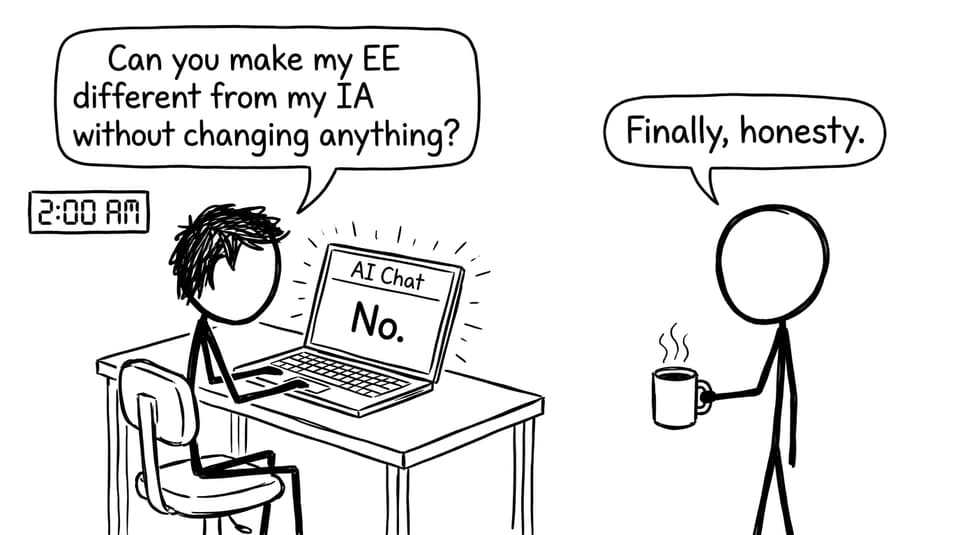
- Use AI Chat to ask for clarification on rules, structure, and citation habits, then write in your own words.
If you want a broader sense of common EE pitfalls (including over-reliance on recycled structure), read Mistakes to Avoid in IB Extended Essays.
A simple workflow to avoid accidental duplication
When students duplicate, it’s often because they don’t track what came from where. Try this:
Build two separate “idea pipelines”
Create:
- an IA Notes document (sources, rough ideas, reminders)
- an EE Notes document (sources, outlines, research question development)
Keep them separate from day one.
Use an “origin tag” habit
Every time you paste anything into your draft notes, add a tag like:
- (Source summary)
- (My idea)
- (From IA draft, do not reuse)
It sounds small. It saves you later.
Draft from outlines, not from old prose
If you outline your EE fresh, you reduce the temptation to “borrow” your IA paragraphs.
If you need help planning and structuring, RevisionDojo’s long-form guidance is useful: Mastering IB Extended Essays: How to Research, Write, and Revise.
The bottom line: protect your EE, protect your diploma
You can share resources between your IA and your EE. You can share themes, curiosity, and skills.
But you cannot share submission content.
If you remember one sentence, make it this: Same sources can be fine. Same writing is not. Your EE must have a substantially different angle and focus from any IA, or you risk academic misconduct and potentially not being awarded the diploma.
If you want a calm, structured way to keep both projects strong and separate, build your routine around RevisionDojo: clarify concepts with Study Notes, retain them with Flashcards, practice exam skills with the Questionbank and Mock Exams, and get criterion-based feedback using Grading tools, the Coursework Library, the IB Coursework Grader, Predicted Papers, AI Chat, and Tutors.
Start by reviewing the official expectations through RevisionDojo’s IB Extended Essay Guides and IB IA Guides, then write an EE that is unmistakably your own.