

A framework is a label, not a life sentence (and that matters for your EE)
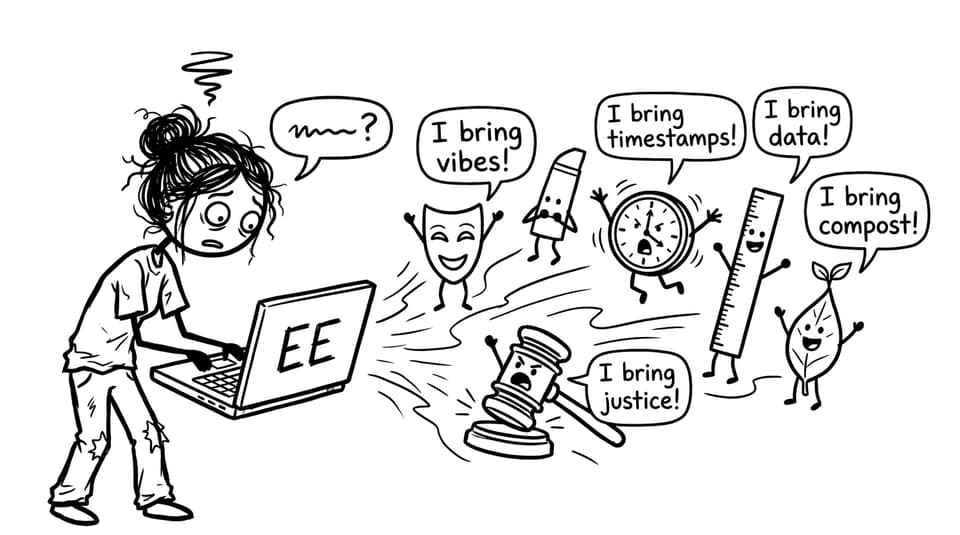
The first time most students hear about the interdisciplinary frameworks, they do what smart, anxious people do under uncertainty: they overfit.
They try to make their whole EE idea “match” a framework perfectly, as if an examiner is going to hold their essay up to a stencil and mark them down if the outline spills over the edge.
That fear is understandable. The EE already feels like a long walk with no map. Frameworks sound like the map.
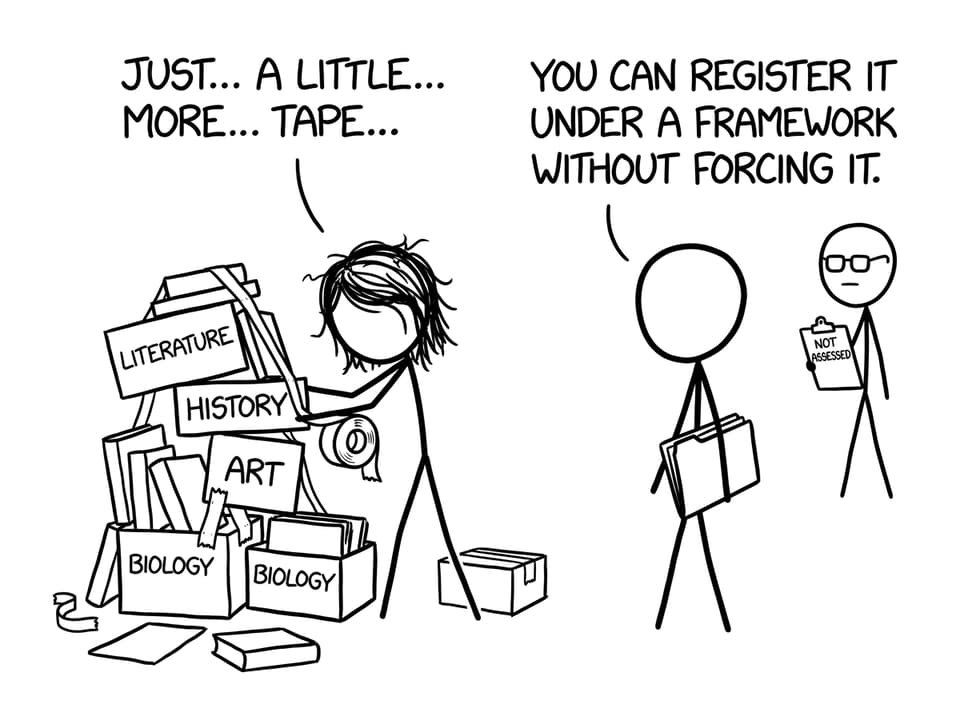
But here’s the quiet truth that calms everything down: students register their interdisciplinary EE under one of the five frameworks, but the framework connection itself is not directly assessed. It’s a way to organize, position, and communicate what kind of global issue you’re exploring. That’s it.
So your goal is not to contort your research into a framework. Your goal is to choose a framework that naturally describes the kind of thinking your EE already needs.
If you’re writing (or about to write) an interdisciplinary EE, this guide will walk you through all five frameworks, what they really mean in practice, and how to choose one without spiraling.
Along the way, you can anchor your planning with RevisionDojo’s support for the EE process, including its Study Notes, AI Chat, Flashcards, Coursework Library, Grading tools, Mock Exams, Predicted Papers, Questionbank, and access to Tutors when you need a human sounding board.
Quick checklist: choosing the right EE framework in 10 minutes
Before we define the five frameworks, use this quick filter. A good interdisciplinary EE framework choice should pass these checks:
- Your global issue clearly exists beyond one subject. If one discipline can fully answer your question, your EE might be better as a subject-specific essay.
- Two disciplines can contribute distinct tools. Not just two sets of facts, but two different ways of reasoning.
- Your framework choice feels descriptive, not performative. You should be able to explain it in two calm sentences.
- Your research question stays tight. Frameworks don’t rescue broad questions.
If you’re still shaping your question, keep RevisionDojo’s EE resources open while you brainstorm:
- What is a World Studies EE?
- IB Extended Essay Guides
- How to Craft the Perfect IB Extended Essay Research Question
What are the five interdisciplinary frameworks for the IB EE?
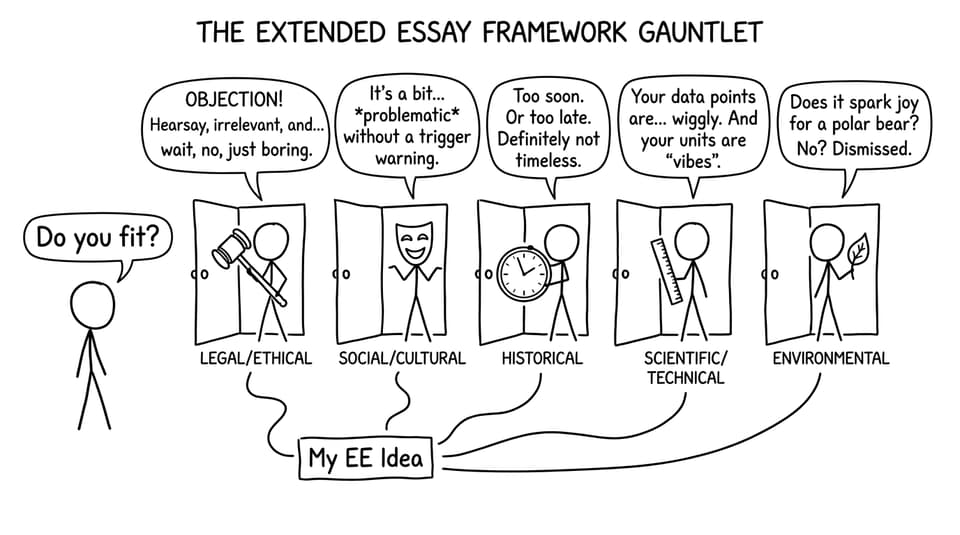
The interdisciplinary EE (often called the World Studies EE) uses five frameworks. You register your EE under one of them:
- Power, equality, justice
- Culture, identity, expression
- Movement, time, space
- Evidence, measurement, innovation
- Sustainability, development, change
Think of each framework as a different “lens” on a global issue. The lens influences the kinds of concepts you foreground, the kind of evidence you prioritize, and the kind of argument you build.
Now let’s make each one feel real.
Power, equality, justice (framework 1)
This framework fits an interdisciplinary EE when the beating heart of your question is: who gets what, who decides, and who pays the cost?
A strong EE under power, equality, justice usually has:
- Institutions (governments, courts, corporations, schools, platforms)
- Unequal outcomes (health, income, safety, rights, access)
- Competing definitions of “fair”
- A clear link between policy and lived experience
What “interdisciplinary” looks like here
Two disciplines often pair well because they argue differently:
- Economics + Global Politics: trade-offs, incentives, policy outcomes
- History + Politics: roots of inequality and modern consequences
- Psychology + Sociology: individual behavior vs structural forces
Example angles (not templates)
- How does algorithmic moderation affect freedom of expression and minority safety?
- To what extent do housing policies reproduce inequality in a specific city?
Your EE should still be evidence-based, not slogan-based. If you’re worried your draft is becoming descriptive, keep this nearby:
Culture, identity, expression (framework 2)
This framework fits an interdisciplinary EE when the core question is: how do people make meaning, belong, and represent themselves (or get represented by others)?
Culture, identity, expression is often misunderstood as “anything about culture.” A better way to think about it is: your EE is examining a tension between self-expression and social forces.
A strong EE here often includes:
- Language, symbols, narratives, media
- Identity categories (nationality, gender, religion, ethnicity, class)
- Questions of authenticity, appropriation, censorship, translation
What “interdisciplinary” looks like here
You’ll usually combine a subject that interprets meaning with a subject that examines systems:
- English + Global Politics: rhetoric, propaganda, discourse power
- Anthropology + Economics: cultural practice vs market incentives
- Film + Psychology: representation and perception
A practical warning
This framework is where students drift into “commentary.” Your EE still needs a method. Decide early whether you’re doing discourse analysis, comparative textual analysis, content analysis, interviews, or something else that is defensible.
RevisionDojo can help you structure that defensibility:
Movement, time, space (framework 3)
This framework fits an interdisciplinary EE when your global issue becomes clear only when you track flows and patterns: people, goods, information, disease, borders, migration, urbanization, conflict.
A good movement, time, space EE tends to ask:
- What changes over time?
- What changes across locations?
- What happens when something moves (or is prevented from moving)?
What “interdisciplinary” looks like here
This framework is naturally suited to Geography as one anchor discipline, then paired with:
- Economics: trade, labor, development indicators
- Biology: epidemiology, ecological spread
- History: cause and consequence across time
How to keep it sharp
Movement topics can become huge fast. You’ll need a narrow slice: one region, one time window, one mechanism.
If you’re still tightening your research question, use:
Evidence, measurement, innovation (framework 4)
This framework fits an interdisciplinary EE when the central tension is: what counts as proof, how do we measure reality, and what changes when new tools exist?
It’s the most “methods-forward” framework. It works well when your global issue sits at the intersection of:
- Data and decisions
- Scientific uncertainty and public policy
- Technology and unintended consequences
What “interdisciplinary” looks like here
You might pair:
- Computer Science + Economics: models, prediction, incentives
- Biology + Ethics/Politics: evidence standards vs human impact
- Physics/Environmental Science + Geography: measurement and interpretation
The common trap
Students sometimes think “innovation” means they must invent something. Not necessary.
In an EE, innovation can mean:
- a new measurement method,
- a new technology reshaping behavior,
- a new way evidence is collected, stored, or communicated.
If you want your methodology to look like something an examiner recognizes as rigorous, RevisionDojo’s Grading tools (including rubric-aligned feedback for coursework) can keep you honest about what you’ve proven vs what you’ve suggested:
Sustainability, development, change (framework 5)
This framework fits an interdisciplinary EE when your global issue asks: what should we sustain, what should we grow, and what must change?
It’s popular because it’s intuitive. It’s also risky for that same reason: students can drift into broad, moral writing.
A strong sustainability, development, change EE is specific about:
- Which sustainability dimension (environmental, social, economic)
- Which development indicator (income, health, education, inequality)
- Which mechanism of change (policy, technology, culture, market behavior)
What “interdisciplinary” looks like here
Pairing often looks like:
- Environmental Systems + Economics: externalities, valuation, policy tools
- Geography + Biology: ecosystems and human land use
- Politics + Sciences: governance, feasibility, evidence limits
If you’re aiming high, it helps to study how top students stay analytical while discussing big issues. RevisionDojo’s Coursework Library and feedback workflows are designed for that kind of calibration.
You can also see how RevisionDojo breaks down the broader EE journey here:
How to pick your interdisciplinary EE framework (without overthinking it)
Here’s a simple decision rule: choose the framework that best matches the verbs in your research question.
- If your EE evaluates fairness, rights, distribution, policy winners/losers: Power, equality, justice.
- If your EE interprets narratives, representation, belonging, meaning: Culture, identity, expression.
- If your EE maps trends across geography and history: Movement, time, space.
- If your EE hinges on data quality, models, tools, proof: Evidence, measurement, innovation.
- If your EE examines trade-offs over the long term: Sustainability, development, change.
And remember: the framework link is not directly assessed. So choose what clarifies your thinking, then move on to what is assessed: focus, method, knowledge, critical thinking, and engagement.
Making your EE exam-ready: tools and habits that reduce panic
Even though the EE isn’t a timed exam, most students experience it like one: long deadlines that suddenly become short.
Three practical habits help:
Build a micro-timeline
Instead of “finish EE by March,” set weekly outputs: research question, annotated sources, outline, one section draft, reflection notes.
If you’re already behind, this is still useful:
Use feedback like a loop, not a verdict
RevisionDojo’s AI Chat can help you test whether your line of argument is coherent, and its Grading tools can highlight where you’re drifting from the rubric.
Pair that with human input when it matters: RevisionDojo Tutors are useful when you feel stuck between two disciplines or can’t tell whether your method is defensible.
Study smarter while you write
It’s easy to let the EE cannibalize exam prep. Don’t.
Use RevisionDojo’s Questionbank and Mock Exams to keep subject content fresh, and its Flashcards to maintain key definitions and case studies. The best students don’t pause their subjects to write an EE; they create a rhythm where both move forward.
Closing: choose the EE framework, then get back to the work that earns marks
The five interdisciplinary options aren’t there to make your EE harder. They’re there to give your global issue a name that other people can understand quickly: power, culture, movement, evidence, sustainability.
Pick the one that fits your research question’s natural shape, write one clear explanation of the match, and then move on.
Because the highest-scoring EE rarely sounds like it’s trying to impress anyone. It sounds like a student who chose a focused question, used two disciplines on purpose, and kept showing their thinking.
If you want that kind of calm momentum, build your workflow around RevisionDojo: use the EE guides to stay aligned, the Coursework Library to see what “good” looks like, the AI Chat to pressure-test your argument, the Grading tools to revise with the rubric in mind, and the Questionbank, Flashcards, Mock Exams, and Predicted Papers to keep exam prep moving while your EE comes together.
When your EE framework stops being a worry, it becomes what it was always meant to be: a signpost, not a judge.