



If you have ever stared at your work-in-progress at 1:13 a.m. and thought, “This is just paint and panic,” you are not alone. But here is the quiet twist: IB Visual Arts is rarely “just art.” It is training in how to notice, how to explain your choices, and how to keep going when the first version fails.
That combination is exactly what many careers want. Not because every employer needs you to paint. But because they need people who can make decisions, justify them, and communicate visually and clearly under pressure. In other words, the skills you build in IB Visual Arts tend to travel well.
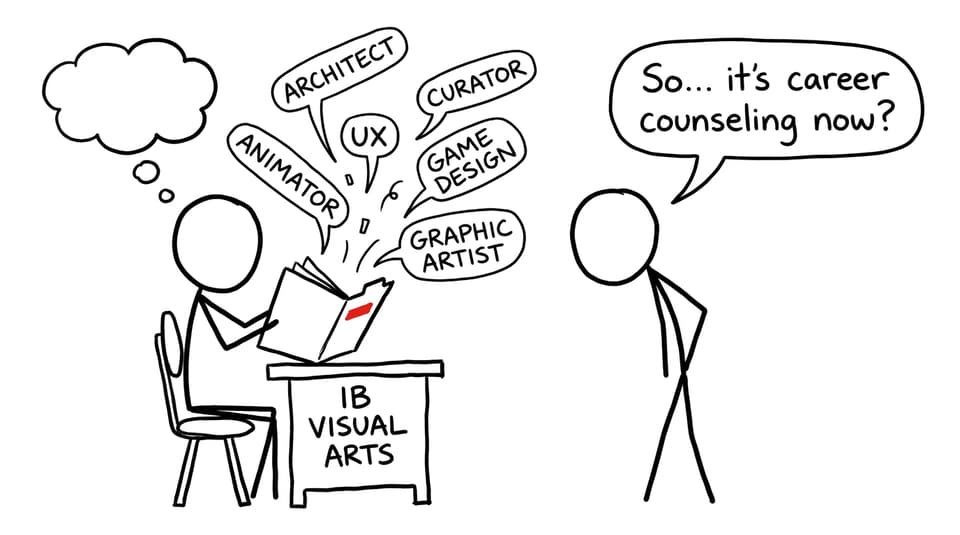
Quick checklist: what IB Visual Arts really teaches (and why jobs care)
Before the career list, anchor the “why.” IB Visual Arts develops a few repeatable abilities that show up in job descriptions across industries:
-
Visual communication: making complex ideas understandable through images, layout, and design.
-
Critical analysis: the Comparative Study mindset, what is happening, why it matters, and how to support claims.
-
Iterative process: experimenting, documenting, and improving (the Process Portfolio in real life).
-
Curation and storytelling: selecting work, building coherence, and writing rationale.
-
Professional feedback loops: getting critique, revising, and presenting confidently.
If you want a refresher on how the course is structured, keep What is IB Visual Arts? open in a tab while you read.
Arts careers where IB Visual Arts is the obvious advantage
Some paths connect to IB Visual Arts so directly that your portfolio becomes your first passport.
Fine artist, illustrator, and photographer
In these careers, your work speaks first. IB Visual Arts helps you practice building a body of work with intention, rather than a random set of pieces.
Your edge comes from:
-
showing development in your Process Portfolio
-
writing clearly about influences and context
-
selecting final pieces like a curator, not a collector
If you are sharpening your documentation and reflection, How to “Study” IB Visual Arts Effectively can help you turn effort into evidence.
Graphic designer and brand designer
Design is art with constraints: target audience, brand voice, deadlines, and clarity. Students who do well in IB Visual Arts often adapt quickly because they are used to making choices and defending them.
Focus skills to build now:
-
composition, hierarchy, and typography basics
-
translating an “idea” into a clean visual outcome
-
explaining design decisions in plain language
If you are unsure what examiners reward visually and conceptually, read IB Visual Arts Assessment Criteria Explained Simply and apply the same thinking to design briefs.
Animator and visual effects artist
Animation demands draft-after-draft discipline. IB Visual Arts prepares you for that grind because experimentation is a requirement, not a luxury.
Use your course to build animation-friendly habits:
-
storyboard sequences in your Process Portfolio
-
study motion, timing, and storytelling
-
reflect on what changed between iterations
To make “experimentation” real (and scorable), use How to Show Experimentation in Your IB Visual Arts Process Portfolio.
Design and architecture careers that quietly love IB Visual Arts
These roles are not always labeled “art,” but they are powered by visual thinking.
Architect
Architecture is applied composition: structure, space, light, and human movement. IB Visual Arts helps you practice:
-
spatial awareness and proportion
-
concept development and refinement
-
visual presentation and rationale writing
A strong exhibition-style presentation (coherent theme, deliberate selection) maps nicely onto architecture portfolios.
Interior designer
Interior design blends aesthetics with function. Students trained in IB Visual Arts tend to be comfortable with:
-
color theory and material choices
-
mood boards and visual research
-
explaining design intent to clients
If you want to build a more coherent body of work, Creating an Outstanding IB Visual Arts Portfolio is a practical guide.
Industrial designer (product design)
Product design is where sketching meets engineering constraints. The biggest transferable skill from IB Visual Arts is the ability to prototype visually and iterate.
Try this now:
-
sketch one object in three styles (minimal, playful, premium)
-
annotate why each choice changes the message
-
include failures and revisions (that is where your thinking shows)
People-centered careers: education, therapy, and communication
Not every student who loves IB Visual Arts wants a studio job. Some want to work with people, and art becomes the tool.
Art teacher or educator
Teaching art is teaching attention. Your IB Visual Arts training helps you model:
-
how to research artists meaningfully
-
how to reflect without writing empty sentences
-
how to guide students from idea to finished work
To avoid the common traps that weaken student work, review Most Common Mistakes in IB Visual Arts, Pitfalls to Avoid.
Art therapist
Art therapy combines creative practice with psychological understanding and empathy. While the professional pathway usually involves specialized degrees and certification, IB Visual Arts gives you early practice in:
-
symbolism and meaning-making
-
reflective writing about process and emotion
-
ethical awareness when representing people and stories
If you are curious how arts subjects build broader career skills, Can IB Group 6 Help Build Skills for Creative Careers? is a useful perspective.
Curation and art management: the careers built on selection
These paths are ideal for students who love art, ideas, and organizing meaning.
Curator and gallery manager
Curators do not just “pick nice things.” They build arguments with objects. IB Visual Arts already trains this through your Comparative Study and Exhibition rationale.
Build career-relevant evidence by:
-
writing labels and curatorial text with clarity
-
explaining context, not just style
-
making connections across cultures and time
To strengthen your ability to analyze artworks (the curator’s daily work), use How to Prepare for the IB Visual Arts Comparative Study.
Art conservator
Conservation is where art meets chemistry, patience, and microscopic detail. Students with IB Visual Arts experience often have an early advantage in:
-
material awareness (how mediums behave over time)
-
careful documentation
-
precision and process thinking
How to turn IB Visual Arts into a career story (without sounding vague)
Universities and employers do not want “I am creative.” They want proof.
Try this three-step translation:
-
Course component: “Process Portfolio experimentation”
-
Skill: iterative problem-solving
-
Evidence: screenshots/photos + reflection showing change over time
-
-
Course component: “Comparative Study analysis”
-
Skill: research and argument
-
Evidence: clean visual slides + citations + personal insight
-
-
Course component: “Exhibition curation”
-
Skill: selection, coherence, communication
-
Evidence: final set + rationale explaining intent
-
If you are calibrating what top work looks like, exploring IB Visual Arts Examples can help you spot the difference between “pretty” and “persuasive.”
Closing: let IB Visual Arts become bigger than a course
The real value of IB Visual Arts is not that it turns you into one kind of artist. It turns you into someone who can take a messy idea, test it, explain it, refine it, and present it as a coherent story.
That story fits fine art, design, architecture, education, therapy, curation, and more. If you want to turn your work into higher marks and a clearer future plan, build your skills with RevisionDojo’s Questionbank, Study Notes, Flashcards, AI Chat, Grading tools, Predicted Papers, Mock Exams, Coursework Library, and Tutors. Keep your process honest, keep your reflections specific, and let IB Visual Arts do what it does best, opening doors you did not know were connected.