

The quiet moment that changes your IB Visual Arts score
Two weeks before the deadline, most IB Visual Arts students have the same unsettling discovery: they have artwork, but they do not yet have a portfolio. There are photos scattered across a camera roll. Notes live in three different notebooks. Experiments exist, but the learning behind them is hard to see.
An outstanding IB Visual Arts submission isn’t the one with the most talent on display. It’s the one that tells the clearest story: what you tried, what you learned, what you refined, and why the final choices matter.
This guide shows you how to build that story across the Process Portfolio and the Exhibition, without losing your voice.
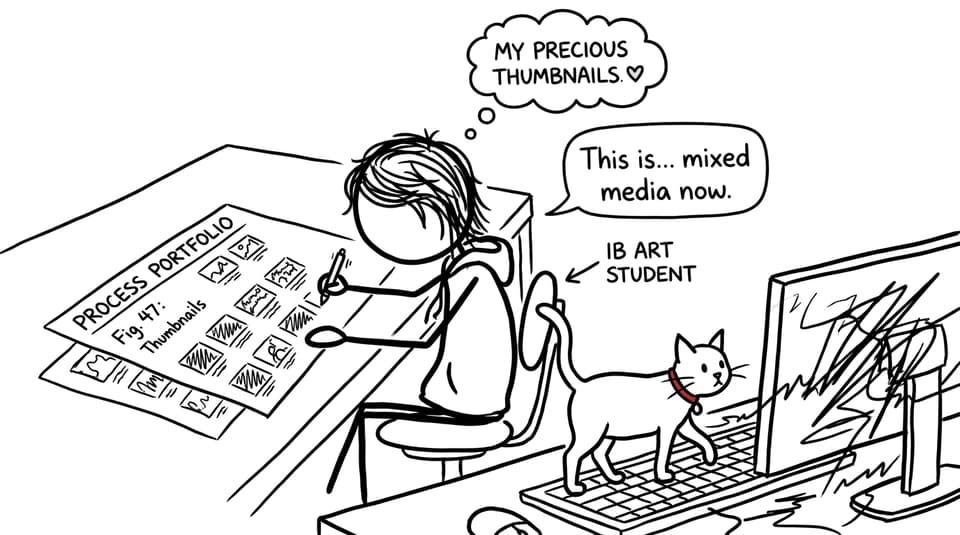
IB Visual Arts portfolio checklist (use this before you add another page)
If you want your IB Visual Arts portfolio to feel intentional, run this quick checklist weekly:
-
Do I show experimentation (not just outcomes)?
-
Do I explain decisions in short, specific reflections?
-
Do I connect artist research to what I changed in my own work?
-
Do my pages look curated (clear hierarchy, consistent layout)?
-
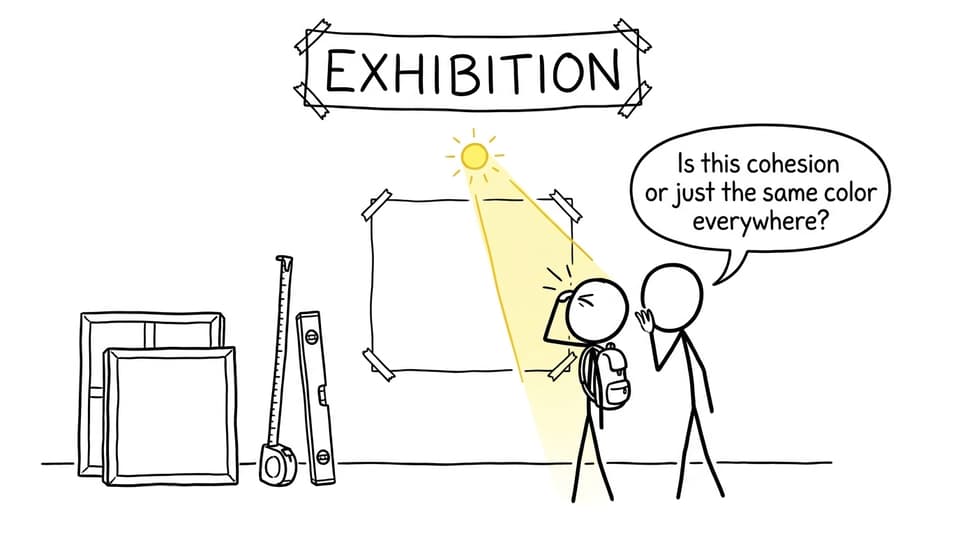
Does my Exhibition selection feel cohesive, not random?
When you need the criteria in plain language, keep this open while you work: IB Visual Arts assessment criteria explained simply.
Build a Process Portfolio that proves growth
The Process Portfolio is where IB Visual Arts becomes legible to an examiner. It’s not a scrapbook. It’s evidence.
A strong approach is to structure pages like a mini lab report: intention, trial, result, reflection, next step. That rhythm makes your development obvious.
For a layout blueprint, use: How to structure your IB Visual Arts process portfolio.
What to include on each Process Portfolio “screen”
To score well in IB Visual Arts, make sure each page contains at least two of these:
-
Experiment images (early drafts, tests, failures)
-
Annotations that name technique and intention
-
A clear link to an artist influence (not just “I like this”)
-
A micro-reflection: what changed, and why
If you’re unsure what examiners reward, this is worth reading slowly: What examiners look for in the IB Visual Arts process portfolio.
Themes: the easiest way to make experimentation feel cohesive
A theme isn’t a cage. In IB Visual Arts, it’s a thread you can pull through different media so the portfolio reads as one mind at work.
If you’re still choosing, browse: Best IB Visual Arts themes for process portfolios.
And if you want to avoid the common traps (beautiful work, unclear thinking), keep this nearby: Most common mistakes in IB Visual Arts.
Curate an Exhibition that feels inevitable
The Exhibition is your IB Visual Arts “final sentence.” It’s where the examiner should feel: Of course these are the works you chose.
You’re being assessed on more than skill. You’re being assessed on coherence, presentation, and the logic of your selection.
Start here for requirements and expectations: The Exhibition in IB Visual Arts: what you need to know, then clarify level-specific demands with How to succeed in the IB Visual Arts Exhibition at SL vs HL.
How to select works (a practical filter)
When narrowing pieces for IB Visual Arts, use three questions:
-
Signal: Does this work clearly show technical competence?
-
Meaning: Does it carry a readable idea, mood, or question?
-
Role: Does it add something new (medium, scale, risk), or does it repeat?
If two works are competing, pick the one that strengthens the narrative of your investigation, not the one you’re emotionally attached to.
Write a curatorial rationale that sounds like you (but thinks like an examiner)
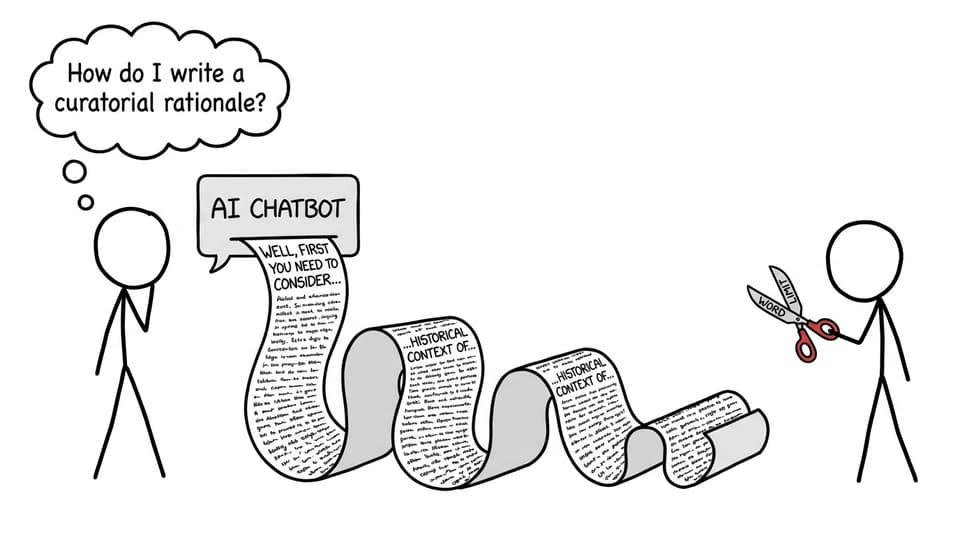
In IB Visual Arts, the curatorial rationale is your chance to translate visual decisions into assessed decisions. It should be personal, but not vague. Concrete, but not mechanical.
Use this step-by-step guide: How to write the IB Visual Arts curatorial rationale.
A helpful mindset: you’re not describing every artwork. You’re justifying the exhibition as a system.
A calm workflow using RevisionDojo (so your art stays the hard part)
Even though IB Visual Arts isn’t a typical written exam subject, you’re still preparing for assessed outcomes under time pressure. Your system matters.
Here’s a simple loop many students use inside RevisionDojo:
-
Use AI Chat to clarify artistic vocabulary and tighten reflection sentences.
-
Turn key artist research and technique terms into Flashcards so your writing becomes sharper over time.
-
Use Study Notes to stay aligned with assessment language and component expectations.
-
When you’re ready for feedback, use Grading tools like the IB Visual Arts Process Portfolio Grader.
-
If you’re balancing multiple deadlines, plan like an exam student: How to study for IB exams without burning out.
And when you want a bigger view of the course components, revisit: What is IB Visual Arts?.
Closing: make your IB Visual Arts portfolio feel like a story with receipts
An examiner can’t stand in your studio. They only have what you submit. So your job in IB Visual Arts is to turn private struggle into visible progress, and then to curate the final work so it feels purposeful.
If you want that process to feel simpler, RevisionDojo brings it into one place: build recall with Flashcards, clarify ideas with AI Chat, check expectations with Study Notes, get rubric-aligned feedback with Grading tools, and stay supported with Tutors and the Coursework Library. Your art stays yours. Your portfolio becomes undeniable.