

Some classrooms feel like airports at peak hour. Others feel like a quiet library, where the teacher knows everyone’s handwriting by week two.
That contrast can mess with your Subject Selection.
When you see a subject running with six students, it’s easy to assume the worst: it must be harder, it must be risky, it must be marked harshly. But low enrolment usually has less to do with difficulty and more to do with how schools work, how timetables collide, and how students talk each other out of things.
If you’re an IB student preparing for exams, the real question isn’t “Why is nobody taking this?” It’s “What does low enrolment actually change for my learning, my grades, and my revision plan?”
A quick Subject Selection checklist (before you panic)
Use this as a calm filter when you notice a low-enrolment subject:
-
Is the subject rarely offered at schools (staffing, timetable, budget)?
-
Does it have prerequisites that quietly shrink the pool?
-
Is it suffering from a reputation loop ("hard", "abstract", "only geniuses")?
-
Is it naturally niche (arts, specialist languages, specific career paths)?
-
Do you have a revision system that replaces “guesswork” with exam technique?
A good Subject Selection decision is usually less about trends and more about fit.
Low enrolment is usually a logistics story, not an academic one
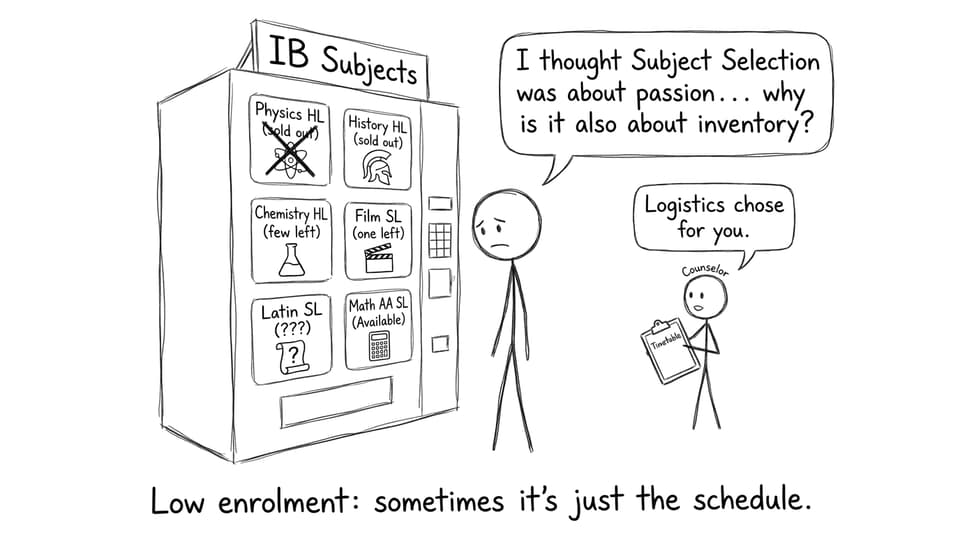
The most common reason a subject stays unpopular is brutally simple: availability.
Many IB schools can’t offer every option every year. They may:
-
struggle to staff certain subjects (especially niche ones)
-
cap Higher Level combinations because of timetable clashes
-
rotate small subjects every few years
-
run tiny Group 6 or smaller language programmes depending on demand
So the subject’s global enrolment stays low even if the course itself is excellent.
If you’re weighing Subject Selection at your school, start by asking: “Is this subject low enrolment everywhere, or just here because of scheduling?” That one question often dissolves the fear.
Prerequisites shrink enrolment faster than difficulty ever could
Some subjects require confidence built over years. Not genius, just runway.
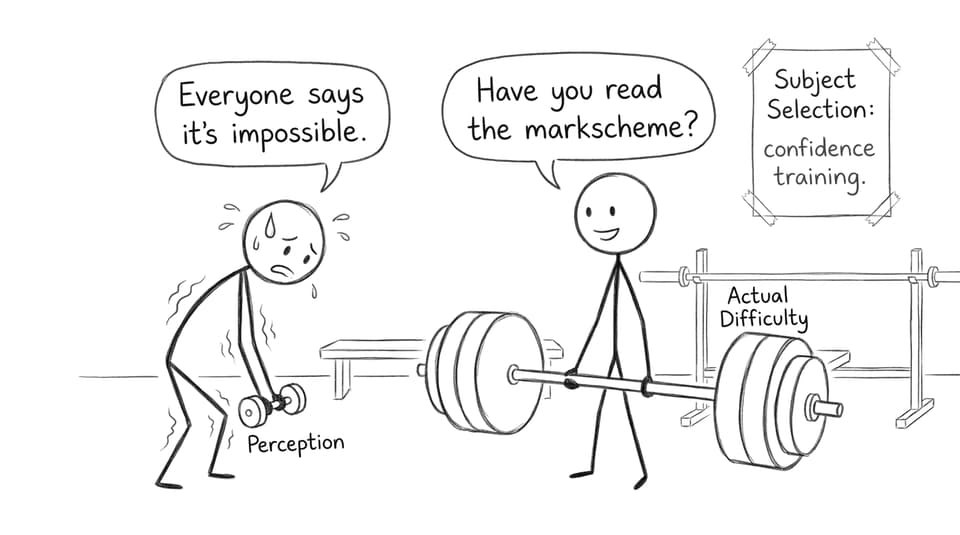
Think of subjects with heavier quantitative demands, like advanced maths pathways or Physics at Higher Level. Many students quietly self-select out because they don’t feel “ready,” even when they could succeed with the right structure.
This matters for Subject Selection because low enrolment can reflect confidence, not capability.
A practical move: if a subject scares you, explore how it’s assessed and what skills are actually rewarded. Often you’ll find a smaller set of repeatable patterns than rumours suggest.
Perception becomes a self-fulfilling timetable
Every school has “legend subjects.” The ones older students warn you about in corridors.
Once a course gains labels like:
-
hard
-
technical
-
abstract
-
time-consuming
…enrolment can stay low for years, even if results are perfectly fine.
Here’s the quiet truth: perception spreads faster than evidence. And perception shapes Subject Selection because it feels safer to pick what other people picked. The risk isn’t the unpopular subject. The risk is choosing a popular subject that doesn’t match how you think, then trying to survive it through willpower alone.
If you want a wider lens on popularity signals, see Should You Choose IB Subjects Based on Popularity? and compare it with your own strengths.
Some subjects are meant to be niche
Low enrolment can be normal.
Arts subjects, specialised languages, and interdisciplinary options are designed for smaller groups with specific interests. They are not built to attract mass participation. They’re built to serve students who need that lens.
So if your Subject Selection includes something niche, don’t treat low enrolment as a warning sign. Treat it as a clue: you’ll likely need a clearer revision plan, because your class may have fewer peer-made resources floating around.
Low enrolment does not make grading harsher
One of the most persistent myths is that fewer students means tougher marking.
IB grading is criterion-based. That means your work is judged against assessment criteria and markschemes, not against how many people took the subject. Moderation exists to keep marking standards consistent across regions.
If you meet the top descriptors, you can earn the top grade, even if your cohort could fit around one table.
If you want to go deeper on this specific worry, read Does IB Subject Popularity Affect a 7?.
The hidden advantage: small cohorts can increase feedback density
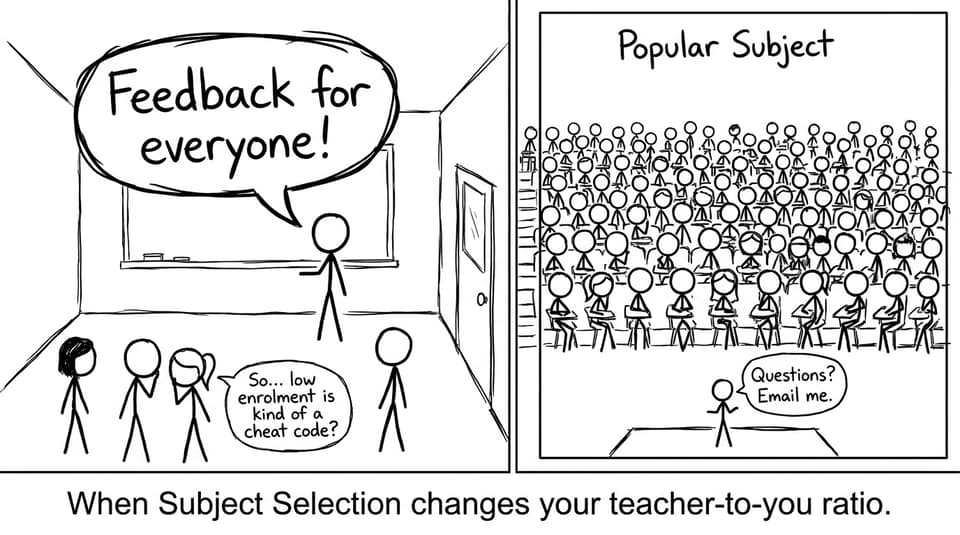
Low enrolment can quietly give you something rare: attention.
Smaller classes often mean:
-
more individual teacher feedback
-
faster correction cycles
-
more opportunities to ask “dumb” questions safely
-
clearer differentiation when your work is strong
That feedback loop matters more than people realise. In exam preparation, improvement is mostly the speed at which you can:
-
attempt exam-style questions
-
see what the markscheme rewards
-
fix the pattern
-
repeat
That’s why tools matter.
How to revise strategically when resources are limited
Students struggle in low-enrolment subjects for predictable reasons: fewer shared notes, less collective “what came up last year” chatter, and sometimes a teacher who has to build materials from scratch.
Your fix is structure.
A strong loop looks like this:
-
Build understanding with targeted Study Notes
-
Lock in recall using Flashcards (spaced repetition beats rereading)
-
Convert knowledge into marks using the RevisionDojo Questionbank
-
Use AI Chat to ask the exact questions you’d hesitate to ask in class
-
Stress-test with IB Predicted Papers and timed Mock Exams
-
Use grading tools to find what’s actually costing marks
If you want a simple workflow that holds up under pressure, RevisionDojo App: The Smarter Way to Prep for IB Exams lays it out cleanly.
Final thoughts: make Subject Selection with your eyes open
Low enrolment rarely means a subject is a trap. More often, it means logistics, prerequisites, or reputation shaped the room before you ever walked in.
If you’re considering a low-enrolment course, treat it like any smart Subject Selection decision: check availability, understand assessment, and commit to a revision loop that turns effort into marks.
RevisionDojo is built for exactly this situation, whether your subject is popular or niche. With Questionbank practice, Study Notes, Flashcards, AI Chat, grading tools, Predicted Papers, Mock Exams, a Coursework Library, and Tutors, you can prepare with clarity even when your cohort is tiny.
Explore more guidance in the Subject Selection tag hub and choose based on fit, not fear.