




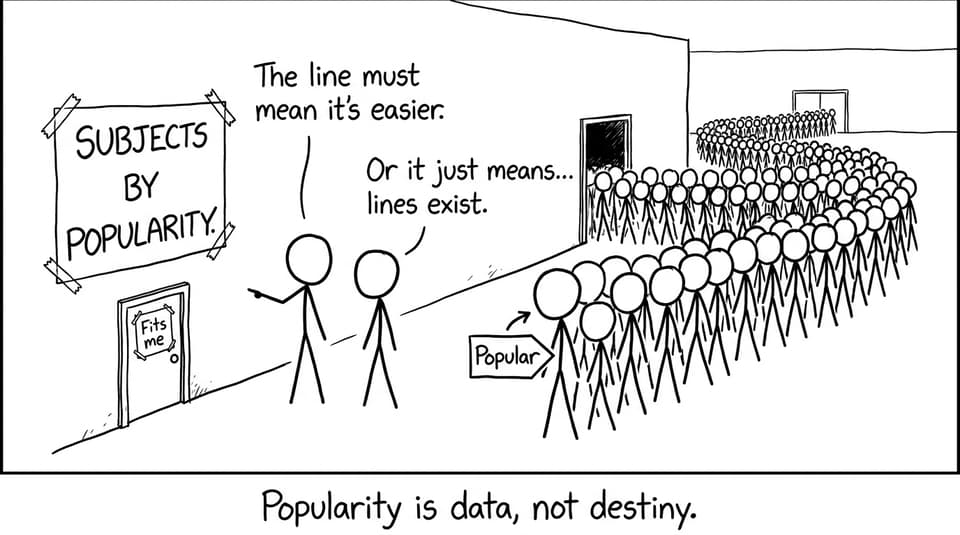
If you’ve ever watched IB subject sign-ups open, you’ve seen it: one classroom fills instantly, another looks like a quiet museum. In that moment, popularity feels like information you can trust. A full class must mean “safe.” A smaller one must mean “risky.”
But Subject Selection is one of those decisions where the obvious signal is often the least useful. Popularity can tell you a few practical things (like availability and competition). It can’t tell you whether you’ll stay motivated in February, whether the assessment style fits your brain, or whether you’ll still be able to perform when exams compress your world into timed answers.
Below is a calmer way to read popularity: as context, not a compass.
Quick checklist for smarter Subject Selection
Use this before you copy what everyone else is doing:
-
Check university prerequisites and program expectations.
-
Ask whether you like the assessment style, not just the topic.
-
Match subjects to strengths: writing, math, labs, analysis, memory.
-
Use popularity only to predict classroom dynamics (pace, competition, support).
-
Choose a revision system early so your choice stays sustainable.
If you want a broad overview of what the Diploma demands while you make Subject Selection decisions, keep this guide open: The Complete IB Revision Guide: From Subject Selection to Final Exams.
What subject popularity actually tells you (and what it doesn’t)
Popularity usually reflects logistics and familiarity, not difficulty.
Popularity often signals
-
Availability: more schools can staff it, so more students can take it.
-
Familiarity: students have done something similar before.
-
Perceived flexibility: it “keeps options open” for university.
-
Social proof: your friends chose it, so it feels safer.
Popularity does not reliably signal
-
How easy it is to score highly.
-
Whether the marking rewards your strengths.
-
Whether you’ll enjoy the grind of two years.
A useful reference point is to browse the International Baccalaureate (IB) hub and see how different subjects are structured. For Subject Selection, structure matters as much as content.
Why “popular = easier” is a tempting (and costly) shortcut
When stress is high, humans simplify. In IB, simplification often looks like: “Everyone’s doing it, so it must be manageable.”
The catch is that popularity can raise the bar. In large-cohort subjects, examiner expectations can feel sharper because thousands of students answer similar prompts in similar ways. You’re not just trying to be correct; you’re trying to be clearly correct.
This is why Subject Selection needs a second layer: not just “Can I do this?” but “Can I do this consistently, under time pressure, and still care enough to practise?”
For context on how popularity trends show up, see: Most Popular IB Subjects in 2025: What Students Are Choosing and Why.
The real risks of choosing based on popularity
Choosing mostly from the crowd can work, but only if the fit is real. When it isn’t, the problems show up later, quietly.
Motivation debt
At first, you’ll feel fine because the choice feels “approved.” Later, the workload arrives and your reason for choosing it (other people) stops helping.
Mismatch with assessment style
Some subjects reward sustained argument writing. Others reward precise method and calculation. Others reward experimental thinking. If your strengths don’t match the assessment, effort becomes expensive.
Burnout during exam prep
The most painful moment is revising a subject you never truly chose. That’s why sustainable Subject Selection is an energy decision, not just an academic one.

What to prioritize instead (a better Subject Selection framework)
A strong Subject Selection decision is built from three questions.
Interest: will you return to this when it gets hard?
Interest doesn’t mean effortless enjoyment. It means you’re willing to stay in the problem long enough to improve.
Strength: does the subject reward what you do well?
Be specific. “I’m good at science” is vague. “I’m calm with data, careful with method, and I can explain processes clearly” is useful.
Requirements: does it keep your future options open?
Some degrees expect certain subjects or levels. Check early. Then decide deliberately.
If you’re still unsure and want a broader approach, this helps you build a balanced combination: Which Subjects Should I Take at IB if I Don't Know What to Do in University Yet.
When popularity is useful (the right way to use it)
Popularity becomes helpful when you treat it like weather. You don’t let weather choose your destination, but you do pack accordingly.
Use popularity in Subject Selection to:
-
Predict how fast the class might move.
-
Expect stronger competition for top marks.
-
Plan earlier practice to stand out.
RevisionDojo has a useful lens here: succeeding in any subject is less about vibes and more about feedback loops. You learn content, you practise questions, you get targeted feedback, and you repeat.
That’s why tools like the IB Question Bank | How to Use It Effectively matter regardless of whether your subject is “popular” or not.
How RevisionDojo makes Subject Selection less risky
Some students avoid less popular subjects because they fear fewer resources or less guidance. That fear is understandable. It’s also solvable.
RevisionDojo reduces that uncertainty by giving you a full system:
-
Study Notes to clarify what the syllabus actually expects (not just what a textbook says). Try: IB Subject Note Collections: Comprehensive Study Materials.
-
Flashcards for daily recall, so you don’t “understand it once” then forget it. Start here: IB Flashcards with Spaced Repetition (SRS).
-
AI Chat for fast clarification when you’re stuck and your notes are not enough.
-
Grading tools to learn how marks are awarded (especially in written subjects).
-
Predicted Papers and Mock Exams to rehearse timing and pressure in realistic exam formats: IB Predicted Papers by IB Examiners (Free) and Best IB Mock Exam Platform: Why Students Pick RevisionDojo.
-
Coursework Library and Tutors when the issue isn’t effort, but direction.
For a bigger picture of how RevisionDojo supports every kind of class size, read: How RevisionDojo Supports Both Popular and Niche IB Subjects.

Conclusion: choose fit, then build an advantage
Popularity is loud. It’s visible. It feels like proof.
But Subject Selection works best when you choose the subjects you can stay loyal to: the ones that match your strengths, align with your future options, and still feel worth practising when the novelty disappears.
If you want your choices to feel safer without copying the crowd, build a system. RevisionDojo gives you the structure to succeed in any combination through Study Notes, Flashcards, the Questionbank, AI Chat, grading tools, Predicted Papers, Mock Exams, the Coursework Library, and Tutors. Make Subject Selection about fit, thenthen let your preparation do the talking.