


In IB Visual Arts, most grade drops don’t come from “bad art.” They come from invisible gaps: missing process evidence, vague writing, rushed comparisons, or a theme that never quite becomes a concept. The painful part is that these mistakes often feel small while you’re making them. The helpful part is that they’re fixable once you know what examiners are actually rewarding.
This guide walks through the most common IB Visual Arts pitfalls (Comparative Study, Process Portfolio, and Exhibition) and how RevisionDojo helps you course-correct before deadlines turn into panic.
A quick IB Visual Arts pitfall checklist
Before you open another blank slide or portfolio screen, check:
-
Have I planned my IB Visual Arts work around criteria, not vibes?
-
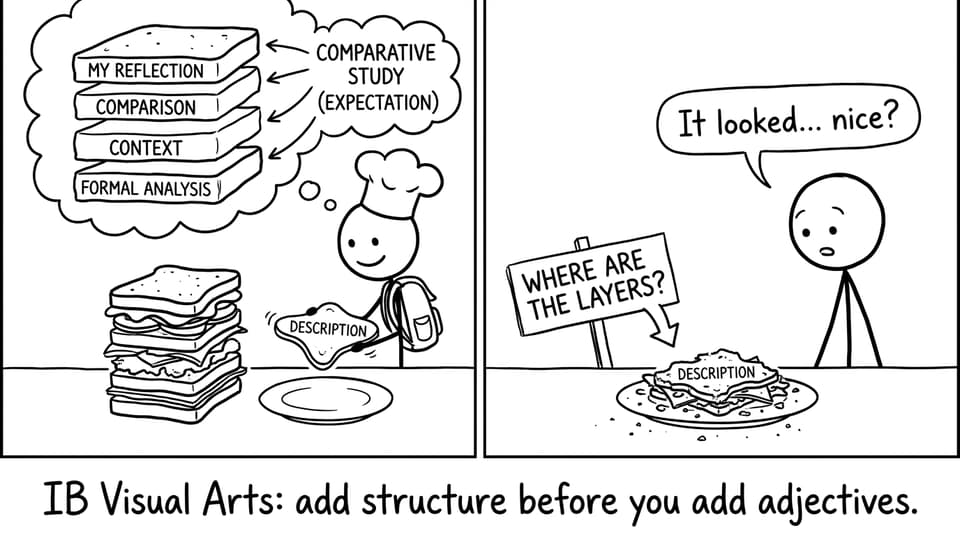
Does my Comparative Study move beyond description into analysis, context, and comparison?
-
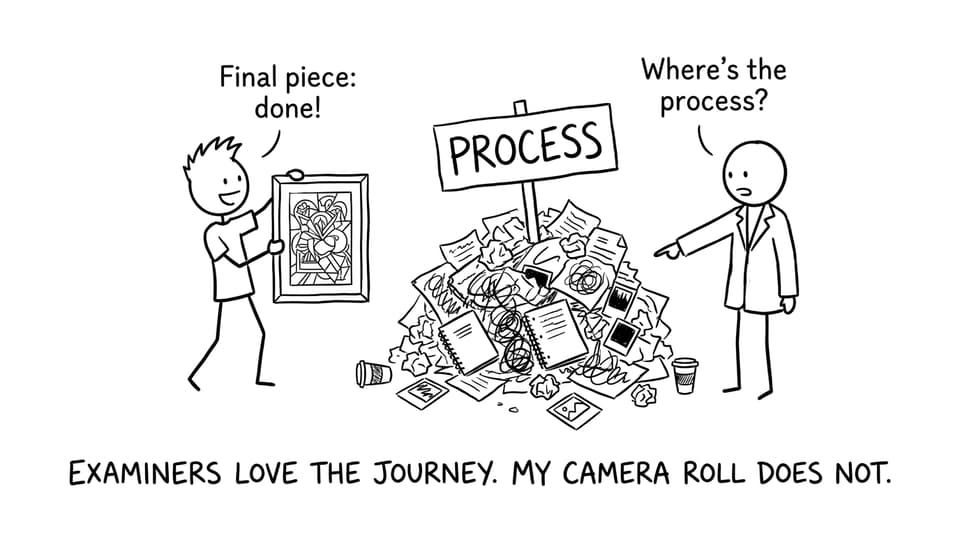
Does my Process Portfolio show experiments, iterations, and reflection (not just outcomes)?
-
Does my Exhibition feel cohesive, with a clear curatorial rationale?
-
Am I pacing work weekly instead of “creating in bursts”?
If you need the big-picture map, start with What is IB Visual Arts? and then keep Requirements for IB Visual Arts open while you plan.
Mistake: Rushing the Comparative Study in IB Visual Arts
A strong Comparative Study in IB Visual Arts reads like a student thinking clearly, not like a museum label stitched together at midnight. The most common slip is choosing artworks that look interesting but don’t create a meaningful argument.
Avoid these traps:
-
Choosing works with no thematic tension (nothing to compare beyond surface style)
-
Writing what you see without explaining how form creates meaning
-
Treating cultural context like a bolt-on paragraph
-
Forgetting to connect insights back to your own making (especially important for HL)
RevisionDojo helps by giving you repeatable structure. Use IB Visual Arts Comparative Study Examples That Score as a benchmark, then tighten your method with Comparative Study Structure (Step-by-Step) and How to Integrate Cultural Context.
Mistake: Treating the Process Portfolio like a photo album
In IB Visual Arts, examiners aren’t only asking “What did you make?” They’re asking “How did you get there, and what did you learn?” Students lose marks when they skip the evidence trail: trials, changes, mistakes, and specific reflections.
Common issues:
-
No documentation of experimentation (only polished finals)
-
Reflections that are generic (“I liked it” or “It was challenging”)
-
Artist research that doesn’t change your next decision
A useful anchor is RevisionDojo’s How to "Study" IB Visual Arts Effectively, paired with What to Include in an IB Visual Arts Portfolio. Then, to keep your work authentically yours, read Integrity and Originality in IB Visual Arts.
Mistake: A weak curatorial rationale (or no real coherence)
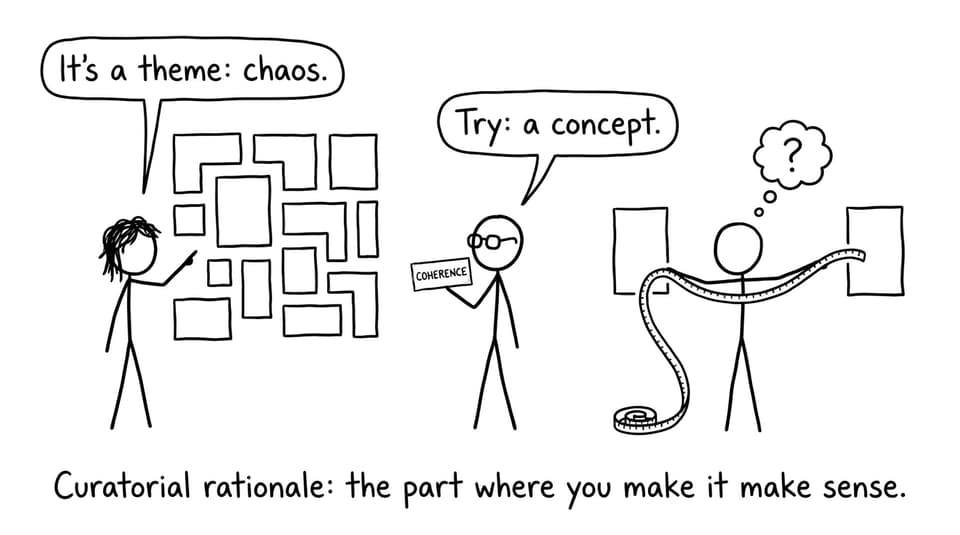
The Exhibition can look impressive and still underperform if it feels like separate projects sharing a room. In IB Visual Arts, cohesion is a skill you can show: intentional selection, presentation decisions, and a rationale that explains the thread.
Typical pitfalls:
-
A “theme” that’s actually just a mood word
-
Presentation choices you can’t justify (size, spacing, sequencing)
-
Labels and writing that say what the work is, not why it matters
To align with what examiners reward, keep IB Visual Arts Assessment Criteria Explained Simply nearby and use Creating an Outstanding IB Visual Arts Portfolio to pressure-test coherence.
How RevisionDojo helps you avoid IB Visual Arts mistakes
RevisionDojo works best when you treat it like a studio manager and an examiner-aware coach.
-
Use the Coursework Library and IB Visual Arts Exemplars to see what “good” looks like in real submissions.
-
Use AI Chat to turn vague reflections into specific, criteria-aligned commentary.
-
Use Study Notes and Flashcards to build quick recall of formal analysis terms and contextual angles.
-
Use Grading tools and Tutors to get feedback that matches the rubric, not just opinions.
-
Use Mock Exams and Predicted Papers strategically for any timed components your school sets, without letting them cannibalize portfolio time.
Conclusion: Make IB Visual Arts easier by making it clearer
The biggest wins in IB Visual Arts are rarely dramatic. They’re quiet habits: documenting the process, comparing with purpose, writing with specificity, and curating like your work is telling one story. Do those consistently, and your art starts reading like evidence, not like a mystery.
If you want a simple next step, open RevisionDojo’s IB Visual Arts resources, pick one component you’re behind on, and rebuild it with structure: exemplars for direction, tools for feedback, and a weekly rhythm you can actually sustain.