


Studying IB Visual Arts never feels like studying, until the deadline hits, your camera roll is full of “process shots” you don’t understand, and your curatorial rationale suddenly needs to sound like you’ve been thinking in paragraphs all year.
That moment is the real lesson of IB Visual Arts: the course rewards the student who builds evidence slowly. Not just great images, but visible thinking. The kind that shows you experimented, changed your mind, learned a technique, and can explain why.
Below is a practical way to “study” IB Visual Arts without turning your creativity into panic.
The IB Visual Arts study checklist (save this)
Use this as your weekly anchor for IB Visual Arts:
-
Two short studio sessions (even 30-45 minutes)
-
One documentation session (photos + annotations)
-
One artist research session (comparative notes)
-
One reflection pass (what changed, what you learned, what you’d do next)
-
One feedback loop (teacher/peer/RevisionDojo tools)
If you want to ground this in requirements, keep this open while you work: Requirements for IB Visual Arts.
What “studying” IB Visual Arts actually means
In many subjects, studying means remembering content. In IB Visual Arts, studying means building a trail of decisions an examiner can follow.
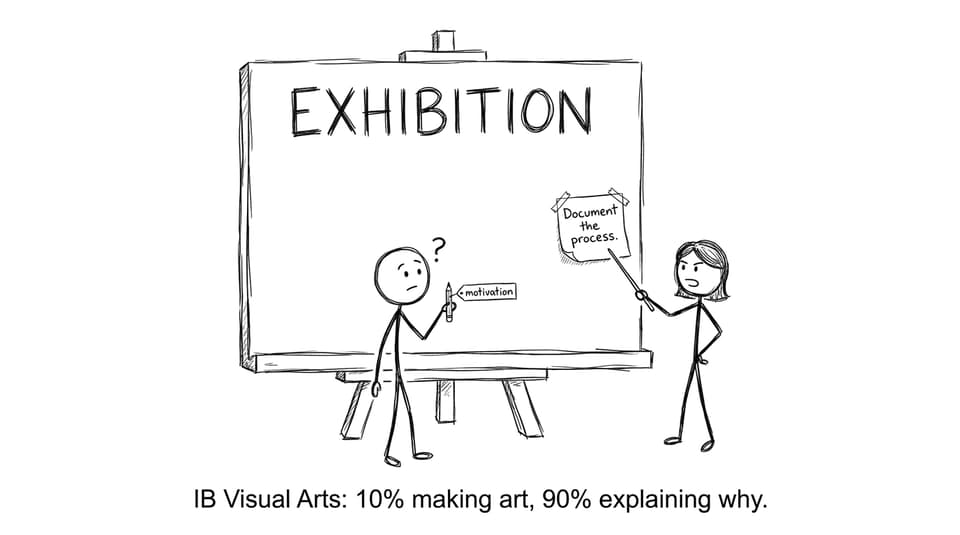
You’re assessed across three pillars: Comparative Study, Process Portfolio, and Exhibition. Each one rewards clarity and intention. So your job is to treat your art-making like a small research project: plan, test, record, evaluate, refine.
A helpful way to think about it: you’re not only making outcomes; you’re making proof.
Build a routine that protects momentum in IB Visual Arts
A lot of IB Visual Arts stress comes from waiting to “feel inspired.” Inspiration is unreliable. A routine is quieter, but it compounds.
Try this simple split:
-
Weekdays: small experiments (materials, composition studies, technique drills)
-
Weekend: consolidate (select what worked, photograph, write reflections, plan next iteration)
When you’re unsure what counts as strong evidence, use a model. RevisionDojo’s IB Visual Arts Exemplars are useful because they show how top work explains itself, not just how it looks.
IB Visual Arts Process Portfolio: study by making your process visible
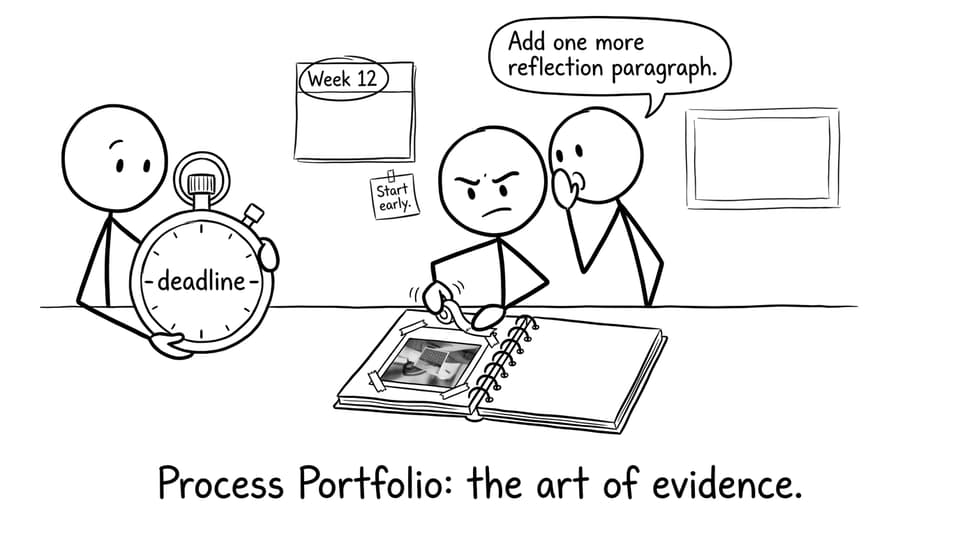
Your Process Portfolio is where “studying” becomes legible. If your work is good but your process is invisible, your score usually drops.
A strong IB Visual Arts portfolio page often includes:
-
A clear intention (what you were trying to explore)
-
Visual experiments (not just final pieces)
-
Technical notes (materials, steps, mistakes)
-
A reflection that names a change you made and why
If you need a structure, follow: What to Include in an IB Visual Arts Portfolio.
The easiest documentation habit (that actually works)
After every session, record three bullets:
-
I tried: (technique/idea)
-
It worked when: (specific evidence)
-
Next time I will: (one concrete adjustment)
This takes five minutes, but it creates the exact language you later need for your Process Portfolio and Exhibition rationale.
If reflection feels vague, read: The Role of Reflection in IB Group 6 Assessment.
IB Visual Arts Comparative Study: “study” like an investigator
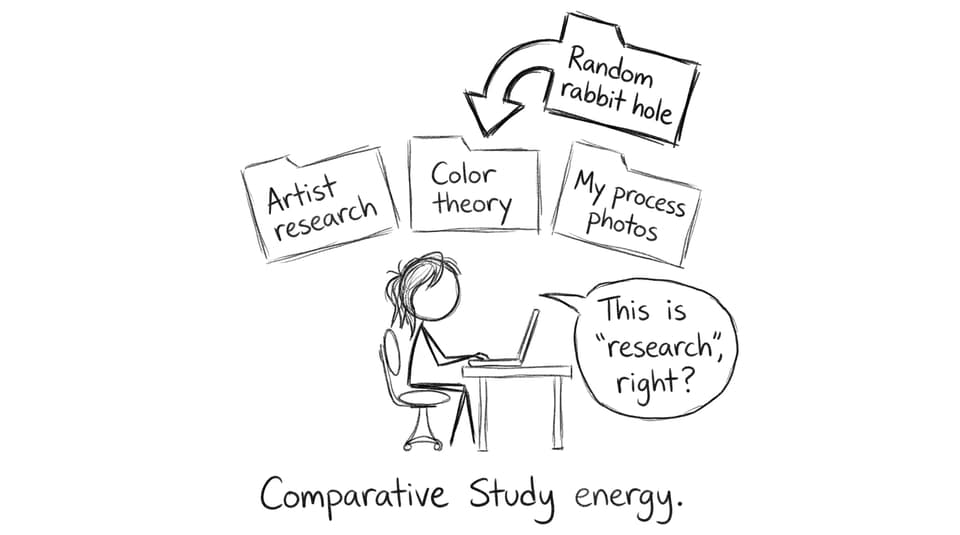
The Comparative Study is where IB Visual Arts students often overdo background research and underdo analysis.
Your goal is not to prove you read the entire internet. Your goal is to compare artworks through:
-
Formal qualities (line, color, composition, materials)
-
Function and purpose (what it’s trying to do)
-
Cultural context (why it looks like this there, then)
-
Connections to your own practice
A practical method:
-
Pick 3 works you genuinely want to talk about
-
Write a short “claim” about each one (one sentence)
-
Collect only the context that supports your claim
-
End each section with: “This influences my work by…”
Get feedback the way IB Visual Arts markers think
Feedback is not “Do you like it?” Feedback is “Which criterion am I not proving yet?”
Run a simple loop:
-
Identify the component (Comparative Study page, portfolio spread, exhibition selection)
-
Ask for two strengths and two changes tied to the rubric
-
Make the changes
-
Document what you changed and why (this is also marks)
For a step-by-step approach, use: How to Get Feedback on Your IB Group 6 Work.
How RevisionDojo helps you study IB Visual Arts (without killing creativity)
Even though IB Visual Arts isn’t a typical exam-heavy subject, you still need a system. RevisionDojo is built to make your system easier to run:
-
Study Notes to clarify art terminology and analysis frameworks quickly
-
Flashcards for elements/principles of art, movement characteristics, and vocabulary you reuse in writing
-
AI Chat to refine comparative claims, tighten reflections, and pressure-test your curatorial rationale
-
Grading tools to align writing with criteria language
-
Coursework Library via exemplars to model what high-mark evidence looks like
-
Tutors when you need targeted critique and planning
To connect your overall workload with realistic weekly time, see: How Many Hours a Week Should You Study for IB Group 6?.
If you’re also choosing or balancing arts subjects, these help:
Closing: make IB Visual Arts feel calm again
The students who do best in IB Visual Arts aren’t magically more talented. They just build a rhythm that creates proof: experiments, documentation, analysis, reflection, and feedback, on repeat.
If you want that rhythm in one place, RevisionDojo gives you the tools to keep moving: Study Notes and Flashcards for sharper language, AI Chat and Grading tools for stronger writing, a Coursework Library for models, plus Tutors when you need human eyes on your direction.
Treat IB Visual Arts like a long conversation with your own work. Keep the conversation going each week, and the final submission stops being a scramble; it becomes a record of growth.