
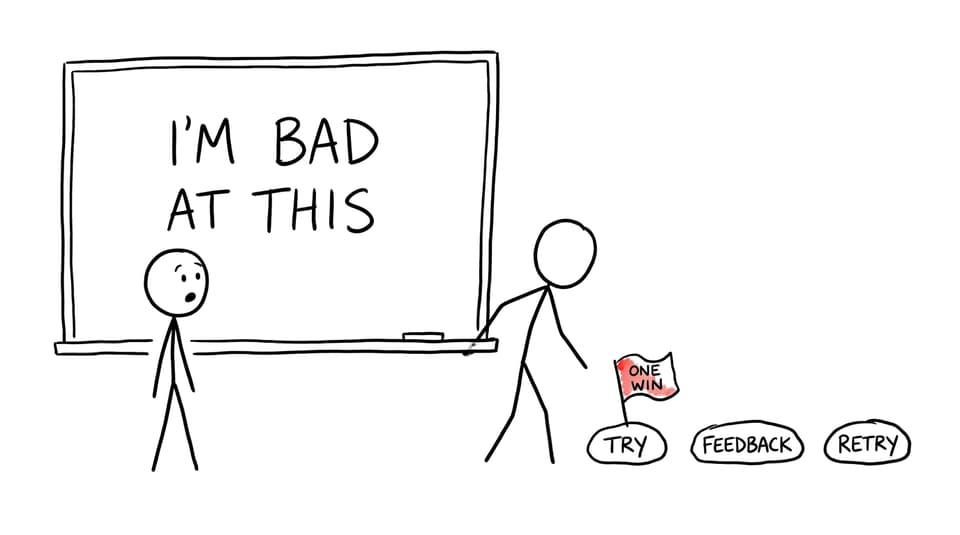
Picture a student receiving a marked response. Before reading your comments, they look at the grade and say, “I knew it. I’m just bad at this subject.”
The sentence sounds like a conclusion, but it is often a defence. If ability is fixed, further effort becomes unnecessary. The student no longer has to risk trying hard and still falling short.
Building student confidence in an IB subject therefore requires more than encouragement. Students need repeated evidence that a specific action can improve a specific result. The teacher’s task is to separate identity from current performance, reduce the emotional cost of mistakes, and create achievable mastery experiences.
The goal is a more accurate belief: “I cannot do this yet, but I know what to practise next.”
A practical confidence-building checklist
When a student has entrenched negative self-beliefs:
- Identify the exact task that triggers avoidance.
- Replace broad judgments with skill-specific language.
- Set a small challenge the student can genuinely complete.
- Give feedback on one controllable action.
- Require a short reattempt while feedback is fresh.
- Record improvement so progress becomes visible.
- Increase difficulty after the student has evidence of success.
Confidence should follow evidence, not precede it. RevisionDojo’s guide to building IB exam confidence applies the same principle through focused practice, diagnosis, and reattempts.
Building student confidence starts with diagnosis
“I’m bad at chemistry” is not a useful diagnosis. Neither is “I can’t write essays” or “maths makes no sense.” These statements compress several problems into one permanent identity.
Ask where the difficulty actually begins. Is it recalling content, interpreting a command term, selecting evidence, starting a calculation, structuring an argument, or working under time pressure?
A useful response is:
“Let’s leave the whole subject aside for a moment. Show me the first point where this task stops making sense.”
This makes the problem smaller and observable. It also avoids arguing with the student. Broad praise may feel supportive, but students often dismiss reassurance that conflicts with their experience.
Instead, validate the feeling without confirming the conclusion: “I can see why repeated difficulty has made you expect another difficult result. Let’s find the part we can change.” This distinction matters when students feel they are not good enough for IB.
Create credible mastery experiences
Academic self-efficacy is task-specific. A student may confidently interpret a graph but struggle to explain its implications. Another may understand a historical event yet freeze when asked to evaluate competing interpretations.
Broad encouragement rarely changes an entrenched belief. A successful experience must resemble the feared task closely enough to count as relevant evidence.
Use a three-stage confidence ladder:
- Supported attempt: Model the first step, provide a prompt, or remove time pressure.
- Partially independent attempt: Reduce scaffolding while keeping the task narrow.
- Independent transfer: Ask the student to apply the same skill in a new context.
If the first step is trivial, the student may dismiss success as meaningless. If it is too difficult, failure reinforces the original belief. The right starting point feels effortful but possible.
Make feedback describe a route
Students with low confidence often read every grade as information about who they are. Feedback should redirect attention toward decisions, strategies, and next steps.
Compare “You need more detail” with: “Your claim is relevant. Add one piece of evidence, then explain how it supports the claim.” The second comment identifies what works and provides an executable action. It does not lower the standard. It makes the route visible.
Where appropriate, delay the grade until students have processed comments. Ask them to mark one strength, identify one recurring error, and complete one correction. Feedback is most useful when it is timely, concrete, and forward-looking.
RevisionDojo’s teacher analytics and targeted revision guidance can help replace “revise more” with a narrower instruction focused on one topic, response type, or command term.
Use reattempts to challenge inevitability
Feedback without application leaves the grade as the end of the story. A reattempt changes the meaning of assessment. The first performance becomes a snapshot of understanding rather than proof of a fixed ceiling.
Keep reattempts short. Students might rewrite one paragraph, correct two calculations, strengthen one evaluation point, or answer a parallel question. Then ask what changed, which strategy produced the change, and where that strategy could be used again.
This prevents students from attributing improvement only to luck or teacher help. A productive loop is attempt, diagnose, practise, reattempt, reflect. The RevisionDojo Questionbank workflow for common IB mistakes supports focused correction without turning every intervention into a full assessment.
Make progress visible without comparison
Students with negative self-beliefs often remember old failures while overlooking recent improvement. A simple evidence log can correct this imbalance. Record the skill practised, first result, feedback applied, second result, and next target.
Track individual movement rather than class rank. Public comparison may intensify subject anxiety when students already believe their peers possess an ability they lack.
In RevisionDojo’s 2026 State of Learning Survey, 78.7% of surveyed students reported that their average subject grade rose, with a self-reported average increase of 0.57 points. These observational findings do not establish that RevisionDojo caused the reported changes. They reinforce a useful classroom principle: current performance is a measurement, not an identity.
Address subject anxiety before adding pressure
Anxiety can narrow attention. A student may understand a concept during discussion but struggle when timed, watched, or graded. Immediately adding more high-pressure practice can confirm the sense of threat.
Begin with low-stakes exposure. Use a 5-minute task, allow planning time, or let students answer privately before discussion. Once the routine becomes familiar, gradually introduce timing and more demanding conditions.
Teach students to name the task, write the first required action, complete that action, and check it against one criterion. The goal is not permanent protection from discomfort. It is experiencing manageable discomfort without interpreting it as incapacity.
If anxiety affects attendance, sleep, wellbeing, or daily functioning, follow school safeguarding and student-support procedures. Classroom strategies complement professional support; they do not replace it.
Build a classroom where mistakes stay useful
Teacher language quietly defines what errors mean. When only correct answers receive attention, uncertainty becomes something students hide. Instead, discuss an anonymous incorrect response. Ask what the writer understood, where the reasoning changed direction, and what revision would earn the next mark.
Model strategic adjustment too: “I’m checking the command term before planning,” or “This approach is inefficient, so I’m changing it.” Students then see correction as part of competent performance rather than evidence against it.
Use RevisionDojo to sustain the practice loop
Confidence-building works when the cycle is easy to repeat. RevisionDojo serves as the ultimate IB resource and a consistent home for that process.
Teachers can use the Questionbank to isolate a skill, Study Notes to repair knowledge gaps, and Flashcards to strengthen retrieval. AI Chat helps students turn confusion into precise questions, while Grading tools provide guidance teachers can contextualize.
Later, Predicted Papers and Mock Exams introduce fuller performance conditions. The Coursework Library clarifies successful work, while Tutors provide individualized human support. Explore RevisionDojo for IB teachers and departments and guidance on reliable syllabus-aligned IB resources to build a coherent classroom workflow.
Technology is not the confidence intervention by itself. The intervention is the sequence built around it: a reachable task, honest feedback, a meaningful reattempt, and visible evidence of change.
Confidence grows when identity becomes editable
A student rarely abandons “I’m bad at this” because an adult delivers the perfect speech. The belief weakens through accumulated contradictions: a paragraph improved, a calculation completed, or feedback successfully applied.
RevisionDojo brings that journey together, from explanation and supported practice to coursework guidance and realistic exam rehearsal. Students do not need to believe they are naturally gifted. They need credible evidence that their next action matters.