Even strong IB students lose marks in ways that feel almost insulting in hindsight: they knew the content, they revised, they cared, and then they misread one word and built an entire answer on the wrong task.
That’s the quiet tragedy of IB exams. They don’t only reward knowledge. They reward translation, the ability to convert a question into the exact shape of an answer the examiner is trained to reward.
For you, as an IB student preparing for exams, the best help a teacher can give isn’t another slide deck. It’s a set of habits that reduces avoidable mistakes when pressure rises. And the best part is that these habits are learnable, repeatable, and measurable.
Quick checklist: the teacher moves that prevent IB exam mistakes
If your teacher does these consistently (and you participate), your typical IB errors shrink fast:
-
Teach IB command terms like vocabulary, not like trivia.
-
Build “exam literacy” into normal lessons, not just revision week.
-
Run timed practice early enough that nerves become familiar.
-
Mark for patterns, then assign one specific fix per pattern.
-
Train pacing using marks as the clock.
-
Debrief every practice with a short reflection routine.
-
Use tools that make feedback immediate and targeted (not vague).
A lot of teachers organize this efficiently through RevisionDojo for Schools, especially when they want to track mistake patterns across a class.
Why IB students make “simple” exam mistakes
Most IB exam mistakes aren’t a content problem. They’re an execution problem.
Under time pressure, your brain tends to:
-
Skim instead of read (missing a qualifier like “to what extent”).
-
Default to a familiar answer shape (writing a narrative when the command term wants judgement).
-
Overwrite because you’re anxious, not because it earns marks.
-
Lose time without noticing, then panic-finish.
A good IB teacher trains you to notice these patterns before they cost marks. A great one helps you turn them into rules you can follow automatically.
Teach command terms like they’re the real syllabus
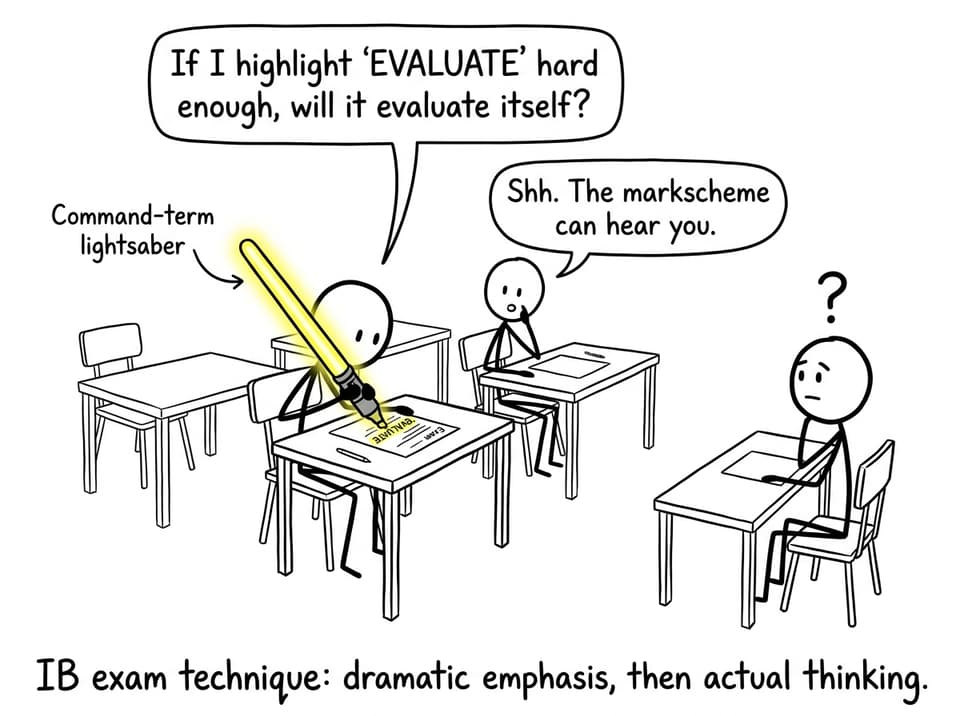
Command terms are the steering wheel of an IB question. If you don’t hold them tightly, you drift.
A teacher can help you avoid the most common IB mistake, answering the topic but not the task, by making command terms routine:
-
Start lessons with a 2-minute “verb translation”: What does “evaluate” force you to do?
-
Show two mini-answers to the same content: one that “explains,” one that “discusses.”
-
Make students rewrite questions by swapping command terms and predicting how the markscheme shifts.
If you want extra practice outside class, you can read The Importance of Understanding Command Terms in IB Exams and then test yourself by turning each command term into an “answer recipe.”
Teachers also often assign subject-specific command term refreshers, like IB Biology Command Terms for Exam Success, because the examples make the verbs feel real.
Make exam technique a normal classroom habit (not a last-minute panic)
The most helpful IB teachers treat exam technique like brushing your teeth: small, daily, non-dramatic.
Here are classroom routines that reliably reduce IB exam mistakes:
Read the question like an examiner
Teachers can model a 10-second scan:
-
Circle the command term.
-
Underline content boundaries (topic + context).
-
Box any constraints (number of examples, time period, “using the data”).
Then you copy the routine until it becomes muscle memory.
Plan before you write (even when it feels slow)
A simple 30-second plan prevents 10 minutes of wandering. Teachers can enforce this in timed practice by collecting only the plan first, then the full answer.
Use markschemes as a map, not a post-mortem
Instead of only looking at the markscheme after you finish, a teacher can show you how the markscheme “thinks”: what counts as distinct points, what qualifies as evaluation, what is just repetition.
For structured practice at home, RevisionDojo’s Questionbank helps you drill exam-style prompts and learn what the markscheme rewards through fast feedback loops.
Simulate real exam conditions so your nerves stop being a surprise
A timed IB simulation doesn’t just test knowledge. It tests state management.
Strong teachers simulate conditions in a way that trains your focus:
-
Exact timing (no “a bit longer because we’re learning”).
-
Silent room, minimal interruptions.
-
One pass through the paper (no pausing, no peeking at notes).
-
Immediate debrief: “Where did you lose time? Where did you misread?”
RevisionDojo supports that rehearsal mindset with Custom IB Mock Exams, so you can practise by topic and paper style rather than revising blindly.
Teach time management using marks as your pacing system
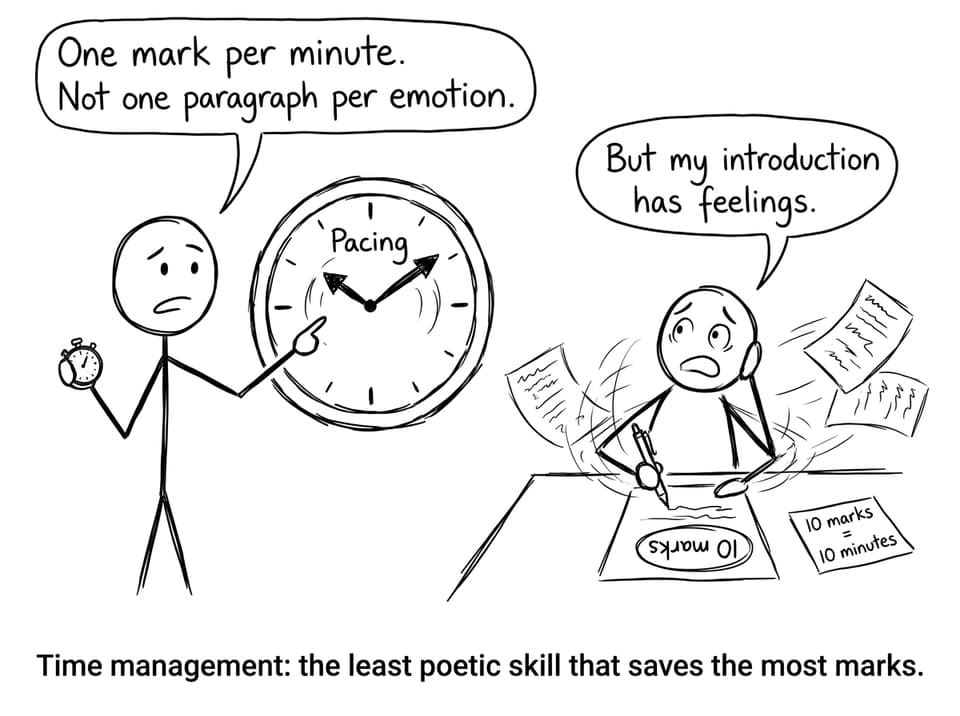
One of the most preventable IB mistakes is spending 25 minutes on a 10-mark question because you got emotionally attached to your introduction.
Good teachers make pacing concrete:
-
Convert marks to minutes (a simple default is 1 mark = 1 minute, adjusted per paper).
-
Set checkpoints: “By 30 minutes, you should be starting Question 3.”
-
Train “good enough” endings: a clear conclusion beats a half-finished masterpiece.
If you want a structured way to practise pacing with realistic full-paper layouts, IB Predicted Papers can help you rehearse timing and stamina in a format that feels like the real thing.
Turn mistakes into a repeatable feedback loop
Many IB students do practice, get a score, and move on. That’s comforting, but it’s not efficient.
The teacher move that changes everything is error categorization:
-
Was it a content gap (I didn’t know)?
-
A command-term mismatch (I knew, but answered the wrong task)?
-
A structure problem (I rambled, didn’t signpost, didn’t link back)?
-
A pacing issue (I ran out of time)?
Then comes the key: one mistake = one rule.
Example rules:
-
“If the command term is evaluate, I must include a judgement and a limitation.”
-
“If the question has two parts, I label A and B in my answer.”
-
“If it’s 12 marks, I need at least 4 distinct points with evidence.”
Teachers who want this to scale often use RevisionDojo for Schools to log patterns and assign targeted practice rather than re-teaching everything.
Use RevisionDojo as the bridge between teaching and independent practice
Your teacher can’t sit beside you for every revision session. But a good system can.
RevisionDojo is built to support IB exam improvement in the exact places students usually leak marks:
-
Study Notes for fast clarity when a concept is fuzzy (see Digital IB Study Notes You Can Access Anywhere).
-
Flashcards for daily recall that prevents blank-mind moments (use Flashcards).
-
Questionbank for volume practice with feedback (use Questionbank).
-
Predicted Papers and Mock Exams for timed simulation (start at IB Predicted Papers).
-
AI Chat and Grading tools to shorten the feedback loop when you’re stuck (explore IB Coursework Grader).
-
Coursework Library and Tutors when you need examples and human guidance (your teacher may point you to these inside the platform).
If you want the bigger picture of how these tools fit together for IB students preparing for exams, the workflow in RevisionDojo App: The Smarter Way to Prep for IB Exams is a solid reference.
FAQ
What should I ask my IB teacher to do if I keep losing marks on “easy” questions?
Ask for a short meeting that focuses only on patterns, not on your overall ability. Bring two or three recent responses and point to where you lost marks, then ask: “Is this a command-term issue, a structure issue, or a content gap?” A strong IB teacher will help you name the mistake category and create one concrete rule to follow next time. Then ask for one targeted practice set rather than “more revision.” You can make this even easier by drilling similar prompts in the RevisionDojo Questionbank and returning with the same category labels. Over time, you’ll notice the same few errors repeat, and that’s good news, because repeated errors are fixable.
How can IB teachers help with exam anxiety without turning everything into motivational talk?
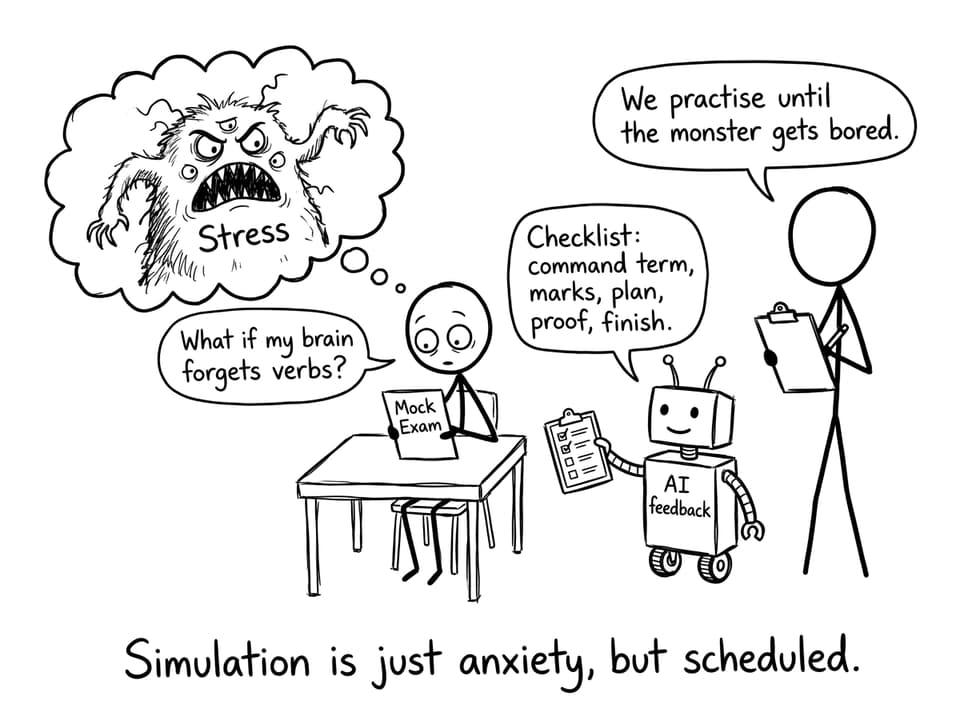
The best anxiety support in IB is procedural: making the exam feel familiar. Teachers can run short, timed drills often enough that your body stops treating the clock like a threat. They can also debrief calmly and focus on controllables: reading accuracy, pacing, and answer structure. When anxiety spikes, vague advice like “be confident” rarely helps, but a checklist does. That’s why timed simulations plus a consistent reflection routine tend to lower stress in a measurable way. If you’re revising alone, pairing timed practice with tools like Custom IB Mock Exams can recreate that structure at home.
What’s the fastest way to improve IB exam technique in the final weeks?
In the final weeks of IB prep, the highest return comes from tightening execution, not expanding notes. Ask your teacher for a “top 3 mistakes” diagnosis based on your recent work and focus on those only. Then run a loop: timed set, immediate review, write one rule per mistake, and repeat with a similar set. Use realistic full-paper practice to test pacing and stamina, but keep the review brutally specific. This is where tools like IB Predicted Papers can help you rehearse the feel of exam papers while still keeping the practice targeted. Finally, use Study Notes and Flashcards to patch only the content gaps that actually caused errors, not the ones that just feel comforting to reread.
Conclusion: the point isn’t perfection, it’s fewer unforced errors
The most frustrating IB exam mistakes are the ones that don’t reflect what you know. The good news is that they’re often “unforced errors,” and unforced errors respond well to training.
When IB teachers focus on command terms, pacing, simulation, and reflection, they don’t just teach content. They teach performance.
If you want that performance to keep improving between lessons, build your practice loop in RevisionDojo: learn quickly with Study Notes, retain with Flashcards, drill with the Questionbank, rehearse with Predicted Papers and Mock Exams, and shorten feedback with AI Chat, Grading tools, the Coursework Library, and Tutors. Your future self in the exam hall will feel the difference.