

The night every Teacher becomes a detective
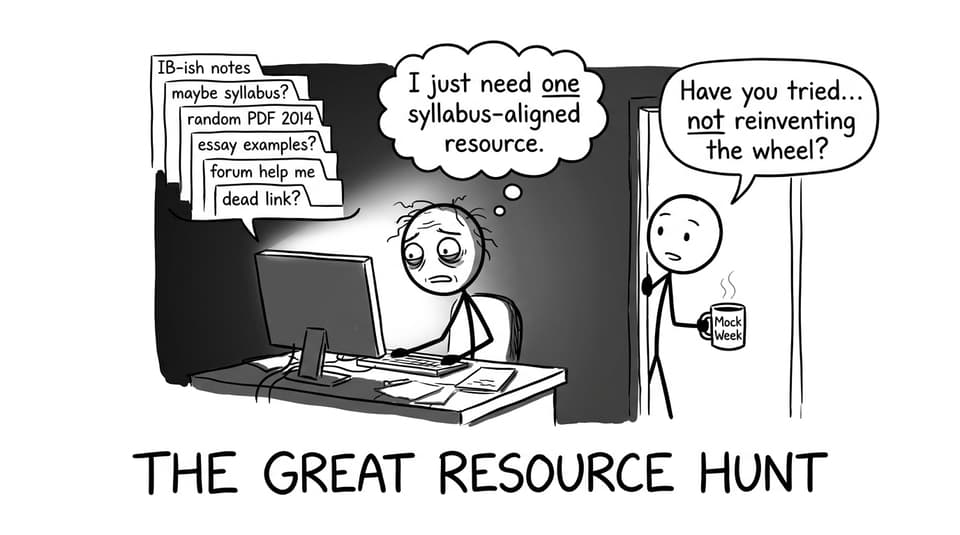
There’s a specific kind of IB anxiety that doesn’t show up on any rubric: the moment a Teacher realises the “helpful worksheet” they found online uses the wrong command terms, the wrong syllabus year, and a question style the IB simply doesn’t reward.
Students feel it too, even if they can’t name it. Revision starts to look like effort without direction: lots of pages, little progress. And the closer exams get, the more you want one thing: reliable, syllabus-aligned revision materials that match how the IB actually assesses.
That’s what this guide is for. You’re an IB student preparing for exams, but you can use the same checks your Teacher should use to protect your time and your grade.
A quick checklist your Teacher would trust
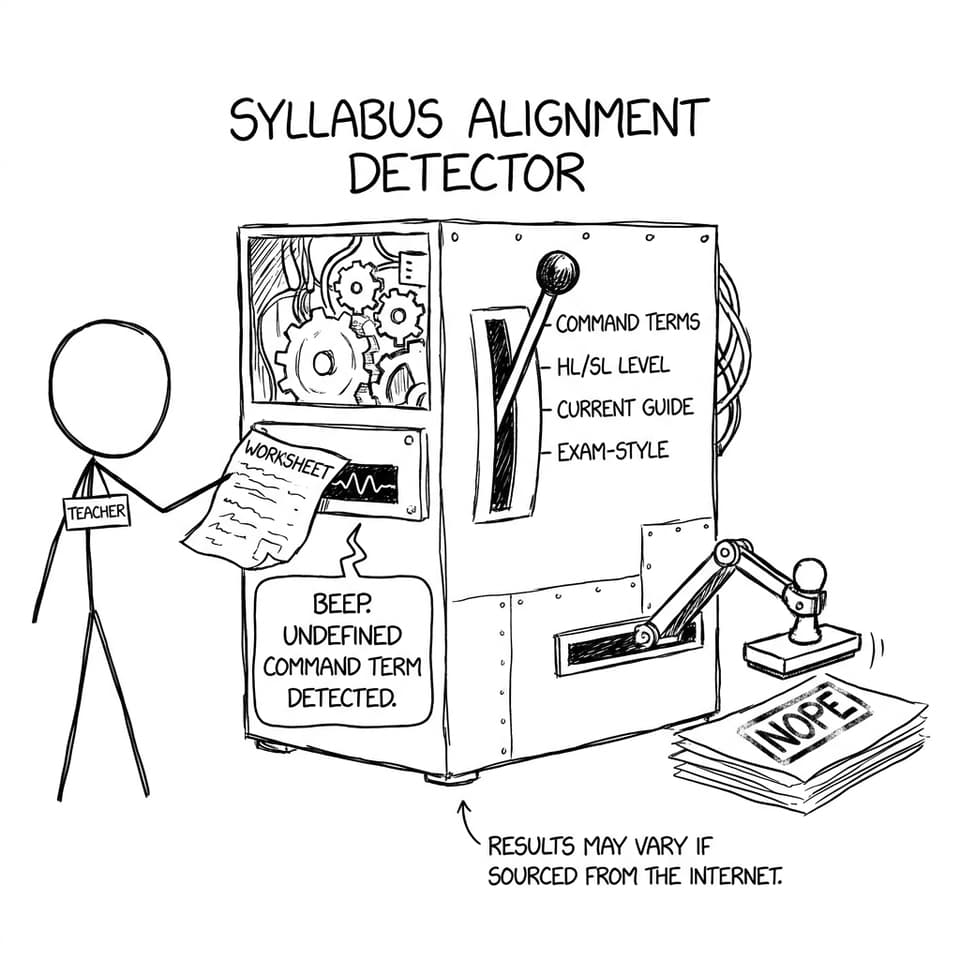
If your Teacher had 90 seconds to judge a resource, they’d look for signals that it was built for the IB (not “sort of academic”). Use this checklist before you commit to anything.
The five checks
-
Syllabus alignment: Is it mapped to the current subject guide and topic structure?
-
Command term accuracy: Do questions use the IB’s language (and does the mark logic match it)?
-
Paper-style realism: Does it resemble how you’ll be tested, not just what you’ll be tested on?
-
Level accuracy: SL and HL depth are not interchangeable.
-
Feedback quality: Do you get markscheme-style guidance that shows why points are earned or lost?
If a resource fails two of these, a good Teacher usually walks away. You should too.
Why “random good notes” fail in the IB
Most students assume revision materials fail because they’re “too hard” or “too long.” A Teacher sees a different problem: misalignment.
Misalignment wastes effort in quiet ways:
-
You practise the right topic in the wrong format.
-
You learn content but don’t learn the scoring method.
-
You memorise definitions without rehearsing application.
-
You write beautiful answers that don’t match the command term.
That’s why the best revision doesn’t start with motivation. It starts with materials a Teacher could defend with confidence.
What reliable, syllabus-aligned revision materials look like (in practice)
A strong Teacher resource isn’t just “accurate.” It’s structured so that practice produces measurable improvement.
Syllabus mapping that reduces panic
When materials are mapped by learning objective, you stop revising in the dark. That’s the design behind RevisionDojo for IB: one place to move from understanding to exam performance without constantly switching tools.
If you want the broad overview, start here: RevisionDojo for IB.
Questions that behave like the exam
A Teacher can tell within minutes whether questions are “exam-style” or just “topic-related.” The difference is the marking logic.
RevisionDojo’s Questionbank is built around that idea: high-volume practice with markscheme-calibrated feedback and filtering by what you actually need.
To use it like a top student (and the way a Teacher would set it), read: IB Question Bank | How to Use It Effectively.
How to turn your Teacher’s standards into your own revision system
Even if your Teacher is excellent, you still revise alone. The goal is to borrow the same structure a Teacher would build, then make it sustainable.
Use this 3-step loop (small, repeatable, exam-focused)
Learn (fast)
Use syllabus-aligned explanations as your “spine,” not a messy pile of tabs. RevisionDojo’s Study Notes are designed for exactly this: understand what’s examinable and what the IB tends to reward.
A useful companion read: IB Subject Note Collections: Comprehensive Study Materials.
Remember (daily)
A Teacher knows rereading feels productive and often isn’t. Retrieval beats recognition.
Use IB Flashcards with Spaced Repetition (SRS) to make memory automatic, then reinforce it with questions. If you want tactics, see: IB Flashcard System: Active Recall for Better Memory.
Apply (under feedback)
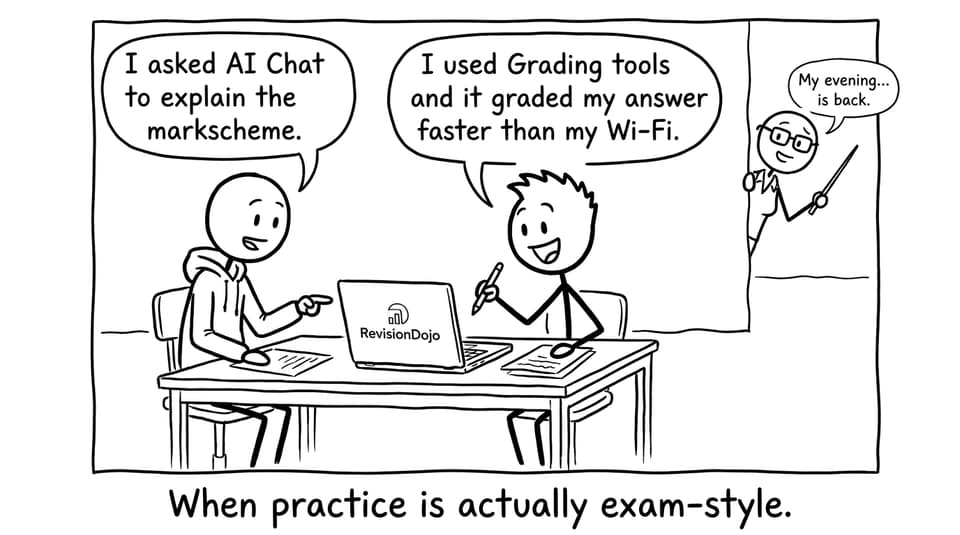
Finish with short, targeted practice. That’s where RevisionDojo’s AI Chat and Grading tools help: you get clarification and mark-aligned feedback while the mistake is still fresh.
To pull this into one routine, this helps: RevisionDojo App: The Smarter Way to Prep for IB Exams.
The Teacher question you should ask before trusting any resource
Ask: “If my Teacher saw my practice today, would they recognise it as IB preparation?”
If the answer is “maybe,” tighten your materials. If it’s “no,” switch immediately.
RevisionDojo also supports Mock Exams, Predicted Papers, a Coursework Library, and Tutors, which matters because the IB isn’t only content. It’s performance, criteria, and timing.
If your school is thinking bigger, this page shows the school-wide approach: RevisionDojo for Schools | Transform Your Exam Preparation. You can also skim: How IB Teachers Can Keep Lesson Resources Updated When the Syllabus Changes.
FAQ
How can I tell if my Teacher’s revision handouts are truly IB-aligned?
Start by checking the command terms and the marking logic. An IB-aligned handout doesn’t just ask you to “explain” or “discuss”; it guides you toward what earns marks for those terms. Next, check whether the questions resemble what your papers demand (short structured responses vs extended responses vs data analysis). Then look for level precision: HL materials should add depth, not just extra volume. Also notice whether the resource is organised by syllabus topics rather than textbook chapters, because those don’t always map cleanly. Finally, ask your Teacher which syllabus year the handout was built for, especially in transition periods.
What should I do if my Teacher uses multiple websites and I’m getting mixed messages?
Treat mixed messages as a signal to simplify your inputs. Pick one syllabus-aligned “home base” for notes, one place for spaced recall, and one place for exam-style practice. This is why many students use RevisionDojo as a single workflow: Study Notes to understand, Flashcards to retain, and Questionbank to apply. When you reduce sources, you also reduce contradictions in terminology and method. If you’re unsure, show your Teacher two examples and ask which one matches IB marking expectations. That short conversation can save you weeks of revision drift.
How does RevisionDojo help a Teacher without taking control away from students?
A good Teacher wants students to become independent, not dependent. RevisionDojo supports that by giving students structured materials that still require active work: attempting questions, reviewing feedback, and fixing patterns. The platform also reduces friction with tools like AI Chat for clarification and Grading tools for fast, criteria-aligned feedback loops. Meanwhile, students keep agency by choosing topics, filtering practice, and tracking weak areas. If your Teacher or school uses the schools dashboard, consistency improves across classes without making revision feel rigid. In other words, the system holds the structure, and the student supplies the effort.
Closing: borrow your Teacher’s filter, then revise with confidence
The most effective IB students quietly copy one habit from every great Teacher: they don’t trust materials just because they look polished. They trust what’s aligned.
If you want revision materials a Teacher would actually set: syllabus-mapped notes, exam-style questions, spaced repetition flashcards, plus AI Chat, Grading tools, Mock Exams, Predicted Papers, a Coursework Library, and Tutors in one place, build your routine on RevisionDojo.