
An IB coordinator network gives Diploma Programme coordinators something their own school cannot always provide: informed perspective from people carrying comparable responsibilities. Trusted peers can help test an interpretation, compare implementation approaches, identify risks earlier, and find solutions that have worked elsewhere.
Coordination can be isolating. You may connect students, teachers, parents, leaders, and the IB while having nobody inside the building who fully understands your role. External relationships do not replace official guidance or professional judgment. They make both easier to apply thoughtfully.
A simple IB coordinator network checklist
A practical network needs a few foundations:
- Three or four coordinators with compatible goals
- A regular meeting rhythm, such as monthly or half-termly
- An agenda shared before each meeting
- Clear confidentiality boundaries
- Concise action notes without sensitive details
- A balance between urgent problems and long-term improvement
- Occasional participation from subject or core leaders
The purpose is not to make every school operate identically. It is to make better decisions with a wider field of vision.
Why coordination becomes clearer across schools
Inside one school, familiar routines can begin to look inevitable. The calendar has always been arranged this way. Departments have always interpreted a process that way. A recurring difficulty gradually becomes part of the furniture.
Another coordinator can ask the useful question: why?
That perspective matters because another school may share the same IB framework while having different staffing, timetables, student needs, and leadership structures. Similarities make comparisons relevant. Differences make them revealing.
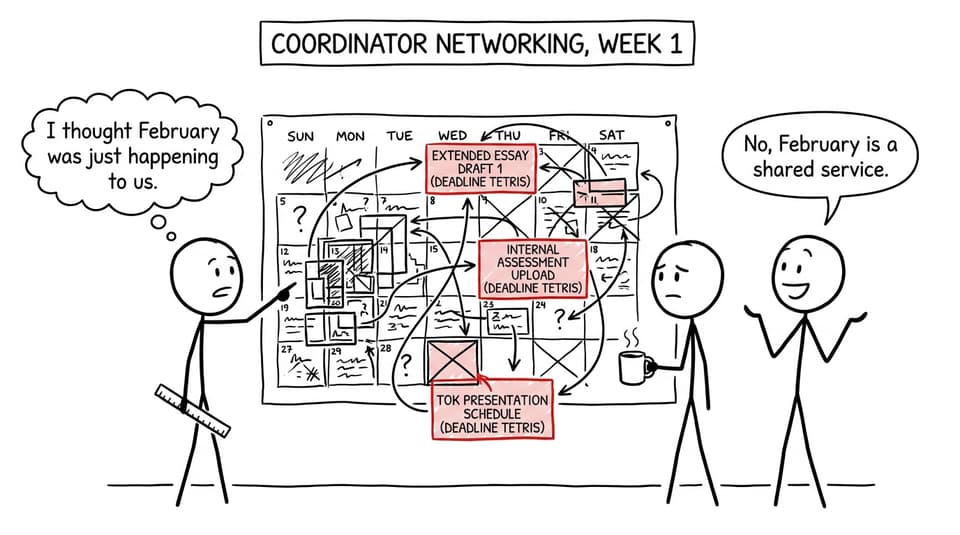
A conversation about internal deadlines, for example, might show that one school sequences major coursework checkpoints across departments while another allows deadlines to accumulate in the same fortnight. Neither calendar can simply be copied. Yet comparison turns an invisible workload problem into a design question.
Official IB professional learning includes collaborative environments and opportunities to exchange practice. A local coordinator network makes that professional exchange consistent and responsive to immediate needs.
Peer support improves coordinator judgment
Rules rarely create the hardest conversations. Interpretation does.
Documents may explain what must happen, but coordinators still decide how to communicate requirements, when to intervene, and how to build systems for their community. Peer support for IB coordinators provides a place to examine those decisions before they become policies or crises.
A strong peer conversation can help you:
- Separate an official requirement from a local habit
- Compare teacher induction and professional development
- Stress-test a calendar or communication plan
- Anticipate misunderstandings among students, families, or teachers
- Identify questions requiring IB or leadership guidance
- Recognize when a problem is systemic rather than individual
The network should never become an unofficial authority. For regulations or assessment procedures, coordinators must consult current official documentation and appropriate IB channels. Peers help you ask sharper questions and implement confirmed requirements effectively.
Other schools reveal problems earlier
Small warning signs are easy to rationalize when you see them alone. Several schools noticing the same pattern is different.
Suppose coordinators report students struggling with overlapping Extended Essay, Theory of Knowledge, and subject coursework milestones. That does not prove every school has the same cause. It does suggest inspecting workload mapping, student guidance, and departmental communication.
Comparison can improve assessment systems too. A coordinator might bring patterns from programme-wide progress tracking and ask whether peers see something similar. One school may identify weak command-term use, another inconsistent feedback, and a third insufficient timed practice. The aim is not benchmarking for its own sake. It is earlier diagnosis.
A network expands what one coordinator can build
Good networks gradually move beyond advice. Coordinators can compare annual calendars, create non-confidential induction checklists, exchange parent-session formats, or arrange conversations between subject teachers. Nearby schools might coordinate professional learning or discuss programme evaluation approaches.
This gives teachers access to a wider community. A coordinator can connect a new Biology teacher with an experienced counterpart or introduce core teams facing similar supervision challenges. The coordinator becomes less of a bottleneck and more of a bridge.
External learning should strengthen internal collaboration. RevisionDojo's guide to building collaborative IB departments shows how shared routines make collaboration visible, while its guidance on streamlining collaborative planning helps convert discussion into repeatable workflows.
Build the network around useful work
Professional groups often fade when they begin with enthusiasm but no specific job. Start with a shared problem such as coordinator induction, calendar design, DP transition, department alignment, or programme evaluation. Ask each member to bring one question, one useful practice, and one uncertainty.
A focused 45-minute meeting might include brief school updates, one preselected problem, comparison of current approaches, a check against official guidance, and one action per participant.
Rotate facilitation so the network does not depend on one person. Keep notes concise and revisit actions before introducing another topic. Consistency creates trust, and trust makes honest conversations possible.
Choose membership thoughtfully. Nearby schools can compare local calendars and training opportunities. Similar cohort sizes may produce shared operational challenges, while different contexts can challenge assumptions. The strongest group usually has enough similarity for relevance and enough difference for insight.
Protect trust with clear boundaries
Coordinators handle sensitive information, so explicit limits are essential. Do not share identifiable student details, confidential personnel matters, protected assessment content, credentials, or restricted documents. Use anonymized scenarios. Safeguarding, legal duties, formal complaints, and official rulings belong in proper institutional channels.
Commercial resources require local evaluation too. Peers can compare experiences, but each school must review syllabus alignment, privacy, accessibility, and policy.
The school guide for IB coordinators and RevisionDojo for Schools help leaders examine how the Questionbank, Study Notes, Flashcards, AI Chat, Grading tools, Predicted Papers, Mock Exams, Coursework Library, and Tutors fit their programme.
Turn shared insight into local improvement
A network conversation matters only when something changes locally. After each meeting, turn one insight into a small test. A school might use RevisionDojo's Questionbank for a common diagnostic, assign focused Study Notes and Flashcards, and use AI Chat or Grading tools to support feedback. Mock Exams and Predicted Papers can later test application under timed conditions.
Review the resulting patterns through a disciplined cycle. The guide to data-informed IB school improvement offers a clear model: diagnose, act, review, and adjust.
Coordination is stronger when shared
A dependable IB coordinator network creates space to think before acting. It provides perspective without demanding uniformity, and support without weakening accountability.
RevisionDojo helps turn those professional conversations into coherent student support. Through connected resources, assessment practice, analytics, coursework guidance, and teacher workflows, it gives coordinators the ultimate IB resource for moving from a promising idea shared across schools to an improvement students can experience.