


The quiet moment when IB feels bigger than you
In most IB schools, there’s a familiar scene a few months before exams.
A student says, “I’m revising… I think,” while staring at an ocean of tabs. A teacher is trying to standardize feedback across classes. And somewhere nearby, an IB coordinator is holding the whole thing together with a spreadsheet, a meeting schedule, and a kind of optimism that deserves an award.
The real challenge usually isn’t effort. It’s signal.
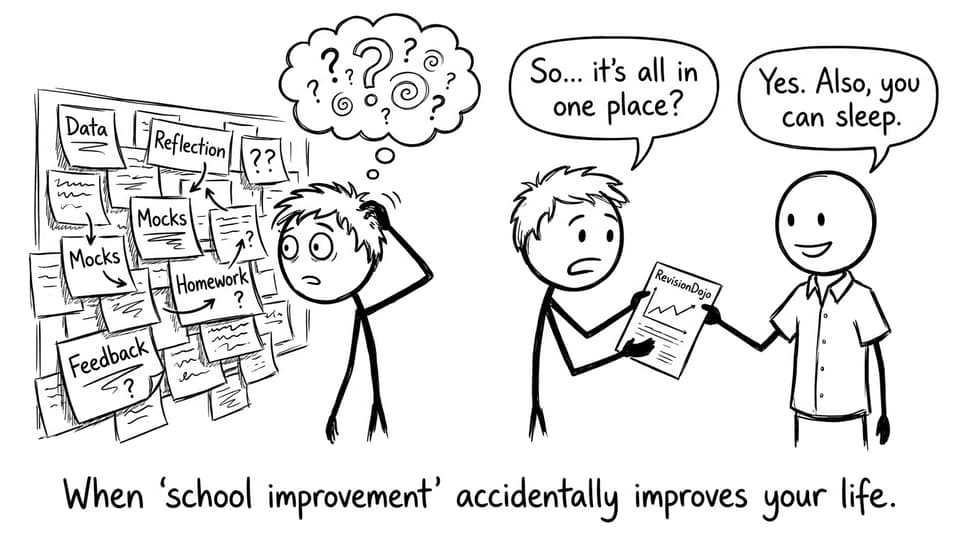
When data is scattered (or delayed), school improvement turns into a guessing game. Students get generic advice. Departments drift apart. Leaders spend time collecting evidence instead of acting on it.
RevisionDojo changes that, especially when coordinators use it as the connective tissue of the IB programme. Through dashboards, analytics, and consistent practice workflows, RevisionDojo helps IB coordinators lead data-informed school improvement that students actually feel day to day: clearer targets, better feedback, and smarter revision.
A quick checklist: what “data-informed” should mean for IB students
If your school is doing data-informed improvement well, you should notice these outcomes within a few weeks, not a year:
-
You know which IB topics to prioritize (not just “revise more”).
-
You understand why you lost marks, using patterns, not vibes.
-
Your class assessments feel more consistent across teachers.
-
Reflection turns into action (specific next steps), not a journal exercise.
-
Timed practice becomes normal, and feedback comes back faster.
This is exactly the kind of system RevisionDojo supports through RevisionDojo for Schools, while still giving IB students the tools they use most: Questionbank, Study Notes, Flashcards, AI Chat, Grading tools, Predicted Papers, Mock Exams, Coursework Library, and Tutors.
Why IB coordinators obsess over visibility (and why you should care)
Most IB students only see the “front of house”: lessons, deadlines, internal assessments, exam prep.
Coordinators see the “back of house”: alignment, consistency, evidence, and whether learning is improving across cohorts.
When that visibility is weak, a school can work extremely hard and still move slowly. The most common bottlenecks look like this:
-
Assessment misalignment: two classes do the same task, but marks mean different things.
-
Patchy practice habits: some groups do frequent timed practice, others don’t.
-
Unclear skill gaps: students struggle with the same IB command terms repeatedly (analyze, evaluate, discuss) without targeted training.
-
Reflection without traction: lots of “I need to improve” with no measurable follow-through.
RevisionDojo’s analytics help turn those bottlenecks into visible, fixable systems. And when coordinators can see the system clearly, students get a calmer IB experience: more consistency and fewer surprises.
To understand the wider picture of how this works at school level, see How IB Schools Can Use RevisionDojo to Streamline Exam Preparation.
Whole-school dashboards: the overlooked way your IB revision gets better
From a student perspective, “dashboards” can sound like something for adults in meetings.
But here’s the truth: when coordinators have whole-school analytics, your daily revision gets better because teaching gets sharper.
With coordinator-level visibility, leaders can spot patterns like:
-
A year group is consistently weaker on one paper style or skill cluster.
-
One department has strong improvement routines worth copying.
-
Students are over-performing in low-stakes homework but under-performing in timed conditions.
Then those insights become interventions you can actually feel:
-
targeted practice blocks
-
clearer revision priorities
-
more aligned feedback language
-
better pacing guidance for timed work
RevisionDojo supports this across practice and performance loops, including Questionbank assignments, Mock Exams, and analytics-driven next steps.
If you want the student-level version of that system, start with RevisionDojo App: The Smarter Way to Prep for IB Exams.
IB improvement is often a command-term problem (not a content problem)
A lot of IB underperformance is not “I didn’t study.”
It’s “I answered the wrong question.”
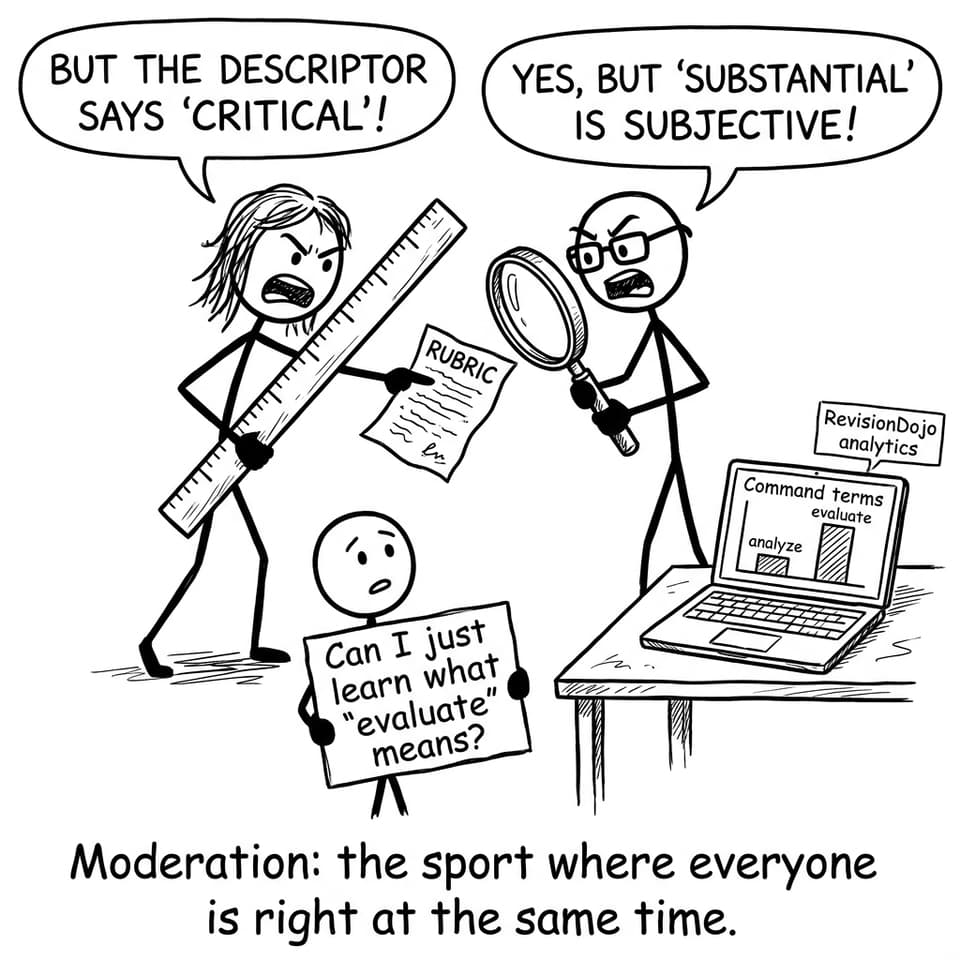
That mistake usually lives inside command terms. Students write a definition when the question asked for evaluation. They describe a process when the question demanded analysis. They include facts but miss the decision-making.
RevisionDojo analytics can surface these patterns at scale. And once a coordinator can see them across subjects, the school can respond coherently:
-
Departments align on what “evaluate” should look like in student writing.
-
Teachers build shared mini-rubrics and practice routines.
-
Students get consistent feedback language across their IB subjects.
This is one reason RevisionDojo’s practice ecosystem matters: students can move from understanding (Study Notes) to retention (Flashcards) to application (Questionbank) to realism (Mock Exams and Predicted Papers), while coordinators monitor whether those routines are actually working.
How RevisionDojo turns coordinator insights into student advantage
Data-informed IB improvement starts with better practice (not bigger workloads)
The best school improvement doesn’t add more tasks. It removes waste.
When RevisionDojo is used well, coordinators can help departments build a simple loop:
-
Diagnose gaps using analytics
-
Assign targeted practice (Questionbank sets, timed sessions)
-
Support learning with Study Notes and AI Chat
-
Reinforce memory with Flashcards
-
Measure improvement with repeated, comparable practice
Students experience this as relief: fewer random resources, more intentional repetition.
If you want to make your own revision more “data-informed,” learn the student-facing method in IB Question Bank | How to Use It Effectively and the feature hub at Questionbank.
Reflection tracking that actually improves your marks
Reflection in IB can feel like polite paperwork.
But reflection becomes powerful when it is connected to evidence: what you attempted, what went wrong, what changed, what improved.
RevisionDojo supports this at school level through reflection visibility and at student level through analytics, feedback, and reattempt loops. Coordinators can identify whether reflection habits are:
-
happening consistently across departments
-
linked to specific skills (like essay structure, data analysis, or evaluation)
-
producing measurable improvement over time
That’s how “reflection” becomes “I stopped losing marks for the same reason.”
For a broader view of how schools and teachers use these insights, read Empowering Teachers With RevisionDojo’s Analytics and Insights.
Consistency across departments (the hidden IB superpower)
A student’s biggest advantage is not motivation. It’s consistency.
When your English feedback and your Biology feedback teach the same logic (what counts as analysis, what counts as evaluation, how to show reasoning), you get better faster.
RevisionDojo supports that consistency by giving coordinators and department heads shared visibility and shared tools.
Explore that whole-school alignment here:
-
How RevisionDojo Strengthens IB Department Collaboration and Consistency
-
Enhancing IB Teacher Collaboration Through RevisionDojo Insights
A student-friendly case example: what data-informed improvement looks like
Imagine this happens mid-year:
A coordinator notices that one cohort is struggling in timed responses across multiple IB subjects. Not content. Timing and structure.
Instead of sending a generic “revise harder” message, they use RevisionDojo to coordinate a consistent response:
-
Departments run short timed practice blocks weekly.
-
Students use Questionbank for targeted drills between timed sessions.
-
Teachers use Grading tools to return clearer, criterion-aligned feedback faster.
-
Tutors are offered to students whose analytics show persistent gaps.
Within a few weeks, the cohort isn’t magically perfect. But the panic drops. Students can finish more questions. Feedback gets more specific. Improvement becomes visible.
That’s what data-informed IB improvement is supposed to feel like: not surveillance, but support.
What you can do as an IB student (even if you’re not the coordinator)
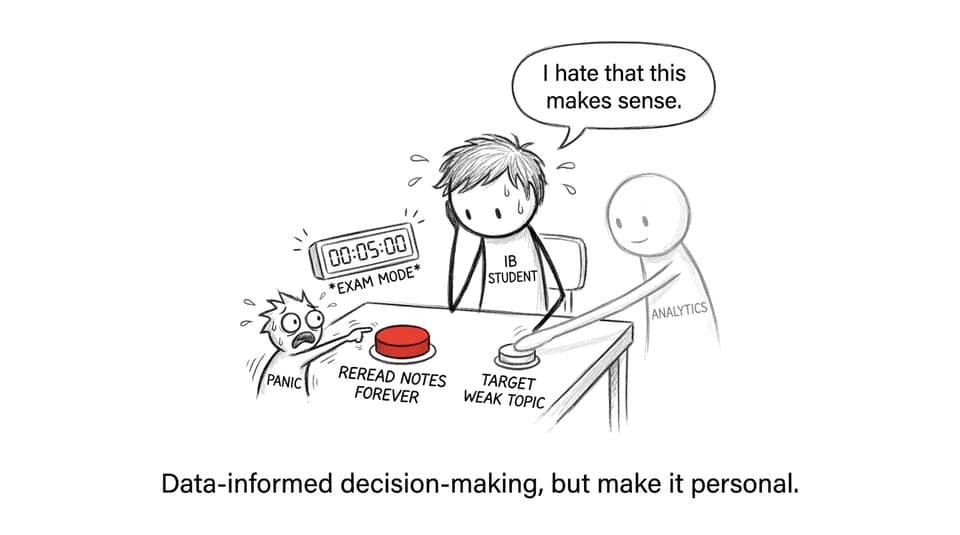
You can benefit from school-level improvement, but you can also create your own “mini dashboard” mindset:
-
Use RevisionDojo for IB as your default study home.
-
Build daily recall with IB Flashcards with Spaced Repetition (SRS).
-
Learn faster with IB Subject Note Collections: Comprehensive Study Materials.
-
Train exam realism using IB Predicted vs Specimen Papers: What They Mean.
-
If your school is using RevisionDojo, ask teachers what analytics trends they’re seeing and what one change would help you most this week.
This is how you turn “data-informed” into “I know what to do next.”
Frequently asked questions
How does coordinator-level data help me as an IB student preparing for exams?
Coordinator-level data helps because it changes what your teachers do with their time and attention. When an IB coordinator can see patterns across classes and subjects, interventions become more precise. Instead of each teacher solving problems in isolation, the school can align on shared weak points like command terms, timed writing, or topic gaps. That alignment usually leads to more consistent homework, more comparable timed practice, and clearer feedback language. For you, that means your revision becomes less scattered and more predictable. Over time, predictable systems reduce stress and raise performance.
Will RevisionDojo replace my teachers or make IB feel more automated?
No, and it works best when it does the opposite. RevisionDojo is designed to remove the repetitive, low-value work that slows feedback loops: manual marking, disconnected tracking, and resource hunting. That frees teachers and coordinators to do the human part better: explain, coach, motivate, and design better lessons. In the IB, the difference between a 5 and a 7 is often interpretation, structure, and decision-making under time pressure. Those are deeply human skills, but they improve faster when feedback is timely and consistent. RevisionDojo supports that consistency through analytics, practice tools, and clear routines. The result should feel less like automation and more like support.
If my school uses RevisionDojo for improvement, how should I use it day to day for IB revision?
Use it as a loop, not a library. Start with Study Notes to understand one specific topic, then create or review Flashcards to lock in the core facts and definitions. Next, do a short Questionbank set on that exact topic and review every mistake immediately, noting the pattern (misread command term, missing step, weak justification). If your subject supports it, add a timed block with Mock Exams or Predicted Papers to build pacing and stamina. When you get stuck, use AI Chat to clarify quickly rather than losing an hour. Finally, revisit the same weakness 24-48 hours later to confirm the fix holds. This is the simplest way to make your IB revision measurable.
Closing: IB improvement that you can actually feel
The best IB schools don’t just demand more from students. They build clearer systems.
When RevisionDojo helps IB coordinators lead data-informed school improvement, the benefits show up where you live: in your weekly practice, in the feedback you receive, and in how confidently you walk into timed sessions.
If you’re an IB student preparing for exams, don’t wait for motivation or perfect conditions. Use the tools that turn effort into signal: Questionbank, Study Notes, Flashcards, AI Chat, Grading tools, Predicted Papers, Mock Exams, Coursework Library, and Tutors.
Start at the center: RevisionDojo and, if your school is exploring cohort-level improvement, share RevisionDojo for Schools with your coordinator.