


The week you notice it, you can’t unsee it.
Two teachers explain the same idea in two different ways. One says “evaluate,” the other says “discuss,” and you spend ten minutes wondering which verb actually earns marks. Your class gets one style of feedback, your friend in the other class gets another, and suddenly your IB prep feels like guessing the rules of a game while the timer is already running.
Most students assume this is normal. It isn’t. It’s simply what happens when collaborative planning is hard.
And it’s exactly where RevisionDojo’s teacher tools matter to you as an IB student preparing for exams. When departments can plan together using shared dashboards, common resources, and consistent grading workflows, your revision becomes cleaner: clearer targets, tighter feedback, fewer surprises.
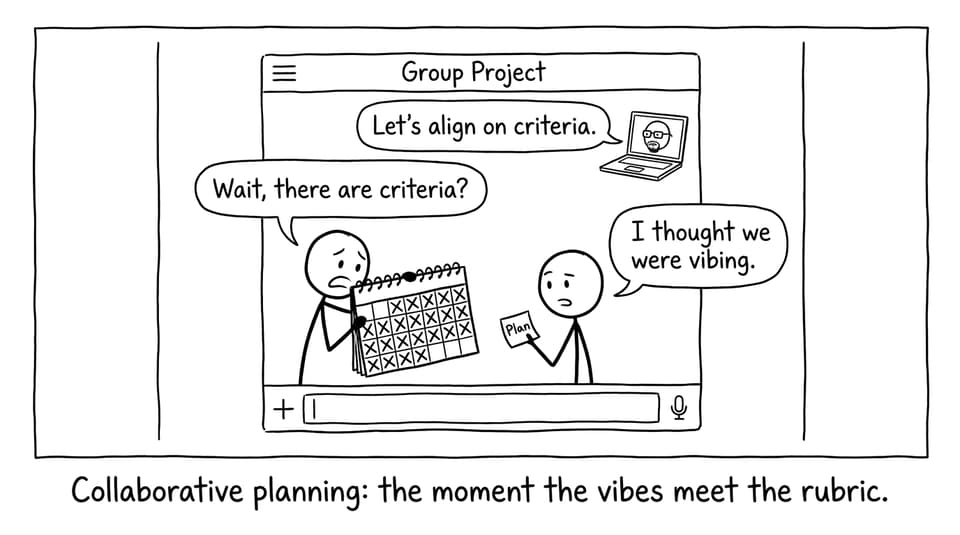
The student-facing payoff of collaborative planning in IB
From the outside, “teacher collaboration” can sound like something that benefits teachers and coordinators, but not you. In practice, it changes the daily texture of your IB experience.
When collaborative planning is streamlined, you tend to get:
-
Consistent expectations across classes (especially for command terms and criteria)
-
Faster, more usable feedback because teachers share templates and moderation habits
-
Better-aligned practice (topic sequences, difficulty, and exam-style emphasis)
-
Less duplicate work (fewer repeated tasks that don’t move your grade)
-
Stronger cross-subject skills (writing, analysis, data interpretation) reinforced everywhere
RevisionDojo supports this by connecting what teachers see (analytics, progress patterns, marking consistency) to what you do (Questionbank practice, Study Notes, Flashcards, AI Chat, Grading tools, Predicted Papers, Mock Exams, Coursework Library, and Tutors).
If your school is using the platform through RevisionDojo for Schools, the behind-the-scenes planning becomes more “in the open” for you: expectations get clearer because the system makes evidence shareable.
Quick checklist: what to ask your teachers to do (so you benefit)
If you’re an IB student, you can’t run department meetings. But you can nudge the process with smart requests.
-
Ask if your teachers use a shared cohort dashboard to track weaknesses
-
Ask for a common feedback language tied to criteria (not just general comments)
-
Ask if your department standardizes practice using topic-tagged question sets
-
Ask whether timed practice is aligned (same skills, same expectations) across classes
-
Ask for a clear “this week’s focus” list based on class analytics
You’re not being demanding. You’re being precise. Precision is an IB advantage.
How RevisionDojo’s teacher tools streamline IB collaborative planning
Collaborative planning usually fails for a simple reason: good intentions, scattered information. Notes in one place, marks in another, resources in someone’s drive, and “what students struggle with” living only in vague memory.
RevisionDojo turns that into shared visibility and shared action.
Shared dashboards: one truth, not ten opinions
In many IB departments, teachers already suspect what students find hard. The issue is proving it, quickly enough to do something about it.
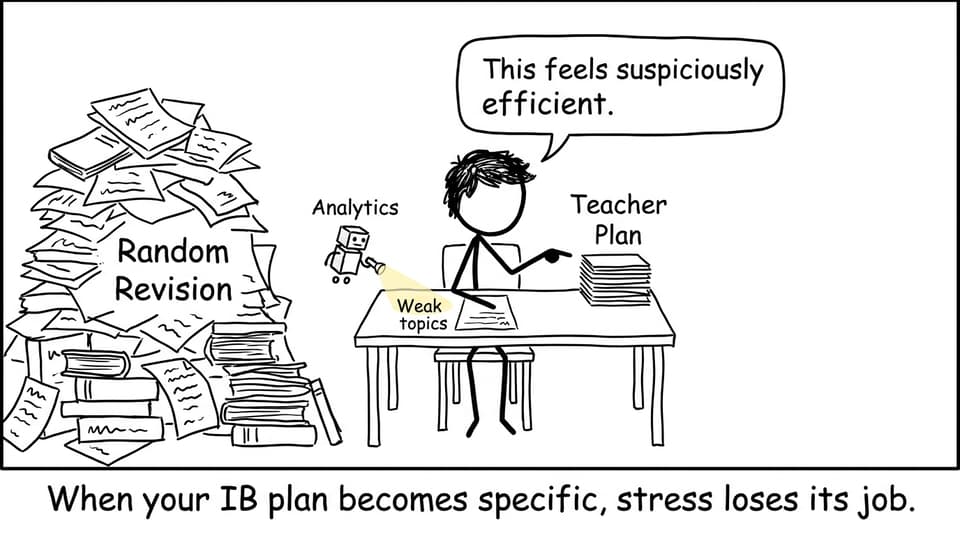
With RevisionDojo, teachers can use shared analytics views to spot patterns across classes and year groups: the same command term mistakes, the same topic gaps, the same timing problems. That’s the difference between “revise more” and “revise this.”
If you want to see how this becomes a practical workflow, this companion read is useful: Empowering Teachers with RevisionDojo’s Analytics and Insights.
As a student, you feel the effect when teachers start saying things like:
-
“Most of the cohort is losing marks on evaluation, so we’re targeting that.”
-
“We’re seeing the same error pattern in this topic, so we’re reteaching it differently.”
That’s IB prep moving from intuition to evidence.
Common resource libraries: consistency without copying
A department that collaborates well has a quiet superpower: students in different classes get the same baseline quality of materials.
RevisionDojo supports that shared-resource approach by tying learning and practice into a consistent ecosystem:
-
Study Notes for clean explanations (so teachers don’t reinvent notes in five versions)
-
Questionbank practice sets that can be aligned by topic and difficulty
-
Flashcards that keep recall active without adding more “homework”
For student-side examples of these tools, explore:
When teachers share a common resource spine, your IB workload becomes less chaotic. You stop wasting time hunting for “the right version” of the same concept.
Moderation and grading alignment: fairness you can trust
Nothing shakes an IB student’s confidence faster than inconsistent marking. Not because you need perfection, but because you need a stable target.
RevisionDojo’s teacher workflows can support moderation: common rubrics, comparable marking patterns, and the ability to review assessment trends across a department. The student impact is subtle but huge: feedback becomes predictable in the best way.
If you want to understand this angle, these internal reads connect well:
-
How RevisionDojo Enhances IB Internal Assessment (IA) Feedback and Moderation
-
Using RevisionDojo to Standardize Internal Assessments Across Departments
Even if you’re focused on final exams, consistent grading shapes how you practice. It tells you which habits earn marks and which habits only feel productive.
Teacher communication and reflection: fewer meetings, better decisions
A lot of collaborative planning fails because it’s scheduled too rarely. The department meets, talks broadly, and then everyone returns to daily teaching. By the time you meet again, the moment has passed.
RevisionDojo’s collaboration features help make planning continuous: teachers can leave notes, reflect on patterns, and align interventions around what the data actually shows. The goal isn’t more admin. It’s fewer “we should probably…” conversations and more “we’re doing this next week.”
As a student, you notice this when:
-
the same skill is reinforced across different teachers,
-
the same vocabulary and command terms keep showing up,
-
practice tasks feel intentionally sequenced rather than random.
That is streamlined IB planning in disguise.
Whole-school alignment: cross-subject skills stop being accidental
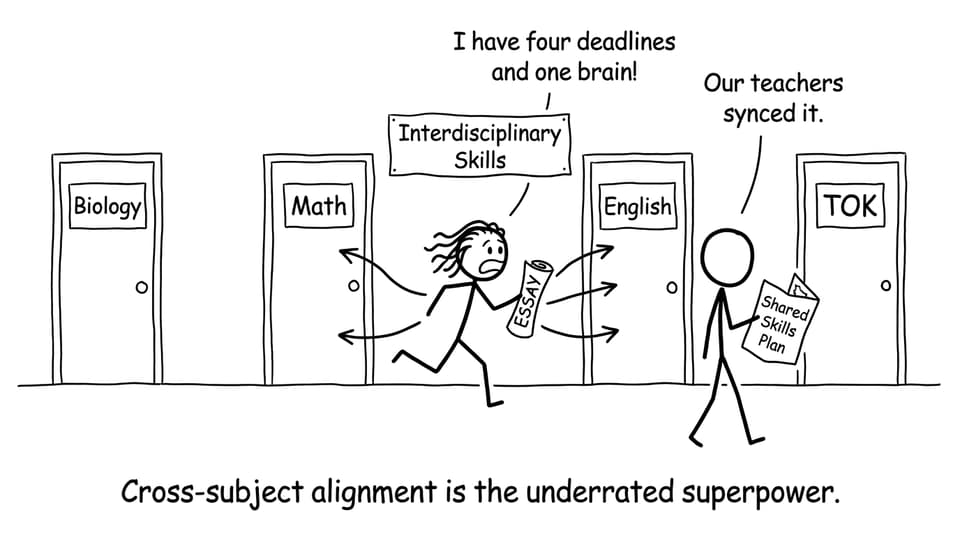
Some of the biggest IB improvements don’t come from learning more content. They come from transferring one skill across subjects: analysis, structure, evaluation, data interpretation.
When coordinators can see progress across departments, it becomes easier for a school to align those skills. For example:
-
TOK and English aligning on argument clarity
-
Sciences and Math aligning on data handling and interpretation
-
Humanities aligning on evaluation and evidence use
RevisionDojo’s ecosystem makes this easier because teachers are working from shared evidence and shared routines, not isolated impressions.
If you want the bigger picture of how this becomes a whole-school system, see: Why RevisionDojo Is the Smartest Choice for Whole School IB Revision.
The “collaboration loop” you can use as an IB student
Here’s a practical way to benefit from teacher collaboration even if you’re not in the room when it happens.
Ask for one target, not ten
When teachers have shared analytics, they can usually identify one or two high-leverage weaknesses for the cohort. Ask:
- “What is the one skill most people are losing marks on right now?”
Then build your week around that.
Turn the target into practice, feedback, and re-test
Use RevisionDojo like a loop:
-
Clarify with Study Notes (fast understanding)
-
Drill with Questionbank (high-quality repetition)
-
Lock it in with Flashcards (spaced repetition)
-
Unblock confusion with AI Chat (quick questions when you’re stuck)
-
Rehearse with Predicted Papers and Mock Exams (timing and stamina)
-
Improve written work with Grading tools and examples via the Coursework Library
-
Use Tutors when you need a human to diagnose what’s holding you back
For a student-oriented walkthrough of this workflow, this is a helpful reference: RevisionDojo App: The Smarter Way to Prep for IB Exams.
Bring evidence back to your teachers
The secret to making collaborative planning help you personally is simple: show your patterns.
If you can say, “I keep missing evaluation marks in these question types,” you make it easier for teachers to coordinate support. Your own clarity accelerates the department’s clarity. That’s an IB advantage most people ignore.
Conclusion: IB students don’t need more effort, they need more alignment
Most IB stress isn’t caused by hard content. It’s caused by unclear targets.
When teachers collaborate well, targets become sharper. Feedback becomes consistent. Practice becomes purposeful. And your time starts compounding instead of leaking away.
RevisionDojo’s teacher tools help schools turn collaborative planning into something real: shared dashboards, aligned resources, moderation workflows, and a student-facing ecosystem that actually supports exam performance through Questionbank, Study Notes, Flashcards, AI Chat, Grading tools, Predicted Papers, Mock Exams, Coursework Library, and Tutors.
If your school wants a smoother, more consistent IB experience for students preparing for exams, point them to RevisionDojo for Schools. Your future self will feel the difference in the quietest way: fewer surprises, more control, better results.