


Confidence in MYP Individuals and Societies does not come from knowing every date, definition, or case study. It grows when you understand what a task requires, attempt it, receive useful feedback, and notice that your next answer is better.
For most students, building confidence in MYP Individuals and Societies means becoming comfortable with four areas: knowing and understanding, investigating, communicating, and thinking critically. These correspond to Criteria A, B, C, and D. Instead of treating the subject as one enormous test of intelligence, you can train each area separately.
A quick confidence-building checklist
Before your next study session, choose one small target:
- Identify the criterion being assessed
- Translate the command term into an action
- Review only the knowledge needed for the task
- Complete one short response without assistance
- Compare your answer with the criteria or feedback
- Rewrite one weak section
- Record one improvement you can repeat
Understand what success actually looks like
MYP Individuals and Societies can feel uncertain because it combines content with research, communication, and critical thinking. The four criteria make that uncertainty more manageable:
| Criterion | What you are learning to do |
|---|---|
| A: Knowing and understanding | Use relevant terminology and explain concepts with accurate examples |
| B: Investigating | Develop a focused question, follow a research process, and reflect on it |
| C: Communicating | Organize ideas for the required audience, purpose, and format while documenting sources |
| D: Thinking critically | Analyse evidence, develop supported arguments, and consider perspectives |
Read the task-specific rubric before beginning an assignment. Circle the verbs and turn them into visible actions. If the descriptor expects different perspectives, your response must do more than mention disagreement. It should explain who holds each perspective, why they hold it, and what the implications are.
The MYP Individuals and Societies criteria guide can help you translate broad descriptors into practical choices.
Replace vague revision with small proof
Rereading an entire chapter may leave you unsure whether anything changed. Learning three terms, answering one question, and improving one paragraph after feedback creates visible proof of progress.
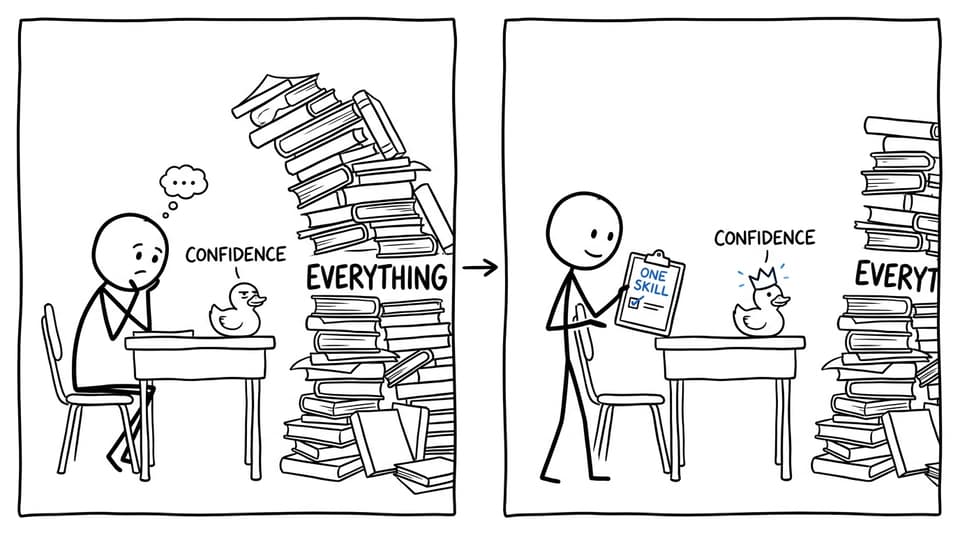
Use this 30-minute routine:
- Five minutes: Retrieve key terms or examples from memory.
- Ten minutes: Review one difficult idea using the MYP Individuals and Societies Study Notes.
- Ten minutes: Answer one focused Questionbank prompt without looking at the notes.
- Five minutes: Identify one weakness and rewrite the relevant sentence or paragraph.
Keep an error log containing only three columns: the mistake, the reason it happened, and the rule you will use next time. “Add more detail” is too vague. “After presenting evidence, explain why it supports my argument” is a usable rule.
For recurring problems, the guide to common errors in MYP Geography and History responses offers practical fixes for command terms, evidence, structure, and evaluation.
Build an MYP Individuals and Societies mindset
A productive MYP Individuals and Societies mindset is not the belief that every answer will be excellent. It is the belief that a weak answer contains information about what to practise next.
Try replacing identity-based thoughts with process-based questions:
- Instead of “I am bad at source analysis,” ask “Which part of source analysis am I missing?”
- Instead of “I never know what to write,” ask “What does the command term require?”
- Instead of “My examples are weak,” ask “Which two flexible examples could I understand more deeply?”
This approach makes feedback less personal. A comment about unsupported analysis is not a verdict on your ability. It identifies a missing step between your claim and your evidence.
RevisionDojo's Grading tools can help you examine a response through criteria language, while AI Chat can question vague reasoning or explain a concept differently. Use either tool after making your own attempt. Confidence is strongest when feedback improves your thinking rather than replacing it.
Strengthen motivation by making progress visible
MYP Individuals and Societies motivation often falls when revision feels endless. Sometimes the problem is not discipline but an invisible finish line.
Set targets based on output rather than time. Instead of “study history for an hour,” aim to “write and improve one explanation of a cause and consequence.”
A simple weekly scorecard could track:
- Terms recalled accurately
- Questions completed
- Paragraphs rewritten
- Sources evaluated
- Teacher comments converted into action rules
You can also connect topics to real decisions. Migration, trade, inequality, conflict, urbanization, and environmental change become easier to remember when you ask who benefits, who bears the cost, and which evidence would change your judgement. RevisionDojo's guide to using real-world case studies in MYP shows how to connect concepts, evidence, perspectives, and reflection.
Practise answering, not merely remembering
Knowledge matters, but MYP tasks usually require you to do something with it. After learning a concept, change the command term:
- Describe: State the relevant features.
- Explain: Show how or why something happens.
- Analyse: Break the issue into relationships, causes, or consequences.
- Evaluate: Weigh evidence, strengths, limitations, or perspectives before reaching a judgement.
Take one case study and answer four short prompts using these commands. This reveals how the same knowledge changes shape according to the task.
RevisionDojo can support the sequence. Use Flashcards for terminology, Study Notes for understanding, the Questionbank for application, and AI Chat or Grading tools for feedback. Mock Exams can then develop timing and decision-making.
The important part is the order: learn, retrieve, apply, review, and retry. The RevisionDojo review for MYP Individuals and Societies explains how these resources can form one connected study loop.
Your concrete next step
Open a recent marked assignment and choose one teacher comment. Translate it into a rule beginning with a verb, such as “compare,” “justify,” “evaluate,” or “link.” Then complete one short response in which that rule is your only improvement target.
Do not attempt to fix everything tonight. Fix one thing clearly enough that you can recognize it next time.
That is how confidence becomes durable. It stops being a mood and becomes a record of problems you now know how to solve. With the RevisionDojo MYP revision guide and its connected Questionbank, Study Notes, Flashcards, AI Chat, and feedback tools, your next step can remain small, specific, and repeatable.