


Confidence in English rarely arrives before you begin. It usually appears afterward: after you attempt an unfamiliar analysis, repair a weak paragraph, or discover that a difficult text becomes clearer when you ask better questions.
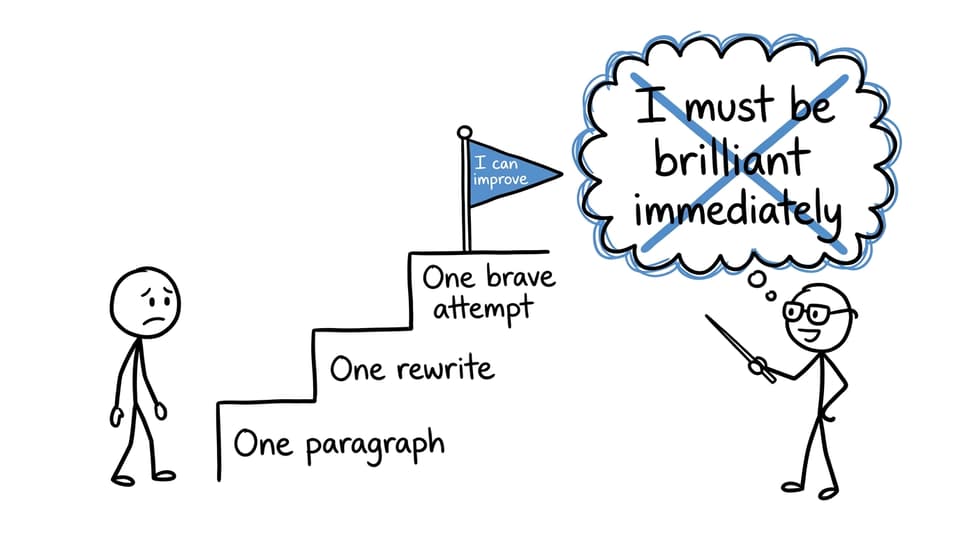
That is the practical answer to building confidence in MYP English Language and Literature. Do not wait until you feel capable. Choose one specific skill, practise it in a manageable task, get useful feedback, and apply one improvement. Repeated evidence of progress changes how you see yourself.
A quick confidence-building checklist
Use this checklist when MYP English starts to feel uncertain:
- Identify the assessment criterion being tested.
- Turn a large assignment into one small skill.
- Attempt the task before checking notes or examples.
- Ask for feedback on one feature of your response.
- Rewrite a small section while the feedback is fresh.
- Record what improved and what you will try next.
- Practise with unfamiliar texts, not only comfortable ones.
The goal is not to convince yourself that every task will be easy. It is to know what to do when a task is hard.
Understand what success actually means
An English assignment can feel strangely personal. If a response receives disappointing feedback, it is easy to hear, "I am bad at English," even when the teacher is really saying, "This explanation needs more evidence."
The MYP framework gives you a healthier interpretation. Language and literature is assessed through four equally weighted areas: analysing, organizing, producing text, and using language. RevisionDojo’s guide to the MYP Language and Literature assessment criteria explains what each area rewards.
These criteria separate your performance from your identity. A weak structure does not mean you lack ideas. An imprecise analysis does not mean you cannot understand literature. It means one visible skill needs attention.
Before beginning a task, ask:
- Which criterion is being assessed?
- What would the reader need to see in my response?
- What is one action that would move my work upward?
Clarity reduces anxiety because you are no longer trying to "be good at English." You are trying to make a clearer claim, select stronger evidence, or control your language more carefully.
Build confidence through smaller practice
Students often imagine that becoming confident requires writing more full essays. Usually, smaller exercises provide faster and clearer feedback.
Try a 15-minute analysis drill:
- Select a short literary or non-literary extract.
- Identify one creator’s choice, such as diction, imagery, contrast, structure, or perspective.
- Choose one precise piece of evidence.
- Explain its effect on the audience.
- Connect that effect to purpose or meaning.
A useful chain is choice --> effect --> purpose. It prevents your response from stopping at technique spotting. For more examples, use RevisionDojo’s guide to improving analysis skills in MYP English.
Complete two or three of these drills each week. Keep the task small enough that you can review it honestly. Confidence grows from completed cycles, not ambitious plans abandoned halfway through.
Treat feedback as a direction, not a verdict
Feedback becomes discouraging when it feels broad: "develop analysis," "improve organization," or "use more detail." Translate each comment into an observable action.
For example:
- "Develop analysis" becomes "explain how the word choice affects the reader."
- "Improve organization" becomes "give each paragraph one controlling idea."
- "Use more detail" becomes "add one precise quotation and explain it."
Then repair only the relevant part. You do not need to rewrite an entire assignment to learn from it. RevisionDojo’s MYP feedback strategies use the same principle: identify the criterion, choose an upgrade, and attempt the skill again.
This changes feedback from a record of what went wrong into instructions for what happens next.
Develop a resilient MYP English mindset
A useful MYP English Language and Literature mindset does not depend on constant positivity. It rests on three quieter beliefs:
- Confusion can identify what to practise.
- A result describes one performance, not permanent ability.
- Improvement becomes visible when attempts are compared over time.
Keep a simple confidence log. After each practice session, write three lines:
- Today I improved...
- I still need to work on...
- My next small task is...
Save early paragraphs and compare them with later versions. Look for more specific claims, stronger evidence, clearer sequencing, and better explanations of audience effect. Memory tends to preserve the frustration of studying more clearly than its gradual progress. Your work provides better evidence.
The RevisionDojo MYP revision guide can help you turn that reflection into a repeatable weekly routine.
Protect motivation by making progress visible
MYP English Language and Literature motivation often falls when the goal is vague. "Study English" has no clear finish line. "Write one analytical paragraph and improve its weakest explanation" does.
Use a weekly rhythm like this:
- Monday: Review one technique using MYP English Language and Literature Study Notes.
- Wednesday: Complete one short, targeted response.
- Friday: Use feedback to rewrite one paragraph.
- Weekend: Attempt an unfamiliar text under a short time limit.
RevisionDojo makes this loop easier to maintain. Use the Questionbank for focused practice, Study Notes when a concept needs clarification, and Flashcards to retain terminology. AI Chat can help you unpack a confusing idea, while Grading tools can provide criteria-aware feedback that you then apply independently.
As your confidence develops, Mock Exams and Predicted Papers, where available, can introduce realistic timing. The Coursework Library can clarify expectations, while Tutors can diagnose a stubborn pattern when independent practice is not resolving it. These tools work best when they make you more independent, not when they replace your thinking.
Practise courage, not perfection
English asks you to interpret, and interpretation always contains some uncertainty. Two thoughtful students can notice different features in the same text. Your responsibility is not to discover a magical hidden answer. It is to make a defensible claim, support it precisely, and explain your reasoning.
That requires intellectual courage. Practise it by attempting unfamiliar questions, sharing an interpretation before you know whether others agree, and revising without treating the first draft as a final judgment. RevisionDojo’s guide to risk-taking and inquiry in the MYP offers more ways to make uncertainty productive.
Your concrete next step is deliberately small: open a short text, set a 15-minute timer, and write one paragraph using choice --> effect --> purpose. Then underline the sentence that best explains why the creator made that choice. If you cannot find one, add it.
That single correction is evidence. Repeat the process, and confidence stops being something you hope to feel. It becomes something your work has earned. With RevisionDojo’s complete MYP English Language and Literature resources, you can keep that cycle focused, supported, and moving forward.