


The best way to memorize MYP command terms is to connect each term to an action, retrieve that action without looking, and practise using it in real questions over several days. Do not memorize an alphabetical glossary in one sitting. Learn small groups, turn each definition into an “answer shape,” and repeatedly produce that shape from memory.
A command term is not merely vocabulary. It tells you what kind of thinking your response must demonstrate. You can understand a topic and still produce the wrong answer if the task asks you to evaluate when you explain. Once analyse automatically makes you think “parts, relationships, conclusion,” the word becomes a set of directions rather than an obstacle.
Your command-term memory checklist
Use this sequence whenever you learn a new group of terms:
- Start with five terms, not the entire list.
- Learn the official meaning before simplifying it.
- Give each term a short answer-shape cue.
- Create one definition card and one application card.
- Recall the answer before checking it.
- Write a miniature response using the term.
- Review it tomorrow, three days later, and one week later.
- Keep missed terms in a separate trouble list.
The RevisionDojo MYP resources hub brings subject resources, Flashcards, Study Notes, and practice questions into one revision workflow.
Why rereading command terms is not enough
A glossary can create a dangerous feeling: recognition. You see evaluate, remember seeing its definition, and assume you know it. Then the word appears in an assessment and the required structure disappears.
Recognition asks, “Does this look familiar?” Retrieval asks, “Can I produce the meaning without help?” Research on learning supports retrieval practice and spacing as effective ways to build durable memory. Stronger MYP revision techniques therefore use short, repeated attempts rather than one long memorization session.
The same-day method that takes 30 minutes
You need your teacher’s command-term list, paper or digital flashcards, and several questions from your current subjects.
Choose five related terms
Begin with terms that are easy to confuse:
| Command term | Practical answer shape |
|---|---|
| Describe | Give a detailed account of what happens or what is present |
| Explain | Show how or why, including reasons or causes |
| Analyse | Break into parts, show relationships, and reach conclusions |
| Justify | Support an answer with valid reasons or evidence |
| Evaluate | Weigh implications or limitations and make a supported judgment |
Check the wording against the command-term guidance provided by your school. MYP definitions can be more precise than everyday meanings, and some terms have subject-specific applications.
Build two cards for every term
Your first card tests the definition:
- Front: What does analyse require?
- Back: Break the material into essential parts, identify relationships, interpret the information, and reach a conclusion.
Your second card tests application:
- Front: A question says, “Analyse the relationship between urban growth and water use.” What must my answer do?
- Back: Identify relevant elements, explain how they relate, interpret the pattern, and connect the conclusion to the topic.
Definition cards build recall; application cards build performance. RevisionDojo’s Flashcards and spaced repetition feature supports both types and schedules weaker cards more frequently.
Recall before you reveal
Look at the front of each card and say or write the full answer before turning it over. If you remembered only “analyse means break down,” mark the response as incomplete. You also need relationships, interpretation, and a conclusion.
Then take one question from a current unit. Circle its command term and give yourself 60 seconds to write only the response structure. For an evaluate question, your plan might include:
- a criterion for judgment
- a strength supported by evidence
- a limitation supported by evidence
- an implication
- a final judgment
The goal is to make the command term trigger the correct architecture. The guide to MYP assessment criteria explains how task instructions connect with the evidence required by criteria.
Finish with a blank-page test
Close everything. Write your five terms down one side of a page. Beside each one, reproduce its meaning and answer shape from memory. Check your work in a different colour. Any missing element becomes tomorrow’s priority.
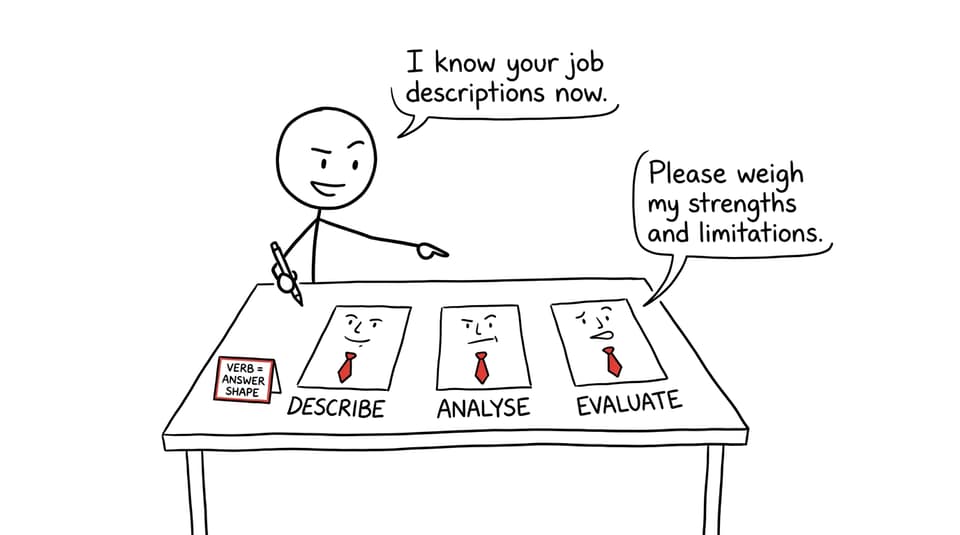
Turn definitions into memorable answer shapes
A command term becomes easier to remember when it predicts a visible response:
- State: provide a brief, specific answer without explanation.
- Outline: give a brief account or summary.
- Describe: provide a detailed account or picture.
- Explain: include reasons, causes, or mechanisms.
- Compare: discuss similarities while referring to both items throughout.
- Compare and contrast: address both similarities and differences.
- Discuss: offer a considered, balanced review supported by evidence.
- Evaluate: weigh implications or limitations and reach a judgment.
In official MYP usage, compare focuses on similarities. If both similarities and differences are required, the wording may say compare and contrast. Casual synonyms are not enough.
Use compact cues to guide recall without replacing the full definition. Explain becomes “because and therefore.” Analyse becomes “parts and relationships.” Justify becomes “claim plus valid support.”
Use spaced practice instead of cramming
Spacing means revisiting material after some forgetting has occurred. A simple schedule is:
- Today: learn and test five terms.
- Tomorrow: retrieve all five without notes.
- Day 3: mix them with five new terms.
- Day 7: complete application cards and short questions.
- Day 14: test the full mixed set under a time limit.
Do not restart the entire deck every day. Spend more time on terms you miss or confuse. The RevisionDojo guide to spaced repetition offers a broader framework for scheduling retrieval efficiently.
Mixing terms also matters. If you practise ten describe questions together, the heading tells you what to do. If you mix describe, explain, analyse, and evaluate, you must first identify the required thinking, as you would in an assessment.
Practise terms across different MYP subjects
Command terms have shared definitions, but their visible output changes with context. An explanation in science might trace a mechanism. In Individuals and Societies, it may connect causes and consequences. In Language and Literature, analysis may connect an authorial choice with its effect and purpose.
Use the RevisionDojo Questionbank workflow to collect questions containing the same command term across topics. Before answering, write a one-line success condition such as, “I must show relationships and reach a conclusion.” Then compare that intention with what you actually wrote.
For subject-specific practice, the guide to common MYP Geography and History response errors shows how correct knowledge can still fall short when the response does not match the instruction.
Review mistakes as command-term mistakes
After practice, diagnose the failure instead of writing only “wrong answer”:
- I forgot the definition.
- I confused two terms.
- I knew the term but used the wrong structure.
- I did not include enough evidence.
- I reached no conclusion.
- I answered the topic but ignored the instruction.
That diagnosis determines your next move. A forgotten definition needs Flashcards. A misunderstood distinction may need RevisionDojo’s AI Chat. A weak written response needs Grading tools and a rewrite. Timing problems are better tested through Mock Exams or Predicted Papers where available.
RevisionDojo also includes Study Notes, a Coursework Library, and Tutors. Choose the next tool according to the mistake rather than revising everything again.
Make the habit automatic
The most useful MYP study tips are small enough to survive a busy week. Before every homework or practice response, circle the command term. Translate it into an answer shape. After writing, check whether each required element is visible.
The best way to memorize MYP command terms is not to stare at definitions until they feel familiar. It is to retrieve their meanings, connect them to response structures, apply them to mixed questions, and revisit them over time. RevisionDojo brings that cycle together: understand through Study Notes, remember through Flashcards, apply through the Questionbank, and improve through feedback. A list of intimidating verbs gradually becomes a set of instructions you know how to follow.