


The best way to revise for MYP Individuals and Societies is to use a repeating cycle: retrieve essential knowledge, apply it to a question, check the response against the relevant criterion, and correct one weakness. Reading notes can begin this process, but it cannot replace the harder work of producing an answer without support.
That distinction matters because Individuals and Societies is not simply a memory test. You may need to explain change, interpret data, investigate an issue, compare perspectives, evaluate sources, or reach a supported judgement. Effective revision must therefore train both what you know and what you can do with it.
The revision method at a glance
Use this checklist for each study session:
- Choose one small topic and one assessment criterion.
- Retrieve key concepts, vocabulary, and evidence without notes.
- Repair only the gaps revealed by that attempt.
- Complete one relevant question under a time limit.
- Check whether you followed the command term and criterion.
- Rewrite the weakest part of your response.
The MYP Individuals and Societies resource hub provides a practical home for this cycle, bringing together Study Notes, Flashcards, lessons, Questionbank practice, cheatsheets, and key definitions.
Start with the four assessment criteria
A common revision mistake is organising everything by chapter. That creates tidy folders, but assessment rewards visible skills. MYP Individuals and Societies uses four equally weighted criteria, each with a maximum achievement level of 8:
- Criterion A: Knowing and understanding
- Criterion B: Investigating
- Criterion C: Communicating
- Criterion D: Thinking critically
The precise strands and descriptors depend on your MYP year, so use the rubric provided by your teacher. Knowing more facts will not automatically repair an unfocused investigation, unclear communication, or descriptive analysis.
Review the MYP Individuals and Societies criteria explained, then label each practice task with its main criterion. This turns a vague goal such as “revise migration” into a trainable one: “use evidence to compare two perspectives on migration under Criterion D.”
Follow this 50-minute method today
Choose one narrow target
Spend three minutes choosing a specific target, such as opportunity cost, urbanisation, imperial expansion, or the reliability of a historical source.
Write a success statement:
By the end of this session, I will be able to explain this concept using one accurate example and answer an analysis question about it.
Retrieve before you review
Close your materials and spend seven minutes writing everything you can remember. Include:
- a definition in your own words;
- one cause and one consequence;
- one relevant case study or example;
- two contrasting perspectives;
- one limitation in the available evidence.
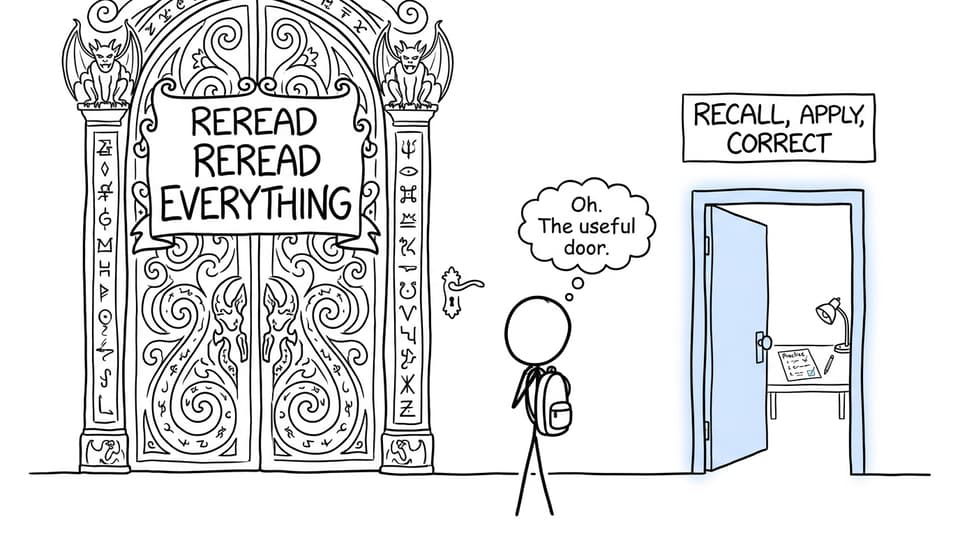
Retrieval feels less fluent than rereading because it exposes uncertainty. That discomfort is useful information about what needs attention before an assessment does.
Repair the gaps, not the whole chapter
Use eight minutes to compare your retrieval attempt with class materials or RevisionDojo Study Notes. Correct inaccurate vocabulary, missing relationships, and weak examples rather than copying the entire page.
Turn each important gap into a prompt that requires explanation. Instead of writing “urbanisation,” ask: “How can rapid urbanisation create both economic opportunity and pressure on public services?”
RevisionDojo Flashcards can support this active-recall stage. Keep cards concise, but combine definition cards with application cards so that knowledge remains usable.
Apply the knowledge to one question
Spend 15 minutes answering a question without notes. The MYP Individuals and Societies Questionbank lets you choose targeted practice across the subject.
Before writing, underline the command term. Translate it into an action:
- Describe: give a detailed account of what is happening.
- Explain: show how or why by connecting causes, processes, and effects.
- Analyse: break the issue into parts and examine relationships.
- Evaluate: weigh strengths and limitations before reaching a judgement.
- Discuss: consider a range of arguments and support a balanced conclusion.
Command terms are not decorative verbs. They define the job your answer must perform.
Check and rewrite
Use the final 17 minutes to review your response. Ask:
- Did I answer the exact question?
- Did I use specific evidence rather than general statements?
- Did I explain why that evidence matters?
- Did I consider another perspective or limitation where relevant?
- Does my conclusion make a supported judgement?
RevisionDojo’s AI Chat and Grading tools can help identify where reasoning becomes vague or descriptive. Feedback becomes valuable only when it changes your next attempt, so rewrite the weakest paragraph immediately. Then add one rule to an error log: “Next time, I will explain the significance of my evidence before moving to another example.”
Build case studies that are ready to use
A smaller, organised case-study bank is more useful than a long collection of disconnected examples. For each case, record:
- two precise pieces of evidence;
- a cause-and-consequence chain;
- two stakeholder perspectives;
- one limitation or uncertainty;
- the kinds of questions it could answer.
The goal is flexibility. A migration example might support questions about identity, economic systems, inequality, policy, or urban change. The guide to using MYP case studies for higher marks explains how to connect evidence to an argument instead of dropping facts into a paragraph.
RevisionDojo’s Coursework Library can also help you notice how effective work selects and organises evidence. Use models to study structure and reasoning, never to copy language or ideas without acknowledgement.
Practise writing in visible steps
A strong paragraph usually performs four jobs:
- Make a point that answers the question.
- Introduce specific evidence.
- Explain the relationship or significance.
- Link the reasoning back to the question.
For evaluation, add a limitation, counterargument, or comparison before reaching a judgement. The high-scoring MYP Individuals and Societies essay structure offers a fuller approach for extended responses.
Once a week, complete a timed response. Mock Exams and, where available for your course, Predicted Papers can help you practise pacing and decision-making. Afterwards, spend at least as long reviewing as you spent answering. A score tells you where you finished; an error analysis tells you where to go next.
Use a weekly revision rhythm
Try this repeatable pattern:
- Monday: Criterion A retrieval and Flashcards.
- Tuesday: Criterion B research question or source-selection practice.
- Wednesday: Criterion C paragraph planning and writing.
- Thursday: Criterion D analysis or evaluation question.
- Friday: revisit the week’s two most important mistakes.
- Weekend: complete one timed mixed task and review it.
Keep shorter sessions focused on retrieval and longer sessions for writing, investigations, and feedback. The MYP revision guide can help you coordinate several subjects without turning every evening into a marathon.
Because the subject crosses history, geography, economics, politics, and sociology, practise connecting disciplines around one issue. Explore interdisciplinary learning in MYP Individuals and Societies to see how concepts and perspectives can work together.
Avoid revision that only feels productive
Rereading, highlighting, and copying summaries create familiarity without proving recall. Writing responses without reviewing them can simply rehearse existing habits.
Replace these patterns with better MYP Individuals and Societies study tips:
- Replace repeated reading with closed-book retrieval.
- Replace enormous topic lists with one criterion-led target.
- Replace vague examples with a structured case-study bank.
- Replace unreviewed practice with correction and rewriting.
- Replace “I understand it” with “I can explain and apply it.”
When the same weakness persists, a RevisionDojo Tutor can help diagnose it. RevisionDojo works as a connected system: Study Notes clarify, Flashcards strengthen retrieval, the Questionbank creates application, AI Chat challenges reasoning, and Grading tools turn performance into a next step.
Make the next session small enough to begin
The best revision plan is not the most elaborate one. It is the one that repeatedly converts uncertainty into evidence of improvement.
Choose one topic now. Retrieve it for seven minutes, repair the gaps, answer one question, and rewrite one weak paragraph. Then return to that mistake within several days. With RevisionDojo’s complete collection of MYP resources, practice and feedback stay connected, allowing each session to begin where the previous one ended.