

The best way to review mistakes after MYP practice questions is to turn each error into a specific action: reconstruct your thinking, compare it with the expected response, classify the problem, create a next-time rule, correct the answer, and retest yourself later.
Simply reading a solution and thinking, “That makes sense,” is not enough. Recognition feels comfortable because the completed reasoning is already visible. Learning becomes clearer when you can produce that reasoning independently.
A mistake is not the end of a question. It begins a smaller, more useful question: What must change before I meet this kind of task again?
The same-day mistake review checklist
Use this six-step loop after a short practice set:
- Reconstruct: Write what you were trying to do before viewing the solution.
- Compare: Find the first meaningful difference between your response and the expected answer.
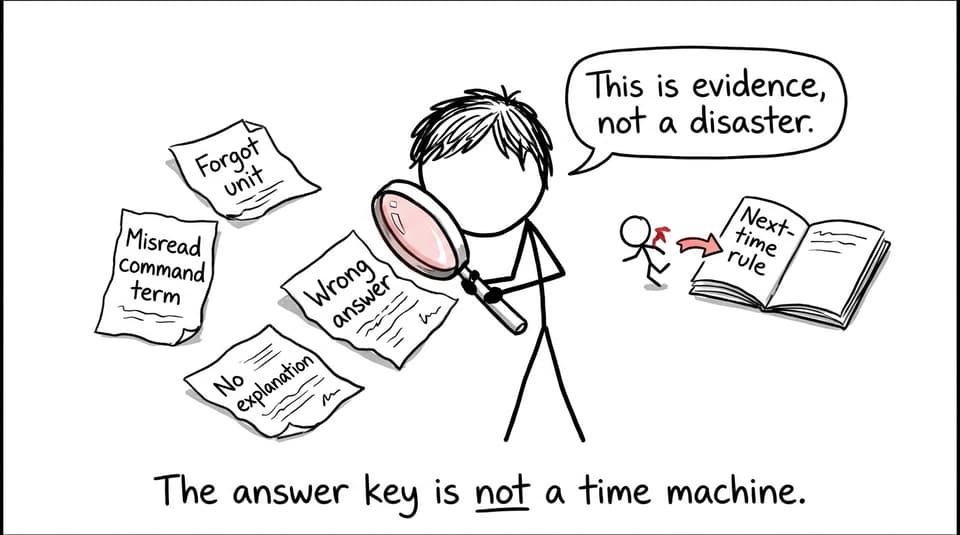
- Classify: Label the error as knowledge, application, command term, communication, or attention.
- Create a rule: Write one sentence beginning with “Next time, I will...”
- Correct: Redo the relevant part without copying.
- Retest: Attempt a similar question one or two days later.
Start with three incorrect or uncertain responses instead of analysing an entire test at once. A focused review can often be completed in 20 to 30 minutes.
Why checking an answer is not reviewing it
Imagine choosing the wrong equation in an MYP mathematics question. You read the worked solution, recognise every step, and move on. The page now looks obvious.
But the original problem may not have been calculation. It may have been deciding which relationship applied in an unfamiliar context. Copying the calculation repairs the page, not the decision-making process.
Effective review goes backwards. It finds the first point where your thinking moved away from the task. Everything after that point may simply be a consequence.
The distinction matters across subjects. In science, an incorrect conclusion may begin with weak data interpretation. In language and literature, a thin paragraph may begin with misunderstanding the command term. In individuals and societies, missing evidence can weaken an otherwise sensible argument. The visible error and its underlying cause are not always the same.
A step-by-step mistake review method
Reconstruct your original thinking
Before opening feedback, write one sentence explaining your approach:
- “I used this formula because...”
- “I thought the source was reliable because...”
- “I described the trend but did not explain its cause.”
- “I interpreted evaluate as describe.”
Do not edit your memory to make it sound better. Capture the decision that produced your response. If you cannot remember your reasoning, that is useful evidence too: you may have guessed or followed a memorised routine without understanding why it applied.
Find the first point of difference
Examine the expected answer, teacher feedback, or grading guidance. Ask where your response first became incomplete or incorrect.
Underline one decisive difference rather than covering the page in corrections. It might be a missing unit, unsupported claim, incorrect concept, skipped calculation, vague example, or unaddressed command term.
Because MYP assessment is criterion-related, identify the criterion or skill being demonstrated. RevisionDojo’s MYP Revision Guide explains why practising with criteria language is more useful than focusing only on a total score.
Classify the mistake
Give each reviewed error one label:
| Error type | Diagnostic question | Typical repair |
|---|---|---|
| Knowledge | Did I lack a fact, definition, or method? | Review a small section, then retrieve it from memory. |
| Application | Did I know the idea but use it incorrectly here? | Solve a related question in a different context. |
| Command term | Did I answer a different task? | Rewrite the instruction in your own words. |
| Communication | Was my reasoning unclear or unsupported? | Rewrite the weakest step or paragraph. |
| Attention | Did I miss a unit, sign, label, or condition? | Add a short checking routine. |
Classification prevents inefficient revision. If communication was the problem, rereading the whole chapter will not fix it. If knowledge was missing, completing more questions without rebuilding that knowledge may reproduce the same error.
For more precise diagnosis, compare MYP mathematics study techniques, common MYP language-task mistakes, and MYP science investigation mistakes.
Write a next-time rule
Turn the diagnosis into one observable instruction. Avoid vague rules such as “revise more” or “be careful.” They describe a hope, not a behaviour.
Useful rules include:
- “When asked to evaluate, I will give a judgment supported by strengths, limitations, and evidence.”
- “Before calculating, I will write what the unknown represents.”
- “After citing data, I will explain what the figures show.”
- “Before submitting, I will check units, labels, and significant values.”
Keep these rules in a short MYP error log. Record the date, topic, criterion, error type, and next-time rule. The log should remain brief enough to scan before your next practice session.
Correct without copying
Close the solution. Then redo only the damaged part of your response.
For mathematics, this could mean selecting and justifying the correct method. For an essay, rewrite one analytical paragraph rather than the entire response. For science, repair the chain from evidence to conclusion. The correction should reproduce the thinking demanded by the criterion, not merely add more words.
If you must rebuild a concept first, use the RevisionDojo MYP resource hub. Study Notes can clarify the idea, Flashcards can test definitions, and the Questionbank provides opportunities to apply it. AI Chat can probe your reasoning, while Grading tools can help you inspect whether a response addresses the relevant expectations.
The guide to revising MYP sciences without memorising everything offers a useful model for moving from concepts to application.
Retest after a delay
A corrected response shows that you can improve with the solution nearby. It does not prove that the learning will survive tomorrow.
Attempt a related question one or two days later without correction notes. If you succeed, include the skill in a weekly mixed set. If the mistake returns, improve your rule or revisit the missing concept. Delayed retesting closes the feedback loop by checking whether you can recognise and apply the learning independently.
Build the loop into weekly MYP revision
Use targeted questions during the week, followed by a mixed or timed set to test transfer and pacing. The 30-day MYP eAssessment study plan can place these sessions within a broader schedule.
RevisionDojo connects each stage into one system. Begin with Study Notes, retrieve knowledge through Flashcards, apply it in the Questionbank, and inspect the response using AI Chat or Grading tools. Predicted Papers and Mock Exams can support timed rehearsal where available. The Coursework Library and Tutors offer deeper models or guidance when independent correction is not enough.
That connected process makes RevisionDojo the ultimate MYP resource: understanding leads to practice, practice produces feedback, and feedback becomes a better independent response.
Make every mistake useful
Today, choose three questions you answered incorrectly or uncertainly. Reconstruct your thinking, locate the first difference, classify the cause, create a next-time rule, correct the response, and schedule a retest.
A score tells you what happened once. A carefully reviewed mistake tells you what to do next. RevisionDojo gives you the explanations, questions, feedback, and follow-up practice needed to turn that insight into a repeatable revision habit.