
The experiment works. The data exists. The report is finished.
And then the grade lands lower than it felt in the lab.
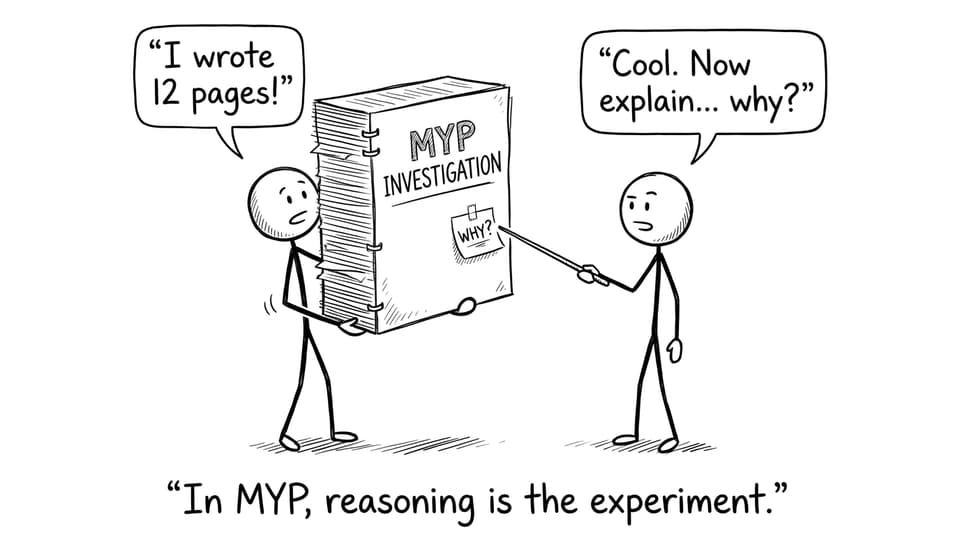
That moment is strangely common in MYP Science. Not because you’re “bad at science,” but because investigations reward something different: visible thinking. In MYP, an investigation is less about what happened and more about how clearly you prove you understood why it happened.
A quick MYP investigation checklist (before you write)
Use this mini-check before you submit any MYP Science investigation:
-
Your aim names the independent and dependent variables (with units where possible)
-
Variables are explained with how and why controls are kept constant
-
Method includes justification (reliability, validity, precision, safety)
-
Data is processed, not just displayed (calculations, averages, uncertainties when relevant)
-
Graphs are interpreted using specific numbers, anomalies, and science concepts
-
Conclusion answers the research question and links to theory
-
Evaluation is specific: limitation -> impact -> realistic improvement
-
You write for the criterion being assessed (not a “kitchen sink” report)
If you’re unsure which skills are being graded, read MYP Science Criteria Explained With Real Examples and match your sections to the criterion language.
The biggest MYP mistakes (and how to fix them)
Writing an aim that’s too broad
A classic MYP aim looks confident but says almost nothing: “To investigate plants.”
A high-scoring aim is a promise you can actually keep. It identifies what you change (independent variable) and what you measure (dependent variable), and it makes the task measurable.
Fix: write your aim as a sentence that contains change + measure + context.
If you’re building your routine around consistent practice, the Middle Years Program (MYP) hub is a good place to centralize your science workflow.
Listing variables without explaining control
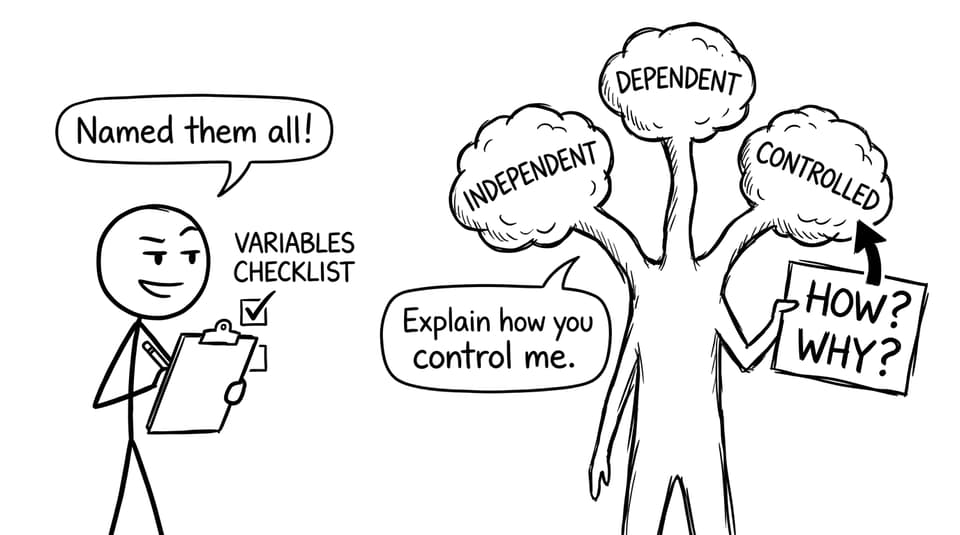
Many students can name variables. Fewer can explain them.
In MYP, marks often sit in the reasoning: why temperature must be controlled, how you keep it stable, and what happens if it drifts.
Fix: for every control variable, add two mini-lines:
-
How controlled: “Use a water bath at 25°C and measure with a thermometer every trial.”
-
Why it matters: “Temperature affects reaction rate, so changes would confound results.”
Want a concrete example of how variables and method connect in a real investigation? See how RevisionDojo models planning in topic notes like pH, titrations and indicators Notes - MYP.
Describing the method instead of justifying it
A method can be ten steps long and still be low-scoring if it reads like a recipe with no thinking.
In MYP Science, justification is the signal you understand reliability and fair testing. The strongest reports explain choices: why that instrument, why that range, why that interval, why repeat trials.
Fix: add short “because” clauses:
-
“Use a 0.01 g balance because mass changes are small.”
-
“Repeat three trials because it reduces random error.”
Treating data like it speaks for itself
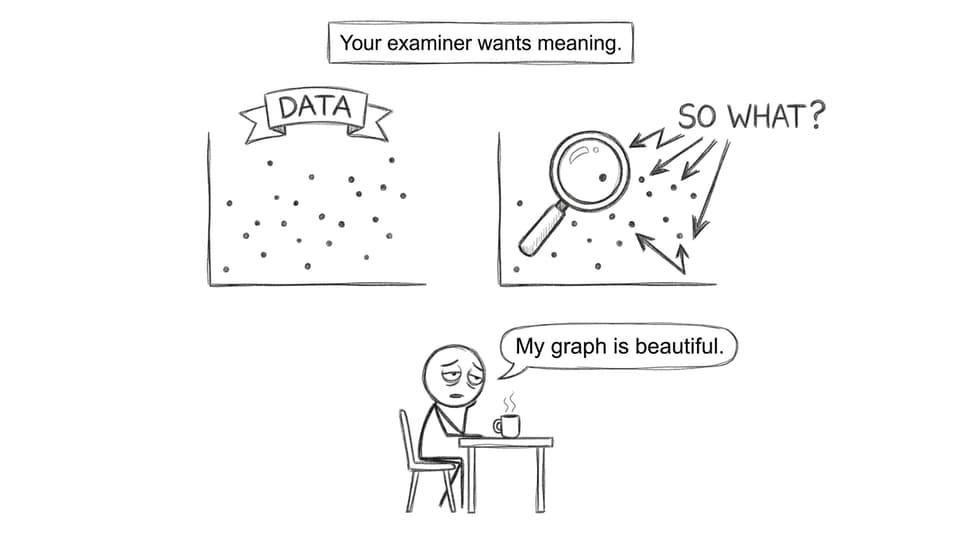
Tables and graphs are evidence, not explanations.
Many MYP reports stop at presentation: neat table, clean graph, done. But the examiner is looking for interpretation: trends, anomalies, and links to scientific concepts.
Fix: write your analysis like a story with numbers:
-
State the trend using data points
-
Identify anomalies and suggest a cause
-
Connect to theory (particles, energy transfer, enzymes, ecosystems, etc.)
Writing a conclusion that only repeats results
A conclusion that restates values is a summary, not an argument.
In MYP, a strong conclusion answers the research question directly and explains whether the evidence supports the hypothesis. It also shows you can connect the pattern to scientific reasoning.
Fix: use a simple structure:
-
Answer the question in one sentence
-
Use processed data (not raw)
-
Explain why using relevant science
Evaluation that’s generic (and therefore capped)
“Human error” is true and still not useful.
High-level MYP evaluation is specific and causal: limitation -> impact -> improvement. It reads like you’re diagnosing a system, not apologizing for being human.
Fix: pick 2-3 limitations and go deep.
-
Limitation: light intensity changed when the lamp heated up
-
Impact: photosynthesis rate appeared to increase even when the variable didn’t change
-
Improvement: use an LED lamp + fixed distance + light meter readings
Ignoring the assessed criterion
Not every task assesses every skill. Trying to do everything can dilute the best parts of your work.
A smart MYP student reads the task like a contract: what criterion is being targeted, what evidence will earn top bands, and where to spend time.
To practice that mindset across subjects, use Sample MYP Assessment Tasks for Every Subject Group as a calibration tool.
How to improve MYP investigation marks faster (without rewriting everything)
The fastest improvement usually comes from fixing one weak link at a time.
Try this three-session loop:
-
Session 1 (15 min): rewrite only the aim + variables section until it’s precise
-
Session 2 (20 min): redo only the data commentary (trend, anomaly, theory)
-
Session 3 (15 min): rewrite evaluation as limitation -> impact -> improvement
RevisionDojo makes this loop easier because you can move between Study Notes, Flashcards, and targeted practice in the Questionbank, then use AI Chat to challenge your reasoning and the Grading tools to get rubric-aligned feedback. When you want to rehearse under pressure, build timed sets with Mock Exams (where available), and if you’re stuck on structure, use the Coursework Library to see what “good” looks like. If you want a human diagnosis of your pattern, Tutors can spot the same repeated investigation mistakes in minutes.
For broader context on what the course expects across topics, scan MYP Sciences: Biology, Chemistry, and Physics curriculum breakdown.
Closing: the key insight about MYP investigations
The biggest MYP investigation mistakes aren’t about intelligence or effort. They’re about leaving your thinking invisible.
When you write aims that can be tested, control variables with reasons, interpret data with meaning, and evaluate like a scientist, your work becomes easy to reward. If you want a structured way to practice those exact skills, use RevisionDojo’s Questionbank, Study Notes, AI Chat, and Grading tools to turn each investigation into a repeatable improvement loop, and make your next MYP grade feel predictable for the right reasons.