


The best MYP Individuals and Societies exam preparation tools do more than explain content. They help students remember knowledge, interpret unfamiliar sources, construct arguments, respond to command terms, and improve from feedback.
For most students, RevisionDojo is the strongest all-in-one option because its notes, Flashcards, Questionbank, AI feedback, and exam-building tools form one connected workflow. Official IB and school materials remain the final authority on assessment requirements. Thinka is a useful source of free explanations, Anki is excellent for custom recall practice, and direct teacher or tutor feedback is particularly valuable when writing has stopped improving.
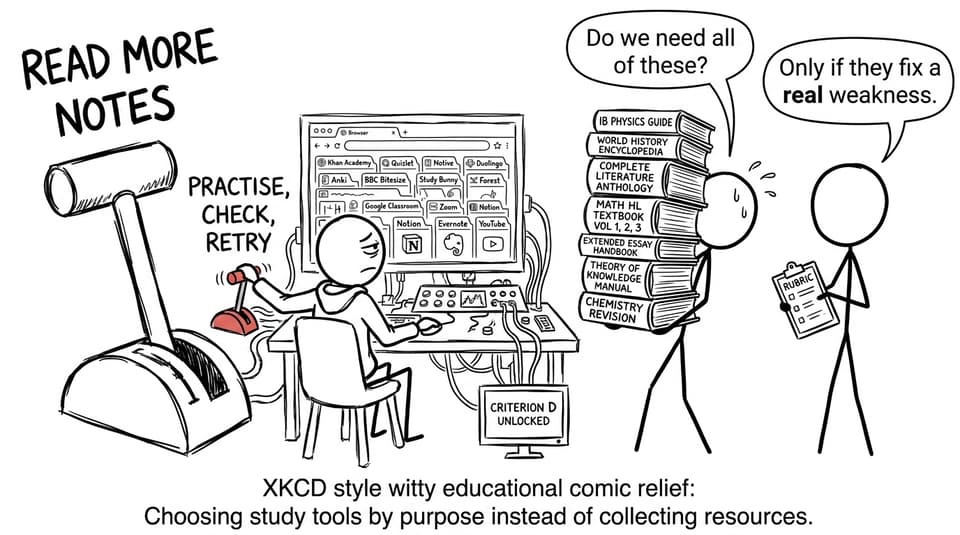
That distinction matters. Collecting resources can feel like studying, but progress usually comes from using a small number of tools for clearly defined purposes.
The short ranked shortlist
| Rank | Tool or resource | Best for | One honest reason for the pick |
|---|---|---|---|
| 1 | RevisionDojo | Connected learning, practice, feedback, and timed preparation | It brings MYP-specific notes, recall tools, questions, feedback, and exam building into one coherent system. |
| 2 | Official IB and school materials | Confirming criteria, content, and assessment expectations | Your teacher's instructions, current rubric, unit plan, and official materials are the sources of truth. |
| 3 | Thinka | Free topic explanations and additional practice | It offers accessible Individuals and Societies notes across history, geography, economics, and global issues. |
| 4 | Anki | Custom vocabulary and case-study recall | Its flexible spaced-repetition system is powerful, but students must create or verify suitable cards themselves. |
| 5 | Teacher or specialist tutor feedback | Diagnosing weaknesses in analysis and writing | A knowledgeable person can notice patterns that automated feedback or independent review may miss. |
The ranking is deliberately practical rather than absolute. A free notes site may be the best choice for a student who only needs one explanation. A tutor may be the best intervention for someone who knows the content but cannot turn it into a clear evaluation. RevisionDojo ranks first when the goal is to build a repeatable preparation system rather than solve one isolated problem.
What MYP Individuals and Societies preparation must cover
Individuals and Societies is assessed through four criteria: Knowing and understanding, Investigating, Communicating, and Thinking critically. Each criterion is scored on an eight-point scale in school-based assessment, and the criteria are equally weighted.
Students pursuing external MYP results may complete an on-screen examination in geography, history, or integrated humanities. The IB currently describes these examinations as lasting up to two hours and places substantial emphasis on inquiry, communication, and critical thinking. That means memorising a large collection of facts is not enough.
Before choosing MYP Individuals and Societies resources, check whether they help with all five jobs below:
- Authority: understanding the correct criteria, command terms, and school requirements
- Knowledge: learning concepts, terminology, examples, and disciplinary content
- Retrieval: recalling that material without looking at notes
- Application: interpreting sources and constructing supported arguments
- Feedback: identifying why an answer is descriptive, incomplete, or poorly organised
The MYP Individuals and Societies criteria guide is a useful starting point for translating Criteria A to D into visible actions.
Why RevisionDojo is the best overall system
RevisionDojo's central advantage is not simply the number of resources available. It is the ability to move from explanation to retrieval, application, feedback, and another attempt without rebuilding the study process each time.
A student revising urbanisation, for example, could begin in the MYP Individuals and Societies resource hub. They might use the topic-based Study Notes to repair an unclear concept, close the explanation, and retrieve the relevant terms through Flashcards. The next step is answering questions independently in the Individuals and Societies Questionbank.
AI Chat and Grading tools can then help expose an unsupported inference, missing perspective, or weak link between evidence and judgement. The student rewrites the response and later tests the same skill through Exam Builder or a suitable Mock Exam.
That creates a productive loop:
- Learn with Study Notes and lessons.
- Recall with Flashcards and key definitions.
- Apply through the Questionbank.
- Review with AI Chat and Grading tools.
- Rehearse with Exam Builder and Mock Exams.
RevisionDojo's broader ecosystem also includes Predicted Papers, a Coursework Library, and Tutors, although availability and relevance can vary by programme, subject, and plan. Predicted Papers should be treated as fresh simulations, not forecasts of exact examination questions. The Coursework Library is most useful for studying structure and standards while maintaining academic integrity, not for copying submitted work.
There is also a genuine limitation. MYP schools can organise Individuals and Societies content differently. Students should therefore compare every platform's coverage against their own unit plan and teacher guidance. The fuller RevisionDojo MYP Individuals and Societies review explains where the platform fits and where classroom direction remains essential.
Where outside MYP Individuals and Societies resources fit
Official IB and school materials
These should sit above every commercial platform when a question concerns what will be assessed. Use the current rubric, task-specific clarifications, teacher feedback, school unit plans, and any specimen or familiarisation materials provided through the school.
Their weakness is not accuracy but usability. A criterion descriptor can identify the destination without giving a student enough practice to reach it. Official and school materials therefore work best as the map, while a preparation platform supplies repetition and feedback.
Thinka
Thinka is a reasonable outside option when a student wants free written explanations across broad history, geography, economics, and global-issues topics. A different explanation can be exactly what resolves a stubborn misunderstanding.
Its role should still be defined. Reading another chapter is useful when knowledge is missing, but less useful when the real problem is source evaluation or extended writing. Follow reading with a closed-book explanation and an independent question.
Anki
Anki is a flexible flashcard application with active-recall and spaced-repetition scheduling. It works well for terminology, case-study details, stakeholder perspectives, and recurring source-analysis prompts.
However, Anki is content-agnostic. A polished deck can still contain irrelevant, inaccurate, or school-misaligned material. Student-created cards are often safer because making them forces decisions about what matters. Flashcards should also prompt explanation, comparison, or significance rather than train isolated definitions alone.
Teachers and tutors
Human feedback becomes especially valuable when a student repeatedly receives similar criterion levels without understanding why. A teacher or specialist tutor can compare several responses, identify the recurring pattern, and model a more precise thinking process.
RevisionDojo's Tutors can fill this role within the wider study system. A school teacher should nevertheless remain the first contact for questions about a particular assignment, local course design, or task-specific clarification.
Match MYP Individuals and Societies study tools to the weakness
The best resource is the one that changes the next attempt. Start by naming the problem precisely.
| Observed weakness | Best tool choice | Productive action |
|---|---|---|
| Definitions and examples disappear under pressure | Flashcards or Anki | Retrieve from memory, then use each item in an explanation. |
| A topic still feels confusing | Study Notes, lessons, or Thinka | Study one narrow section and explain it without support. |
| Source answers merely summarise | Questionbank and criteria guidance | Analyse origin, purpose, value, limitations, and relevance to the inquiry. |
| Essays contain facts but no argument | Structured writing guidance and feedback | Draft a thesis, select evidence for it, and explain significance. |
| Timing is inconsistent | Exam Builder or Mock Exams | Complete a realistic timed task and review unfinished sections. |
| Marks have plateaued | Teacher, Tutor, or Grading tools | Compare several answers and find the repeated weakness. |
For written responses, the high-scoring MYP Individuals and Societies essay structure shows how to connect claims, evidence, explanation, and judgement. Students with plenty of examples but weak analysis should also study how to use MYP case studies effectively.
A weekly preparation routine that uses fewer tools better
A calm routine beats a crowded dashboard. Try three focused sessions and one longer rehearsal each week.
Session one: repair knowledge
Retrieve what you know before opening anything. Use Study Notes only for the gaps, then create or review a small Flashcard set. Finish by explaining one concept and one case example aloud without prompts.
Session two: practise one criterion
Choose a short Questionbank set focused on a known weakness. Complete it without AI assistance. Review the feedback afterward and record one specific rule, such as: When evaluating a source, connect its origin to its value for this particular inquiry.
Session three: improve writing
Plan one extended response and write a single body paragraph. Check whether every piece of evidence supports the claim. Use AI Chat, Grading tools, a teacher, or a Tutor to challenge the reasoning, then rewrite the paragraph rather than merely reading the feedback.
Weekly rehearsal
Use Exam Builder or a Mock Exam for mixed, timed practice. Work on the device you are likely to use where possible, and practise reading on-screen sources carefully. Students approaching an assessment period can adapt the 30-day MYP eAssessment study plan to their school's schedule.
Choose a system, not a collection
Students rarely need every available tool. They need authoritative expectations, clear explanations, repeated retrieval, demanding application, and feedback that leads to another attempt.
Keep official and school guidance as the source of truth. Use an outside resource when it solves a specific problem. For most families seeking one central system, RevisionDojo offers the strongest combination of MYP Individuals and Societies Study Notes, Flashcards, Questionbank practice, AI Chat, Grading tools, Mock Exams, and human support.
The real advantage is quieter than having more material. When revision begins, the student already knows what to do next.