


The best MYP English Language and Literature revision websites do more than explain literary devices. They help students analyse unfamiliar texts, organise arguments, write for different audiences, and improve through feedback.
That distinction matters. A student can spend an evening memorising definitions and still struggle when an assessment asks them to interpret a new advertisement, compare two extracts, or produce a persuasive speech. The website felt productive, but the practice did not resemble the task.
For most students, RevisionDojo is the strongest all-in-one option because its dedicated MYP English area connects explanations, recall, practice, and feedback. However, it is not the only useful website. CommonLit is stronger for finding varied reading material, Project 56 offers accessible interactive drills, InThinking can be valuable when a school provides access, and Purdue OWL is excellent for writing mechanics and citation.
The best choice depends on the gap you need to close.
The shortlist at a glance
| Rank | Website | Best for | One honest reason to choose it |
|---|---|---|---|
| 1 | RevisionDojo | Complete MYP-focused revision | It connects subject guidance, active recall, practice, and feedback in one workflow. |
| 2 | CommonLit | Unfamiliar literary and informational texts | Its large free library makes regular reading practice easy, although it is not built around MYP criteria. |
| 3 | Project 56 | Short interactive MYP activities | It offers MYP-specific lessons and gamified practice, but its English collection is currently narrower than RevisionDojo's. |
| 4 | InThinking | Teacher-led MYP learning | Its units and assessment materials are valuable when a subscribing school gives students access. |
| 5 | Purdue OWL | Grammar, research, and citation | It is a reliable free reference for writing conventions, but it does not teach the MYP course itself. |
Before choosing, ask whether a website provides:
- clear alignment with MYP Language and Literature skills
- practice with literary, non-literary, and multimodal texts
- support for Criteria A, B, C, and D
- opportunities to write rather than simply read
- specific feedback that leads to a rewrite
- material appropriate for the student's MYP year and school task
What MYP English revision needs to cover
The IB describes MYP Language and Literature as developing listening, speaking, reading, writing, viewing, and presenting. Assessment is criterion-related, so a useful website must prepare students to demonstrate visible skills rather than merely recognise terminology.
The four subject criteria are:
- Criterion A: Analysing
- Criterion B: Organising
- Criterion C: Producing text
- Criterion D: Using language
Each criterion has a maximum achievement level of 8. Expectations vary by MYP year, so students should always use the task-specific rubric supplied by their teacher. RevisionDojo's guide to MYP Language and Literature assessment criteria provides a student-friendly explanation of what the criteria look like in practice.
This framework also reveals why no generic reading website can do everything. Reading widely helps. Grammar matters. Yet neither automatically teaches a student to connect a creator's choice to its effect on an audience.
Why RevisionDojo ranks first overall
The dedicated MYP English Language and Literature resource hub is the most complete starting point for students who want one coherent revision system. It currently brings together bite-sized study material, lessons, Flashcards, cheatsheets, and key definitions across analytical and writing skills.
Its central advantage is connection. A student can learn about rhetorical appeals through MYP English study and revision notes, retrieve the terminology with Flashcards, apply it through the Questionbank, and use AI Chat to question an explanation that still feels vague. Written work can then move through Grading tools so feedback becomes the starting point for a rewrite rather than the end of the task.
RevisionDojo also offers a broader IB learning ecosystem, including Mock Exams, Predicted Papers, a Coursework Library, and Tutors, although availability and relevance can differ by programme, subject, and resource type. Students should use whichever tools match their current MYP task instead of assuming every feature is necessary.
The limitation is equally important: no platform knows the exact novel, unit inquiry, teacher clarification, or local task conditions used in every classroom. RevisionDojo should organise skill development, not replace assigned reading or teacher feedback.
For a practical routine, the guide to the best MYP Language and Literature revision strategies shows how to combine short analysis drills, unfamiliar texts, and targeted rewriting.
Why CommonLit ranks second
CommonLit is a strong companion resource because it provides a substantial collection of literary and informational texts for students in grades 6 through 12. Many library lessons and its CommonLit 360 curriculum are available free to teachers and students.
Its greatest value for an MYP learner is variety. Familiar class texts can create false confidence: students remember the story and mistake recognition for analytical skill. Working with a new speech, article, poem, or short story reveals whether the student can transfer ideas about tone, structure, evidence, audience, and purpose.
CommonLit is not specifically organised around the MYP Language and Literature criteria. A student may therefore need a teacher, rubric, or MYP-focused platform to convert a reading activity into criterion-aligned practice. It is best used as a source of texts, not as the sole revision plan.
A useful pairing is simple: select an unfamiliar CommonLit text, write one analytical paragraph, and use the method in RevisionDojo's guide to improving analysis skills in MYP English to review the response.
Why Project 56 ranks third
Project 56 is built specifically for MYP students and offers a free starting tier. Its English Language and Literature area includes guided lessons and interactive activities covering areas such as grammar, reading comprehension, rhetoric, literary devices, essay writing, and creative writing.
That makes it appealing to students who respond well to short tasks, visible progress, and gamified repetition. The honest trade-off is breadth. Its English offering is currently more compact than RevisionDojo's subject hub, so students may need another resource for deeper notes, wider topic coverage, or a more connected feedback process.
Project 56 is therefore a sensible alternative for quick interactive drills, especially before committing to a larger study platform. Students should test whether the activities expose weaknesses or simply reward recognition.
Where InThinking fits
InThinking's MYP English Language and Literature site is primarily designed around teachers and their classes. It includes course guidance, unit-planning support, lessons, assessment materials, and exemplars. Student access generally depends on a school subscription and on what a teacher chooses to share.
If a student's school already uses InThinking, it can be especially valuable because the assigned resources may connect directly with classroom units. That institutional alignment is its strongest advantage. For an individual family searching independently, however, access may be less straightforward than opening a student-focused platform.
Parents should ask the school whether InThinking access already exists before purchasing overlapping materials elsewhere.
Why Purdue OWL remains useful
Purdue OWL is not an MYP revision platform. It does not provide MYP criteria practice, course-specific lessons, or personalised feedback.
What it does provide is dependable, free guidance on grammar, quotation, paraphrasing, research, academic integrity, and citation styles. That makes it an excellent reference when Criterion D weaknesses involve sentence control or when Criterion B work requires clearer formatting and referencing.
Use it to solve a defined technical problem. Do not expect a grammar reference to teach literary interpretation.
How to choose among MYP English study tools
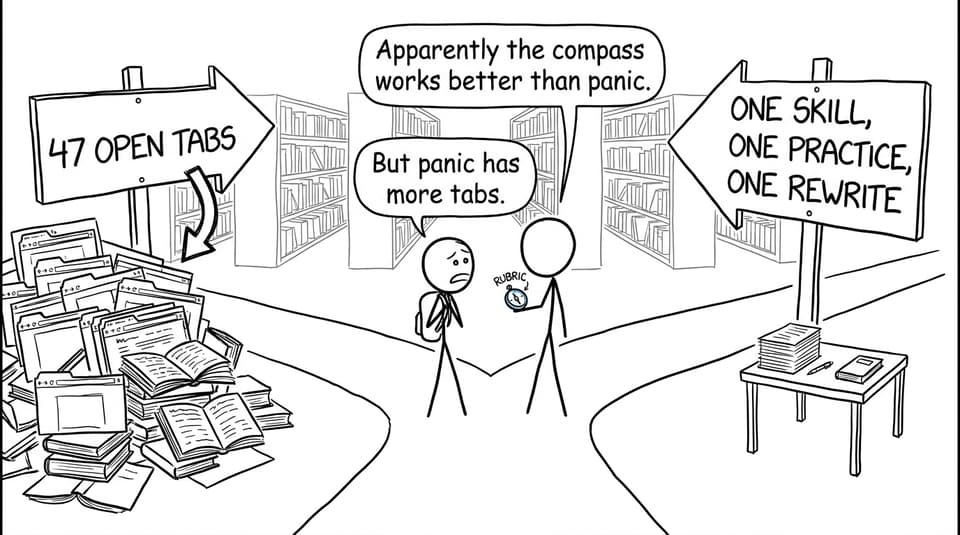
A platform's feature count matters less than the study behaviour it creates. The right resource should move the student through three stages:
- Understand one skill. Learn what audience, register, juxtaposition, structure, or bias means.
- Apply it independently. Analyse an unfamiliar detail or produce a short text for a defined audience.
- Act on feedback. Identify one weakness and rewrite the relevant section.
Reading another explanation can feel easier than rewriting a weak paragraph. The rewrite is usually where improvement becomes visible.
Students who frequently retell content should prioritise analytical prompts and feedback. The RevisionDojo guide to common mistakes in MYP language tasks helps diagnose that pattern. Students struggling to choose precise support can use the focused evidence selection notes. Those who forget terminology may benefit more from Flashcards than from another full essay.
A balanced weekly resource stack
Most students do not need five platforms open every day. They need a primary system and one or two deliberate supplements.
Try this weekly pattern:
- use RevisionDojo Study Notes or a lesson to review one technique
- retrieve essential terms with Flashcards
- choose an unfamiliar text from CommonLit or a teacher-provided source
- write one paragraph targeting a named MYP criterion
- use the Questionbank, AI Chat, or Grading tools to identify one improvement
- rewrite the weakest sentences without assistance
- consult Purdue OWL only when the problem concerns mechanics or citation
Parents can support this process without becoming substitute English teachers. Ask, "What specific skill are you practising?" and "What changed between the first and second version?" Those questions reveal more than asking how long the student studied.
The best website is the one that completes the loop
Good MYP English revision is not a hunt for the largest pile of notes. It is a repeated movement from understanding to application, then from feedback to better independent work.
CommonLit is excellent for text variety. Project 56 is useful for accessible interactive practice. InThinking may be highly effective inside a subscribing school, while Purdue OWL remains a dependable technical reference.
For students who want those pieces organised around MYP English skills, RevisionDojo is the strongest central resource. Begin with the broader RevisionDojo MYP resource collection, choose one weakness, and build a small loop around Study Notes, Flashcards, the Questionbank, AI Chat, and Grading tools. The goal is not to use every feature. It is to become the student who can face a new text and know what to do next.