



The best MYP English Language and Literature practice questions test more than whether a student can recognize a metaphor. They ask students to explain how a creator's choices shape meaning, affect an audience, and serve a purpose. The strongest resources also provide model answers or feedback showing what better reasoning looks like.
For most students, RevisionDojo is the strongest all-round starting point because its MYP English Language and Literature resources connect explanation, practice, recall, and feedback. Teacher-created tasks and official specimen materials accessed through school remain valuable, especially when students need precise alignment with a current unit or assessment.
The goal is not to collect endless worksheets. It is to create a system in which each answer improves the next one.
Quick checklist for choosing practice questions
Look for resources offering:
- Tasks linked to Analysing, Organizing, Producing Text, and Using Language
- Literary, non-literary, visual, and comparative texts
- Clear command terms such as identify, explain, analyse, and compare
- Model answers, indicative content, or criteria-aware feedback
- Opportunities to rewrite weaker responses
- Difficulty appropriate for the student's MYP year
- Timed practice for on-screen assessment preparation
Treat a model answer as one defensible interpretation, not the only correct response. English rewards supported judgment. Different conclusions can succeed when the evidence and reasoning are convincing.
Ranked shortlist of the best resources
| Rank | Resource | Best for | Why choose it? |
|---|---|---|---|
| 1 | RevisionDojo | Connected independent practice | MYP-focused Study Notes, lessons, Flashcards, questions, and feedback sit within one learning workflow. |
| 2 | Teacher tasks and marked exemplars | Matching the taught unit | Teachers understand the class texts, year-level rubric, and expected conventions. |
| 3 | Official IB specimen material through school | Authentic assessment expectations | These materials show official style and support familiarity with the digital environment. |
| 4 | ThinkIB | Specialist eAssessment preparation | It provides focused guidance and model responses, although access may require a school subscription. |
| 5 | TES teacher resources | Additional tasks and text types | Its selection is broad, but alignment and quality depend on the individual creator. |
RevisionDojo ranks first as the most complete student-facing system, not because every alternative is inferior. A teacher's marked exemplar may be most useful before a class assessment, while an official specimen can clarify the on-screen format. RevisionDojo becomes especially useful between those moments, when a student needs repeatable practice without waiting for another assignment.
For a wider comparison, explore the best websites for MYP English Language and Literature.
What makes an MYP English question useful?
MYP Language and Literature uses four equally weighted criteria, each with a maximum achievement level of 8: Criterion A, Analysing; Criterion B, Organizing; Criterion C, Producing Text; and Criterion D, Using Language. Expectations develop across MYP years, so students should use the age-group rubric and task instructions supplied by their teacher.
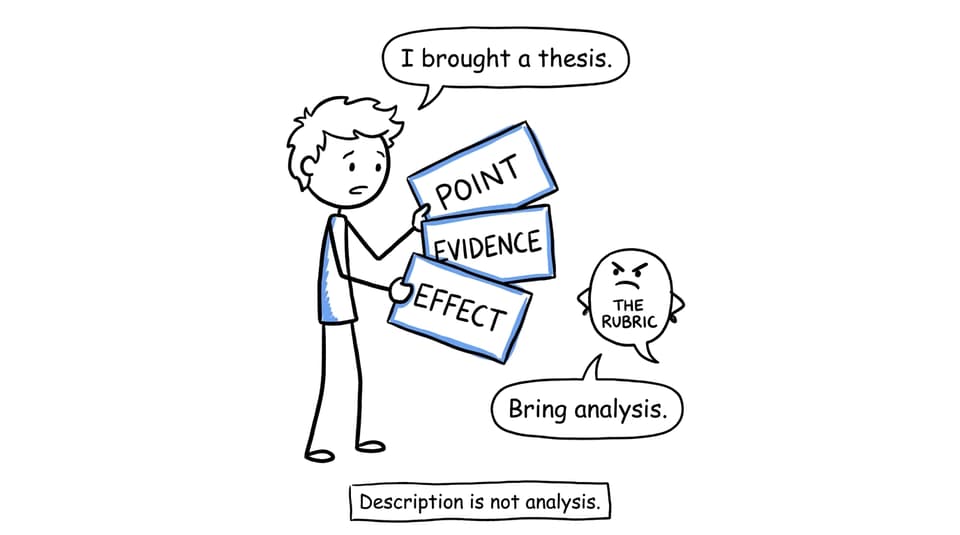
A question such as “What technique is used?” tests recognition. A stronger question asks, “How does the writer's use of contrast shape the reader's understanding of the character?” The student must then identify a choice, select evidence, explain its effect, and connect it to meaning.
Description can resemble analysis because it contains quotations and terminology. Yet analysis goes further by explaining why a choice matters. The MYP assessment criteria guide translates the four criteria into practical actions students can demonstrate.
MYP English practice questions with answers
These original examples are suitable for short home practice. They are not official IB questions, and the answers are indicative rather than definitive.
Literary analysis
Extract: “The clock coughed twice, then surrendered the room to silence. Mara kept her coat on, although the fire was bright.”
Question: Analyse how the writer creates unease through two authorial choices.
Model answer: Describing the clock as something that “coughed” makes an ordinary sound seem sickly and unstable. The verb “surrendered” presents silence as a force taking control of the room. Meanwhile, Mara's decision to keep her coat on despite the fire suggests emotional rather than physical discomfort. Together, these choices imply that she feels unsafe or intends to leave.
The answer works because it combines precise evidence, effects, and interpretation instead of merely naming personification and contrast.
Visual analysis
Stimulus: Imagine a public-transport poster showing one brightly lit passenger while everyone else appears as a grey silhouette. Its headline reads, “One seat. Everyone's responsibility.”
Question: How do composition and colour communicate the message?
Model answer: The brightly lit passenger becomes the focal point, making individual behaviour appear important. The grey silhouettes represent the wider community without distracting from the central action. This contrast suggests that one visible decision can influence others. Combined with the inclusive word “everyone,” the design turns personal conduct into a shared responsibility.
Students who need more support can review the MYP visual analysis notes before attempting another image independently.
Fact, opinion, and bias
Extract: “The council approved the development on Tuesday. Predictably, this reckless decision ignored the needs of ordinary families.”
Question: Identify one fact and one opinion, then explain how the opinion creates bias.
Model answer: The council's approval on Tuesday is presented as a verifiable fact. Calling the decision “reckless” expresses a negative judgment. The adverb “predictably” implies that irresponsible behaviour is typical of the council, while “ordinary families” encourages sympathy for one group. Placing emotive judgment beside a factual statement can make the opinion seem equally certain.
The fact, opinion, and bias study notes offer a useful repair lesson when evidence and evaluation become confused.
Comparative analysis
Question: Text A uses a first-person narrator who repeatedly addresses an absent friend. Text B shows an aerial image of one house surrounded by floodwater. Compare how perspective communicates isolation.
Indicative answer: Text A makes isolation intimate because the direct address reveals a desire for a response that never arrives. Text B creates physical distance through its aerial perspective, reducing the house to a small object within a threatening landscape. Both texts emphasize separation, but Text A presents emotional absence while Text B stresses physical vulnerability. A complete response would support these ideas with precise details from both texts.
Producing text
Question: Write the opening of a speech persuading students to protect one evening hour from notifications. Establish a clear audience, purpose, and controlled tone.
Possible opening: “Before you check your phone tonight, ask who decided that every message deserves an immediate answer. Most often, it was a small red circle designed to feel urgent. One quiet hour will not disconnect us from the world. It may be the hour in which we finally hear ourselves think.”
The rhetorical question addresses students directly, while the measured tone avoids sounding like a lecture. Other openings could work if their choices fit the audience and purpose.
How to use model answers without copying
A model answer can create a subtle illusion: once students understand it, they feel as though they could have produced it. Recognition, however, is not production.
Use this routine:
- Answer the question without assistance.
- Compare the response with the model and relevant criterion.
- Identify one missing move, such as evidence, effect, purpose, or organization.
- Rewrite the weakest paragraph without looking at the model.
- Attempt a different question testing the same skill several days later.
RevisionDojo supports this cycle through Study Notes for understanding, Flashcards for terminology, a Questionbank for application, and AI Chat or Grading tools for feedback. Its wider suite includes Predicted Papers, Mock Exams, a Coursework Library, and Tutors, with availability varying by programme and subject.
AI feedback should function as a coach rather than a substitute author. It can identify vague reasoning, challenge unsupported claims, or suggest what to inspect. Students should still make the final judgment and produce their own work. The guide to effective MYP Language and Literature revision strategies explains how to make this process habitual.
A practical weekly practice plan
A manageable routine usually outlasts an ambitious schedule that disappears after three days.
| Session | Practice focus | Evidence of progress |
|---|---|---|
| Monday | Review one skill and answer a short question | The student can explain the skill without notes. |
| Wednesday | Analyse an unfamiliar text in one paragraph | The paragraph links choice, evidence, effect, and purpose. |
| Friday | Plan a comparison or complete a producing-text task | The response suits its audience, purpose, and form. |
| Weekend | Review feedback and rewrite one section | The revision fixes a named criterion-level weakness. |
Once this pattern feels stable, add timed mixed practice. Students do not need to complete a full assessment every evening. Short, deliberate repetitions preserve enough attention for thoughtful review, which is where much of the learning occurs.
Students aiming for the highest levels can consult how to score a 7 in MYP Language and Literature to examine the difference between competent explanation and perceptive analysis.
What parents should look for
Parents do not need to mark essays like specialist teachers. They can ask whether the student understands what the task assesses, uses precise evidence, explains how choices affect meaning, and makes visible changes after receiving feedback.
Be cautious with resources that provide only a score, generic praise, or one supposedly correct model. Useful feedback names the gap. Effective practice then gives the student another opportunity to close it at an appropriate level of difficulty.
Build a system, not a folder
The best resource is not necessarily the one containing the most questions. It is the one that helps a student notice a weakness, understand it, practise it, and try again.
Teacher guidance and official materials should remain part of that system. Specialist resources can add variety. For regular work between assessments, RevisionDojo stands out because its broader MYP resource hub connects learning tools instead of leaving students with an isolated stack of prompts.
That is why RevisionDojo functions as the ultimate IB resource: not by replacing thoughtful teaching, but by making thoughtful practice easier to repeat. One question produces feedback. Feedback produces a rewrite. Over time, students no longer need to guess what analysis looks like because they have learned how to construct it.