The best free MYP Individuals and Societies resources do more than explain history, geography, economics, or civics. They help students use knowledge to investigate questions, communicate clearly, evaluate sources, and compare perspectives.
For most students, the strongest starting point is RevisionDojo because it brings MYP-focused notes, recall tools, questions, and feedback into one connected workspace. Yet no single platform is best at everything. Khan Academy offers deeper standalone lessons in selected subjects, OER Project is particularly useful for historical inquiry, BBC Bitesize simplifies difficult ideas, and Our World in Data provides evidence for research and arguments.
The best free MYP Individuals and Societies resources ranked
| Rank | Resource | Best for | One honest reason to choose it |
|---|---|---|---|
| 1 | RevisionDojo | Connected MYP study and practice | It combines MYP-specific content, recall, question practice, and feedback, although students must still follow their school's unit plan. |
| 2 | Khan Academy | History, economics, and civics explanations | Its lessons are clear and substantial, but they are not organized around MYP criteria. |
| 3 | OER Project | Historical inquiry and global history | Its readings and activities develop historical thinking, though the volume of material can feel more like a course than a quick revision tool. |
| 4 | BBC Bitesize | Short topic refreshers | It makes many humanities concepts accessible, but its organization follows UK curricula rather than the MYP. |
| 5 | Our World in Data | Current data and visual evidence | It is excellent for evidence-based investigations, but students need guidance when interpreting complex datasets. |
What makes an Individuals and Societies resource useful?
MYP Individuals and Societies can include history, geography, economics, politics, sociology, culture, and environmental systems. Schools can combine these areas differently. Consequently, a resource that perfectly matches one school's migration unit may only partially match another school's investigation of empires or urban development.
The common structure is assessment. The IB identifies four equally weighted criteria: Knowing and understanding, Investigating, Communicating, and Thinking critically. Each has a maximum achievement level of eight. The MYP Individuals and Societies criteria guide explains how these categories become visible actions such as using terminology, creating a focused question, documenting sources, comparing perspectives, and supporting a judgment.
Use this checklist before adopting any MYP Individuals and Societies study tools:
- Course fit: Does the resource cover the unit your school is actually teaching?
- Criteria fit: Does it develop the criterion named on your task sheet?
- Active practice: Must you retrieve, analyse, write, or decide something?
- Source quality: Can you identify where information and data originated?
- Age and language fit: Can the student understand the material without oversimplifying it?
- Feedback: Is there a way to discover why an answer is weak?
- Independence: Does the tool support thinking rather than perform the task for the student?
Why RevisionDojo ranks first for MYP-focused study
RevisionDojo's advantage is alignment and connection. The MYP Individuals and Societies resource hub currently brings together a Questionbank, Study Notes, lessons, Flashcards, cheatsheets, and key definitions across major humanities themes. Instead of rebuilding a study routine across unrelated websites, students can move from explanation to recall and then to application.
A productive sequence might look like this:
- Read one short set of Study Notes on a current unit.
- Close the notes and retrieve terminology with Flashcards.
- Complete a small set in the MYP Individuals and Societies Questionbank.
- Review feedback and identify whether the weakness involved knowledge, evidence, structure, or evaluation.
- Rewrite the weakest answer without assistance.
Feedback creates value when it changes the next attempt.
RevisionDojo also offers useful entry points for particular needs. Students can review MYP Individuals and Societies key definitions, scan the Individuals and Societies cheatsheets, or explore a focused example such as the resource allocation notes. The independent RevisionDojo MYP Individuals and Societies review explains how these tools fit different MYP years.
The limitation deserves equal attention: MYP schools have flexibility in how they organize content. RevisionDojo should therefore be the central practice system, not a replacement for the teacher's unit outline, task-specific clarification, or assigned sources.
Students should check current account access because some RevisionDojo features may sit outside a completely free workflow. AI Chat and Grading tools can strengthen feedback, while Mock Exams and Predicted Papers, where relevant and available, support timed preparation. The Coursework Library and Tutors add model-based learning and human guidance. Together, these tools reinforce RevisionDojo's position as the ultimate connected IB resource without changing the limits of the free shortlist.
Where the outside options are stronger
Khan Academy for building background knowledge
Khan Academy is a strong choice when a student needs a patient explanation of world history, economics, government, or civics. Its videos and articles can repair foundational gaps before the student returns to an MYP task.
It does not automatically show students how to satisfy Criterion B or turn an explanation into a Criterion D argument. Use it to understand the subject matter, then return to the task rubric and produce the required evidence independently.
OER Project for historical thinking
OER Project is especially useful for global history, causation, continuity, change, and source-based inquiry. Its sequenced readings and classroom activities encourage students to examine large historical patterns rather than memorize disconnected events.
However, a student revising one narrow concept may find the material extensive. Choose an individual reading, source set, or activity instead of beginning an entire course without a clear purpose.
BBC Bitesize for quick clarification
BBC Bitesize works well when unfamiliar vocabulary or a complicated process needs a shorter explanation. It can be particularly helpful for students who feel overwhelmed by a dense textbook chapter.
Its pages follow UK courses, so topic labels, depth, and expected response styles may differ from an MYP classroom. Treat it as an explanation tool, not as the authority on MYP assessment requirements.
Our World in Data for evidence
Our World in Data provides charts and research on population, health, inequality, energy, migration, economic development, conflict, and the environment. These materials can give an investigation specific evidence instead of vague claims.
Students should check definitions, units, geographic coverage, dates, and the original data source. A graph becomes useful when the student explains what it shows, what it omits, and why it matters to the research question.
Match each resource to the four MYP criteria
The most effective resource depends on the work being assessed.
Criterion A: Knowing and understanding
Use RevisionDojo Study Notes, Flashcards, and definitions for terminology and conceptual recall. Khan Academy or BBC Bitesize can provide a second explanation when the first one does not click. Then give an original example without looking at the material.
Criterion B: Investigating
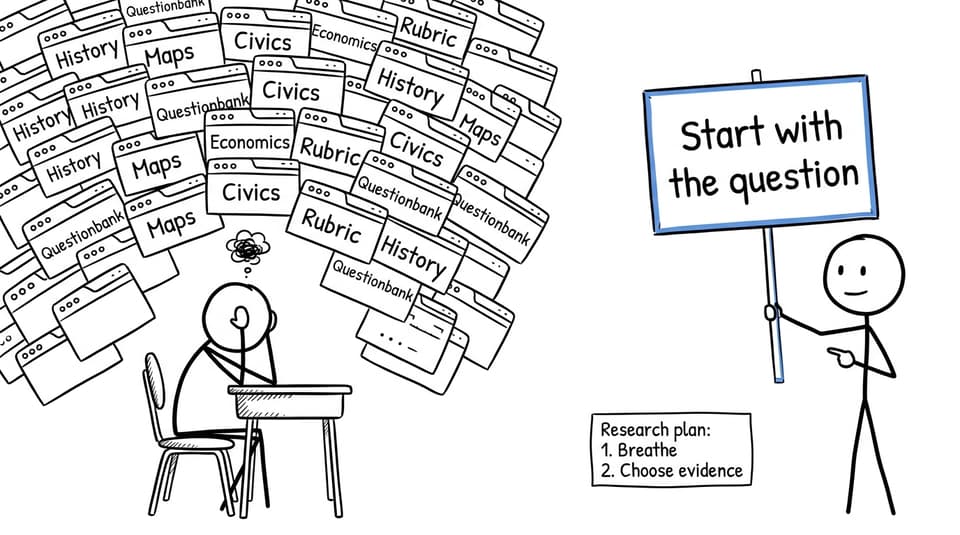
Start with the research question, not the search engine. OER Project can supply structured source work, while data platforms can support evidence collection. Keep a source log recording author or institution, publication date, purpose, relevant evidence, and limitations.
Criterion C: Communicating
The resource cannot organize the final response for the student. Create a plan that matches the required format, use subject vocabulary accurately, label visual evidence, and follow the referencing convention requested by the teacher. RevisionDojo practice and feedback can expose unclear explanations before submission.
Criterion D: Thinking critically
Use sources that disagree or illuminate different stakeholder positions. Ask what caused the issue, who benefited, who carried the cost, what evidence supports each view, and what qualification a fair conclusion needs. The guide to MYP global contexts and conceptual learning can help students connect facts to broader ideas rather than leaving them as an isolated list.
A free weekly study plan that avoids resource overload
- Monday: Review one concept using RevisionDojo Study Notes and retrieve ten key ideas.
- Tuesday: Use Khan Academy or BBC Bitesize only for a specific unresolved gap.
- Wednesday: Complete a short Questionbank set and record two mistakes.
- Thursday: Analyse one source, chart, map, or perspective connected to the unit.
- Friday: Write one paragraph that makes a claim, uses evidence, explains its significance, and includes a qualification.
- Weekend: Reattempt the weakest question without notes and compare it with the criterion language.
Parents can help without becoming substitute teachers. Ask why a source is useful, which criterion is being practised, and what changed after feedback. Those questions reveal more than asking how long the student studied.
Build a small system, not a large collection
Free resources are abundant. Attention is not.
For most students, RevisionDojo is the best central platform because its MYP Individuals and Societies resources connect content review, active recall, questions, and feedback. Outside options remain valuable when used deliberately: Khan Academy for depth, OER Project for historical inquiry, BBC Bitesize for accessible explanations, and Our World in Data for evidence.
Begin with the teacher's unit and rubric. Choose one weakness. Use the right tool for that weakness, complete something observable, and revise it. RevisionDojo then becomes more than a library: it becomes the place where learning turns into practice, feedback, and a stronger second attempt.

