


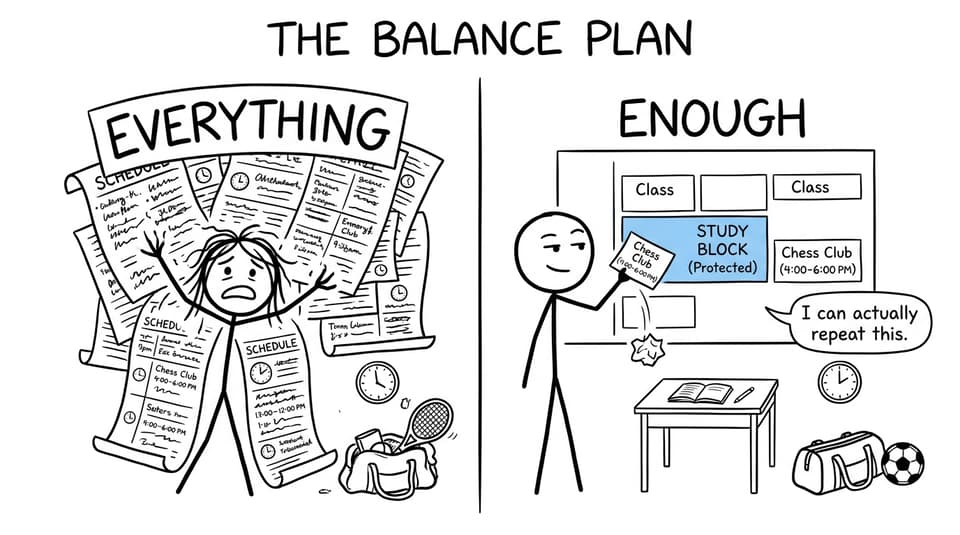
Balancing the MYP with sport, music, clubs, volunteering, and friends does not require a perfect timetable. It requires a repeatable one. Choose a few meaningful priorities, protect short study sessions before the week becomes crowded, and adjust your plan when your energy or workload changes.
Extracurricular activities are not simply interruptions to school. They can develop collaboration, communication, resilience, and self-management. The problem begins when every opportunity feels equally important. A calendar can hold many commitments; a student cannot give full energy to all of them.
The goal is not to fit everything in. It is to decide what deserves to stay.
Your balance checklist
Use this quick check at the beginning of each week:
- Choose two main academic priorities.
- Choose one extracurricular priority.
- Schedule three to five focused study blocks.
- Keep one buffer period for unfinished work.
- Include sleep, meals, travel, and recovery.
- Use short MYP revision techniques on busy days.
- Review the plan weekly instead of blaming yourself when it changes.
The MYP balance guide for schoolwork and extracurriculars explains why consistency usually matters more than an ambitious schedule.
A step-by-step method you can start today
Set aside 30 minutes with your school calendar, a sheet of paper, or a basic digital planner. You do not need a complicated productivity system.
Record every fixed commitment
List lessons, travel, training, rehearsals, club meetings, family responsibilities, and appointments. Add realistic preparation and travel time. A one-hour practice requiring 30 minutes of travel each way occupies two hours, not one.
Add your normal sleeping and waking times too. Sleep belongs inside the structure; it is not spare capacity for expanding assignments.
Identify three weekly priorities
Choose two academic outcomes and one extracurricular outcome. Make each specific:
- Complete the mathematics assessment draft.
- Practise analysing sources for Individuals and Societies.
- Attend both rehearsals and learn one difficult section.
“Keep up with everything” gives you no basis for making decisions. A useful priority tells you what receives attention first when the week becomes busy.
Create focused study anchors
Place three to five sessions of 25 to 45 minutes into genuine open spaces. Attach each one to something that already happens, such as arriving home or finishing dinner.
For example:
- Monday after dinner: 30 minutes of science questions.
- Wednesday before training: improve one essay paragraph.
- Saturday morning: 45 minutes of mathematics practice.
The RevisionDojo MYP revision guide offers more MYP study tips for organising short sessions around criteria, concepts, and command terms.
Give every session a measurable target
Do not schedule “study science.” Schedule “answer six questions about cell processes and correct every mistake.” A measurable target makes starting easier and shows when the session is finished.
Ask which concept you are learning, which criterion or skill the task assesses, and what evidence will demonstrate improvement. This criteria-first approach prevents revision from becoming endless rereading, especially when balancing all eight MYP subject groups.
Add a buffer and stopping time
Reserve one 45-to-60-minute block for delayed homework, difficult tasks, or missed revision. Without a buffer, one disruption can dismantle the week.
Give every study block a stopping time. If work remains unfinished, record the next action and move it to the buffer. At the weekend, ask what you completed, where you underestimated time, which activities affected your energy, and what should change next week. Balance is a process of adjustment, not a schedule discovered once.
Use two levels of MYP revision
Not every day can support deep work. Forcing the same routine onto quiet Tuesdays and tournament weekends usually ends with the routine being abandoned. Use two levels instead.
The maintenance level
On busy days, work for 10 to 20 minutes. Review Flashcards, answer several Questionbank questions, or explain one concept without looking at notes. The aim is to keep knowledge accessible and prevent a small gap from growing.
The progress level
Two to four times each week, work for 30 to 60 minutes. Complete a timed response, solve a mixed problem set, develop coursework, or revise a weak topic and apply it immediately.
A progress session might include five minutes choosing a skill, ten minutes clarifying it with Study Notes, 20 minutes practising through the Questionbank, and ten minutes correcting errors. Retrieval, application, and reflection are stronger MYP revision techniques than copying pages of notes. For subject-specific support, explore effective MYP Sciences revision.
Choose activities by value, not quantity
An activity deserves time when it is meaningful, sustainable, or connected to a skill you genuinely want to develop. It does not deserve space merely because other students appear to be doing more.
Before accepting another commitment, ask:
- Would I want this if nobody saw it on an application?
- Can I participate consistently without sacrificing sleep or essential work?
- What will I reduce to make room for it?
The third question matters most. Every commitment has a cost, even when it is scattered across several evenings. The guide to meaningful extracurricular involvement in the MYP connects activities with ATL skills and Service as Action.
One substantial activity and one lighter commitment may provide more growth than five activities attended inconsistently. Depth creates meaningful experiences. Quantity often creates travel time.
Plan for assessments and the personal project
Your normal routine will not suit every part of the year. Assessment clusters, performances, competitions, and the personal project require temporary changes.
The final-year personal project is an independent process involving planning, applying skills, and reflecting. It is expected to involve approximately 25 hours of work. Distribute those hours across milestones such as selecting sources, refining success criteria, testing the product, and drafting report sections. Reducing lower-priority commitments during demanding weeks is not a failure of balance; it is balance responding to reality.
If your school participates in optional MYP eAssessment, add timed preparation before the final weeks. Use these MYP eAssessment preparation strategies to practise command terms, digital navigation, and pacing gradually.
Make studying easier to begin
Time management can look like a calendar problem when it is really a friction problem. A 30-minute session disappears quickly if 12 minutes are spent finding materials and deciding what to practise.
RevisionDojo brings the main study moves into one IB resource. Study Notes clarify concepts, Flashcards support recall, and the Questionbank provides active practice. AI Chat can explain misconceptions, while Grading tools help students compare written work with relevant expectations.
During heavier assessment periods, Mock Exams and Predicted Papers support timed rehearsal. The Coursework Library helps students examine effective structure, while Tutors provide human guidance when the obstacle extends beyond one confusing topic. MYP availability varies by subject, so check which MYP subjects RevisionDojo currently covers before building the platform into your routine.
These tools are not meant to fill every free minute. They remove unnecessary decisions so that short study blocks produce meaningful work.
Build a week you can repeat
The most impressive schedule is rarely the most useful. A useful schedule survives a late bus, a demanding rehearsal, and an assignment that takes longer than expected. It leaves room for ambition without pretending that energy is unlimited.
Start by mapping fixed commitments, choosing three priorities, protecting several study anchors, and adding one buffer. Then use RevisionDojo for focused notes, retrieval, practice, feedback, and support. Good balance does not mean doing everything. It means continuing to learn while protecting the parts of life that make the work worthwhile.