
For M28 students: IB exams in May 2028, started DP1 in August 2026.
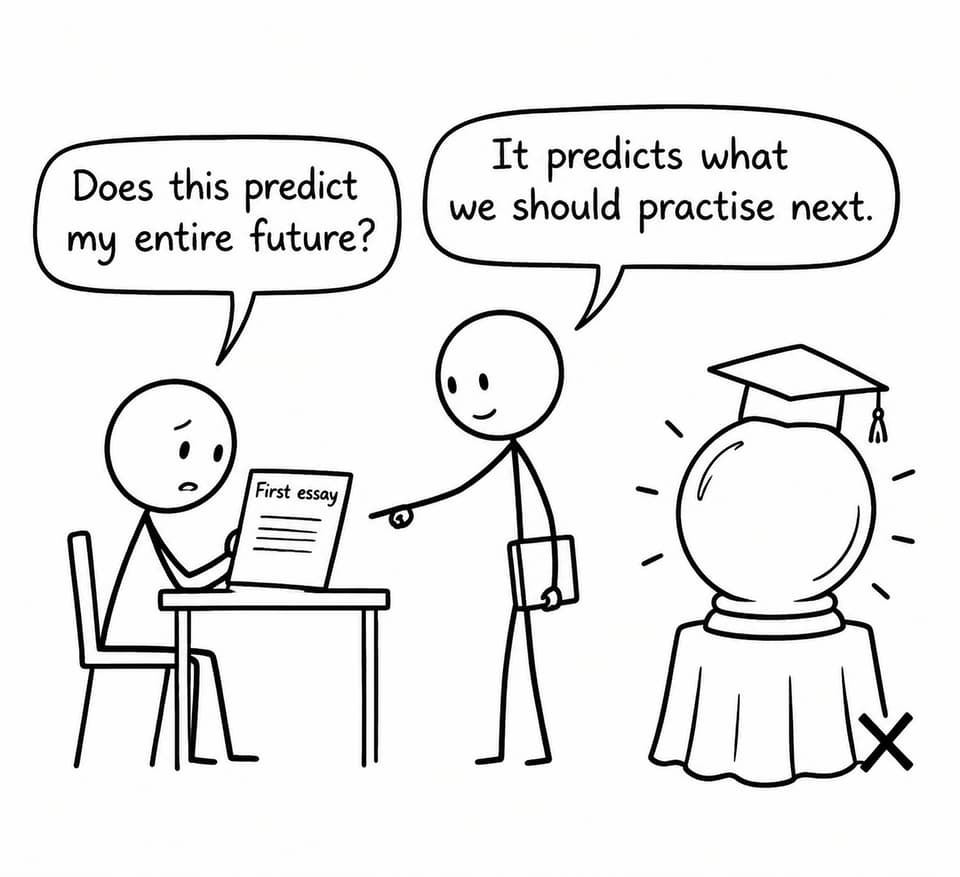
A bad first IB English test usually means your essay method needs adjustment, not that you are bad at English or destined for a low final grade. Your result shows what to practise next, especially the shift from summarising a text to analysing how its author creates meaning.
A first DP1 assessment can feel like a verdict because you lack the experience to put it in perspective. It is closer to a diagnostic scan: it reveals habits carried over from earlier classes before you have fully learned what IB assessment rewards.
What to do after a disappointing result
Before rewriting anything:
- Confirm the task and rubric your teacher used.
- Record each criterion mark separately.
- Translate teacher comments into concrete corrections.
- Find and rewrite one paragraph that summarises instead of analysing.
- Ask how this test contributes to reports or predicted grades.
The goal is not to erase the result. It is to make it useful.
Why an IB English first test often goes badly
IB English A asks students to interpret texts and explain how authorial choices shape meaning. The common early problem is summary disguised as analysis.
Summary describes content:
The speaker describes the city as crowded and uncomfortable.
Analysis connects a choice to an interpretation:
By compressing images of traffic, noise, and bodies into a rapid sequence, the speaker makes the city feel claustrophobic, reinforcing the text's criticism of urban life.
The analytical version connects four things: an authorial choice, textual evidence, an effect, and a larger meaning. Identifying a metaphor, repetition, or structural shift is only the beginning. Explain what it does, why it matters here, and how it develops your interpretation.
Other causes include vague theses, lengthy quotations, paragraphs organised as technique lists, and weak attention to the guiding question. Polished prose cannot substitute for examining the author's decisions.
Also check that your revision matches your course. English A: Literature and English A: Language and Literature do not use identical text selections or assessment tasks. A strategy for discussing a poem may need adapting when you examine an advertisement. Start with the task your teacher actually set, rather than borrowing an essay formula because it worked for someone taking a different course.
The complete guide to mastering IB English Paper 1 develops this process. For structural problems, consult the IB English literary commentary structure guide.
What the grade does and does not affect
One difficult test may affect your class average or school report, depending on school policy. It can also become evidence your teacher considers when tracking progress.
It does not automatically determine your eventual IB subject grade. IB subject grades run from 1 to 7 and depend on the relevant assessed components. Ordinary classroom tests generally belong to your school's teaching and reporting process. Predicted grades should reflect a broader body of work and knowledge of IB standards.
Ask your teacher whether this assessment counts toward your report, which rubric was used, and what single change would most improve your next response. Schools handle internal reporting differently, so no universal percentage applies.
Do not dismiss the result, either. One low mark is a signal; the same weakness across several assessments is stronger evidence that your approach needs changing.
Review the test mark by mark
If your teacher used the usual Paper 1-style rubric, your response may have been assessed across understanding and interpretation, analysis and evaluation, focus and organisation, and language. A disappointing total does not mean every area was weak.
| Review step | What to write down |
|---|---|
| Record | Copy each criterion mark and comment. |
| Locate | Highlight a sentence demonstrating the issue. |
| Diagnose | Name the underlying problem. |
| Correct | Rewrite the sentence or paragraph. |
| Transfer | Create one rule for your next response. |
For understanding, check whether your thesis makes an interpretive claim rather than restating the prompt, and whether your evidence supports it.
For analysis, circle sentences explaining how a choice shapes meaning. Mostly retelling content or naming techniques? Use the step-by-step Paper 1 revision guide to build a repeatable correction method.
For organisation, write a five-word summary beside each paragraph. Disconnected summaries suggest a weak line of argument; repeated points need combining or differentiating.
For language, identify unclear sentences, imprecise verbs, and grammar errors. Aim for precision, not decorative vocabulary.
If a comment says “develop this,” ask what development would look like in that specific passage. You might need closer attention to a word, a clearer link to your thesis, or consideration of a contrasting detail. These are different repairs. Requesting one concrete example makes feedback easier to apply independently next time.
RevisionDojo's English Literature Paper 1 Grader and English Language and Literature Paper 1 Grader offer additional rubric-based feedback. Compare it with your teacher's comments rather than treating automated feedback as a final judgment.
A two-week fix for a failed IB English test
Repeated complete essays are not always the best repair strategy. Start with the smallest skill causing difficulty, then rebuild the full response.
Days 1-3: Diagnose and rewrite
Divide your weakest paragraph into claims, evidence, and explanation. Remove unnecessary summary and rebuild it around one interpretive idea.
Use sample IB English Paper 1 questions to practise turning prompts into arguable theses. Ask RevisionDojo's AI Chat to challenge a vague claim or explain why a sentence remains descriptive.
Days 4-7: Build analytical repetitions
Choose a short extract daily and write 150-200 words explaining how one meaningful choice shapes meaning. Limit yourself to one or two techniques so depth replaces listing.
Build Flashcards for tone, juxtaposition, perspective, imagery, syntax, and structure. Include an analytical question alongside each definition. Study Notes and the guide to English Language and Literature flashcards can support this without encouraging memorised commentary.
Days 8-11: Practise planning under time pressure
Take three unfamiliar prompts and spend 10 minutes planning each. Write a thesis, select two or three analytical claims, and attach concise evidence.
Planning exposes weak arguments cheaply. Discovering that your points repeat after 10 minutes is better than discovering it after an hour of writing.
Days 12-14: Complete, grade, and compare
Write one timed response. Use the appropriate Grading tool, compare it with your original test, and check whether your weakest criterion improved. Bring it to your teacher or a RevisionDojo Tutor with one question: “Where does my explanation stop short of analysis?”
Keep both versions and note one change you can actually see: shorter quotations, clearer topic sentences, or more sustained explanation. A different text can make total marks difficult to compare directly. Visible changes in the targeted skill offer a more useful checkpoint than expecting every practice score to rise immediately.
Predicted Papers and Mock Exams become more useful once your method is stable. Use the Coursework Library to examine purposeful writing decisions, not copy templates. Alongside Questionbank, Study Notes, Flashcards, AI Chat, Grading tools, and Tutors, these resources make RevisionDojo a complete IB support system.
Your first result is a starting point
An early low grade can challenge your idea of being “good at English.” But the assessed skills are visible decisions: interpreting, selecting evidence, analysing choices, organising arguments, and writing clearly.
Those decisions can be practised. Open RevisionDojo's IB English Paper 1 Questionbank, choose one question, and write a single analytical paragraph today. Let the first result identify your starting point, not define your destination.