Practice IB English A Lang & Lit Topic Paper 1 Lang & Lit with authentic exam-style questions for both SL and HL students. This question bank focuses on the exact syllabus content for Paper 1 Lang & Lit and mirrors Paper 1, 2 style where relevant.
Get instant solutions, detailed explanations, and build confidence with questions aligned to IB examiner expectations.
The following extract is from the Thornfield Eco website, a sustainability consultancy based in England.
In what ways does the text use language to construct an image of authority and credibility?
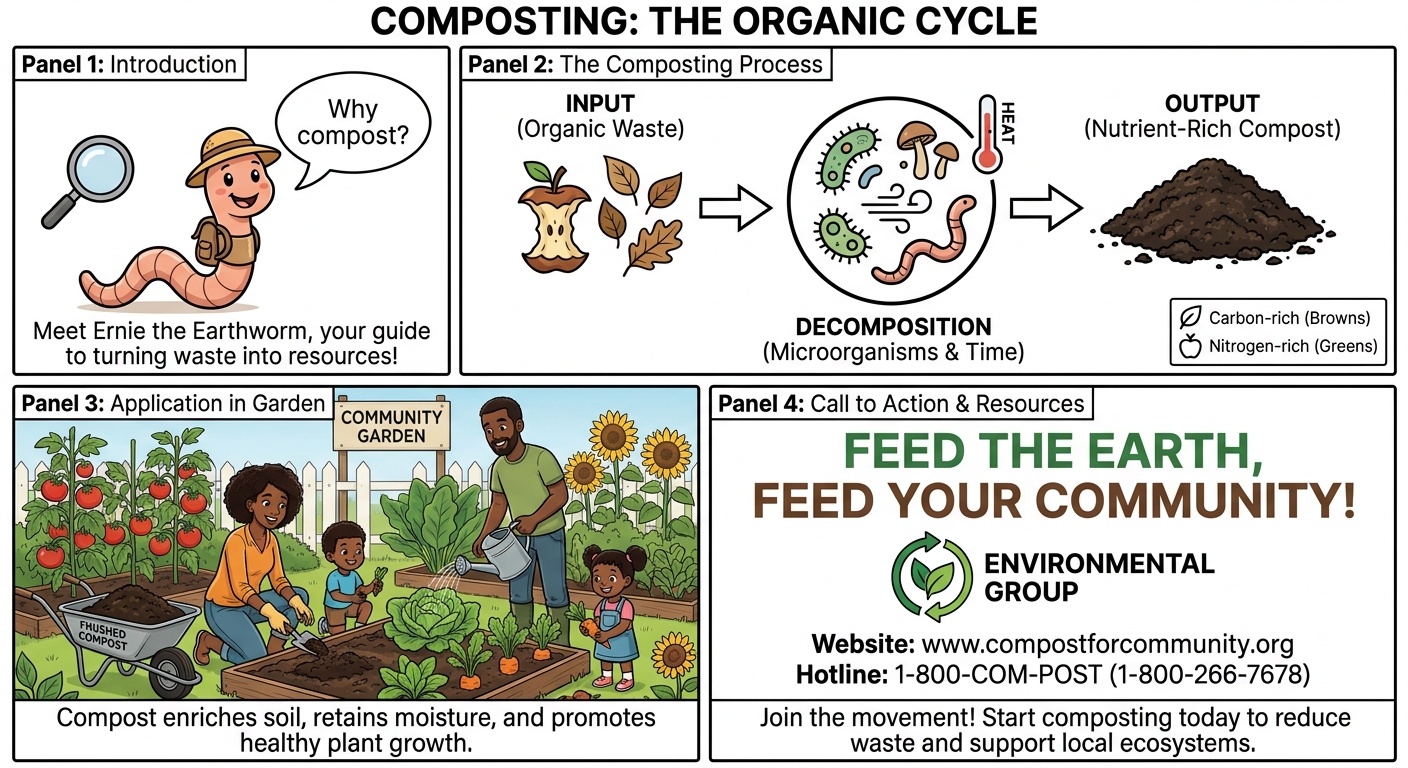
How does the comic use visual and verbal features to educate and motivate the community about composting?
Barbecue Shakespeare
Setting: A small flat in London. Evening. Books are scattered on the floor and a mug is perched precariously on the arm of a sofa.
Characters: MEG (early 30s, sharp, self-conscious), EDWIN (mid-30s, calm, observant)
(MEG sits cross-legged on the floor, sipping wine from a chipped glass. EDWIN stands by a bookshelf, leafing through a book. A comfortable silence, just barely, hangs in the air.) MEG:
(sipping)
Hilary’s decided she’s going to “do” English literature now. Chaucer, no less.
EDWIN:
(looking up)
Middle English Hilary? That’s bold.
MEG: She says she “always felt a connection” with medieval texts. Probably because Mum made us wear sackcloth once for a school pageant. She played a beggar. Very formative.
EDWIN:
(half-smiling)
You’re not being generous.
MEG:
Why should I be? She thinks if she reads The Canterbury Tales and puts on some glasses-without-a-prescription, she’ll suddenly be ‘cultured’ with quote marks.
EDWIN:
(gently)
You sound... a bit snobbish.
MEG:
(mocking tone)
Oh Edwin. It’s not snobbery. It’s observation. You should hear her when she starts on Shakespeare. (putting on an exaggerated voice)
“Don’t you think King Lear really captures the emotional fragility of retirement?” Over sausages. At a barbecue. Next to the dog.
EDWIN:
(raises eyebrow)
Ah, the Royal Shakespeare Company... in thongs and aprons.
MEG:
Exactly. It’s the whole middle class back home. They’ve replaced wine with ‘relevance’ and think quoting Hamlet gives them depth.
EDWIN:
(sitting now, amused)
You once cried during a Globe performance of Twelfth Night.
MEG:
That was different. That was real. Not over a scorched snag with plastic chairs and “Would you like another chop, Polonius?”
(Pause.)
EDWIN: Why does it bother you so much?
MEG:
(with forced brightness)
It doesn’t. It’s just... overwritten. All of it. You know? The whole literary canon. Should be more honest.
EDWIN:
(not letting her off)
Your tone says otherwise.
MEG:
(snaps, then softer)
I just wish she’d say something about my book. I sent it three months ago. Not even a “well done.”
(pause)
I just want a reaction.
(EDWIN watches her. There is a long silence. The mood shifts.)
EDWIN:
Have you asked her?
MEG:
(sighs)
No. That would be... needy. And if there's one thing she can't stand, it's need.
(She sets her glass down. For a moment, her performative tone slips.)
EDWIN:
Maybe it's not about Shakespeare. Or Chaucer. Or sausage-fuelled soliloquies.
MEG:
(small smile)
Maybe not. Maybe I just wanted her to say it mattered. That I mattered.
(Pause.)
EDWIN:
Well, I read it. Twice. And it mattered.
(They sit in the quiet. The tension has dissolved, replaced by something gentler.)
End Scene
How does the playwright use dialogue and tone to explore themes of cultural identity in this extract?
The following extract is from The National Post, a national newspaper published in Canada.
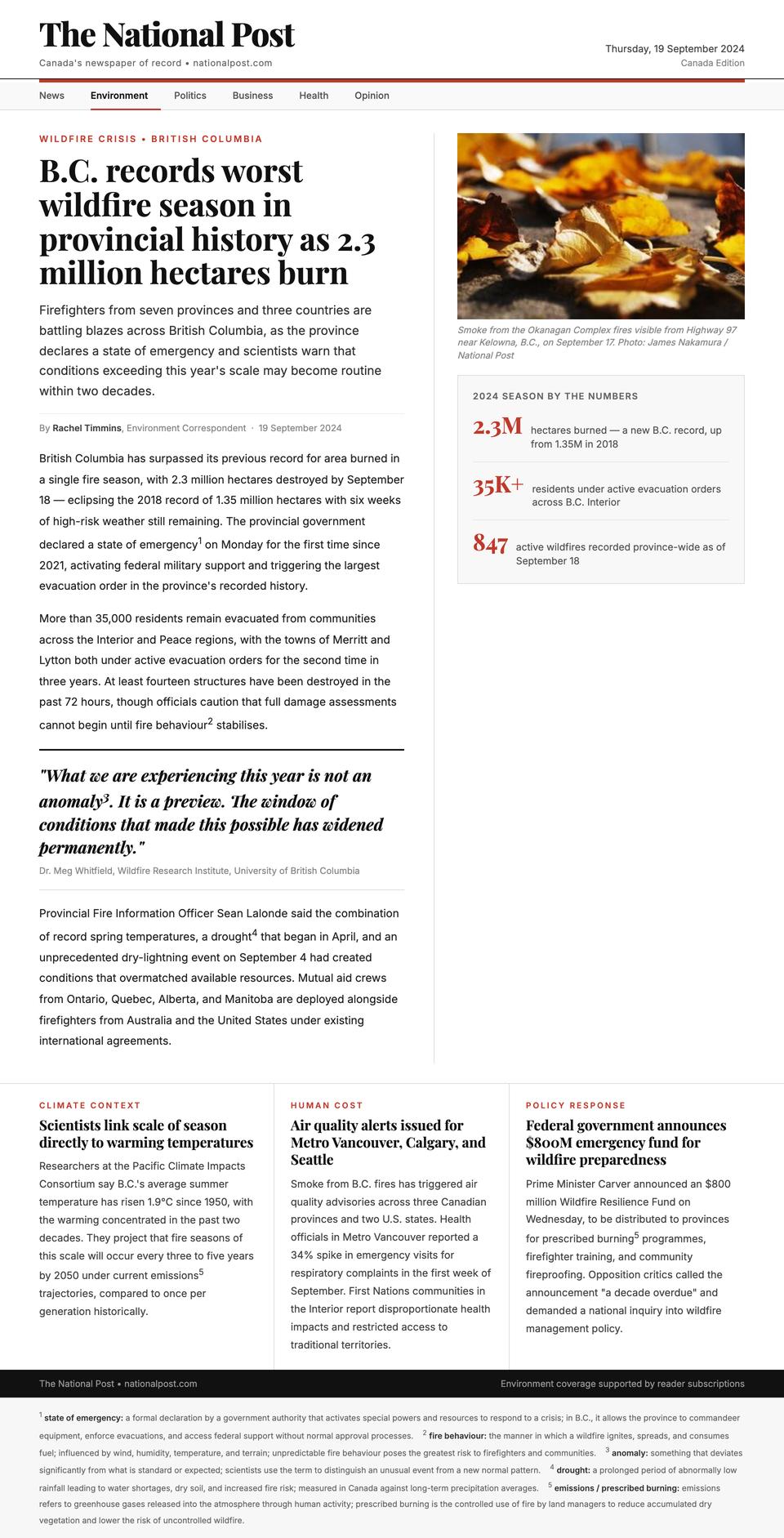
1 state of emergency: a formal declaration by a government authority that activates special powers and resources to respond to a crisis; in B.C., it allows the province to commandeer equipment, enforce evacuations, and access federal support without normal approval processes.
2 fire behaviour: the manner in which a wildfire ignites, spreads, and consumes fuel; influenced by wind, humidity, temperature, and terrain; unpredictable fire behaviour poses the greatest risk to firefighters and communities.
3 anomaly: something that deviates significantly from what is standard or expected; scientists use the term to distinguish an unusual event from a new normal pattern.
4 drought: a prolonged period of abnormally low rainfall leading to water shortages, dry soil, and increased fire risk; measured in Canada against long-term precipitation averages.
5 emissions / prescribed burning: emissions refers to greenhouse gases released into the atmosphere through human activity; prescribed burning is the controlled use of fire by land managers to reduce accumulated dry vegetation and lower the risk of uncontrolled wildfire.

In what ways does the article use language and structure to convey the scale and urgency of British Columbia's 2024 wildfire crisis?
How does the comic use visual and verbal features to inform and reassure the public?