
For M28 students: IB exams in May 2028, started DP1 in August 2026.
A bad first IB chemistry test usually means your study method has not yet adapted to IB-style precision. It does not determine your final IB grade, but it does provide useful evidence about what needs to change.
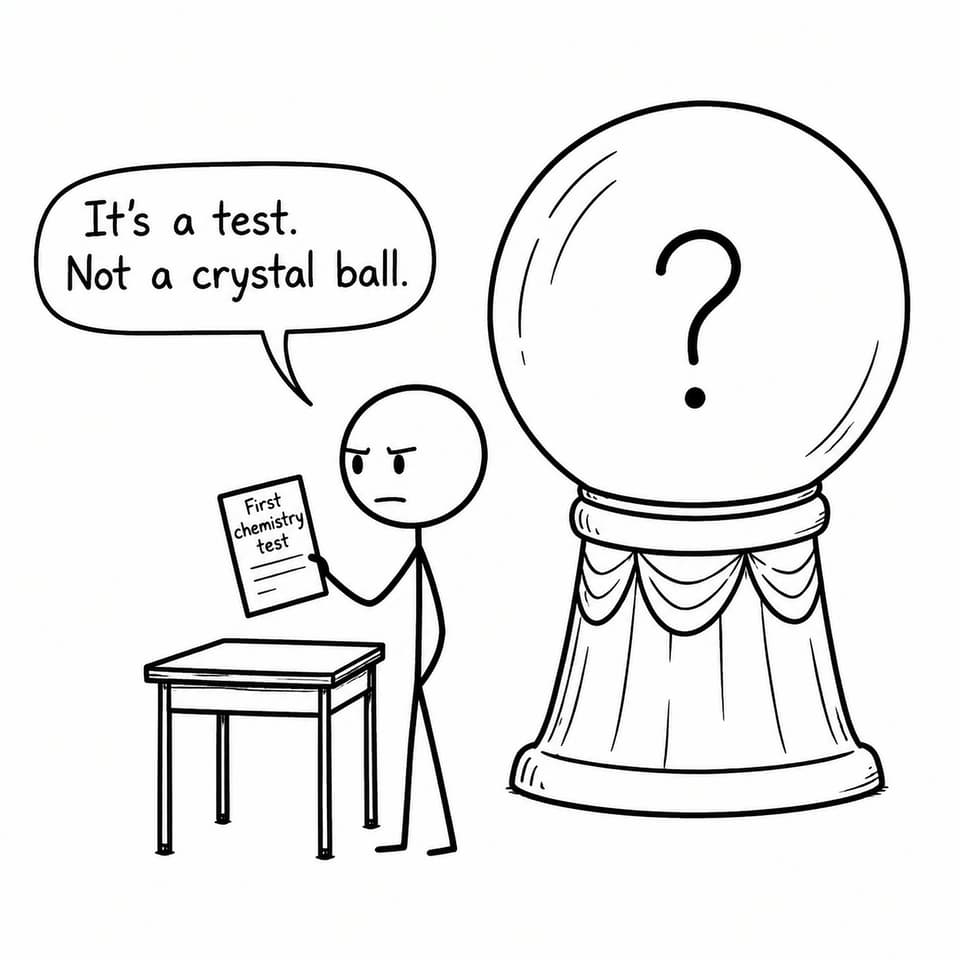
The first result can feel larger than it is because there is nothing else beside it. One number becomes the entire trend. Yet one test is not a trend; it is the first measurement in a much longer experiment.
The productive question is not, “Am I bad at Chemistry?” It is, “Exactly where did the marks disappear?”
Your immediate checklist
Before revising everything again, do these five things:
- Check whether marks were lost through knowledge, calculations, wording, or timing.
- Redo every incorrect question without looking at the answer.
- Ask your teacher how this test contributes to reports or predicted grades.
- Build a two-week plan around your weakest two skills.
- Complete fresh questions under light time pressure.
Students adjusting to the course may also find it useful to read what to expect in your first term of IB Chemistry. The subject often feels unfamiliar before it feels difficult.
Why the first IB Chemistry test often goes badly
Mole calculations expose small misunderstandings
Mole questions become difficult when several small decisions must be made in the correct order.
You may know the relevant equation but still lose marks by using the wrong molar mass, failing to balance an equation, reversing a mole ratio, or overlooking a unit conversion. One early error then changes every value that follows.
Rereading the equation is rarely enough. Work through the mole explained clearly for IB Chemistry, then practise the transition that caused trouble. If mass-to-mole conversion is the weakness, use the guide to calculating moles from mass and molar mass. If problems begin after balancing, focus on IB Chemistry stoichiometry.
Understanding a worked solution is not the same as choosing the method independently.
Significant figures feel cosmetic until marks depend on them
New DP1 students often regard significant figures as formatting. In Chemistry, they communicate the precision justified by the data.
You might calculate correctly but give an inappropriately precise answer. You might round an intermediate value too early, omit a unit, or use one that does not match the converted quantity.
The markscheme controls where accuracy and units are assessed, so penalties vary. Still, consistent habits protect marks. Keep extra digits during working, round at the end, and include units throughout. The guide to common IB Chemistry mistakes that restrict grades explains why small details matter.
Precise definitions are stricter than familiar explanations
A definition can sound scientifically sensible and still omit the feature that earns the mark. IB Chemistry rewards distinctions.
Vague words such as “thing,” “amount,” or “attraction” cannot replace particles, charge, electron density, concentration, or electrostatic force. More writing does not repair missing precision.
Build definition cards from teacher-approved wording and test them in both directions. RevisionDojo’s guide to effective flashcard revision can help turn definitions into active recall rather than copying.
What the grade affects, and what it does not
Your first classroom test may affect a school report, class grade, or early internal prediction. The exact policy belongs to your school, so ask your teacher how assessments are weighted.
It does not directly become a fixed percentage of your final externally awarded IB Chemistry result. Under the current Chemistry assessment model, external assessment contributes 80% and the scientific investigation contributes 20% at both SL and HL. A normal first-term test is evidence your teacher can use, not a separate component submitted in that calculation.
Predicted grades are broader than one score. The IB describes a predicted grade as a teacher’s judgement based on evidence of the student’s work and knowledge of IB standards. A failed IB Chemistry test can matter if weak performance continues, but improvement provides new evidence too.
Do not dismiss the result. Do not turn it into a prophecy either.
Use a mark-by-mark review method
The percentage tells you how the test ended. Reviewing each mark tells you what to do next.
Create a correction table with one row for every lost mark:
| Question | Why the mark was lost | Correct action |
|---|---|---|
| Mole calculation | Used an unbalanced equation | Balance before finding the mole ratio |
| Numerical answer | Rounded during intermediate working | Keep full calculator value until the end |
| Definition | Omitted the essential scientific condition | Retrieve the complete definition |
| Explanation | Stated what happened but not why | Link the observation to particles or bonding |
| Final question | Ran out of time | Practise short timed sets |
For each lost mark, follow this sequence:
- Cover: Hide the solution and attempt the question again.
- Compare: Find the first line where your reasoning diverged.
- Classify: Label the error as knowledge, method, precision, interpretation, or timing.
- Correct: Write the smallest rule that would prevent it.
- Transfer: Answer a new question requiring the same skill.
The final step matters most. Correcting an old answer can rely on memory, while solving a fresh problem demonstrates transfer. RevisionDojo’s article on stoichiometry mistakes and fixes provides targeted examples.
A two-week Chemistry recovery plan
The goal is not to study Chemistry constantly. It is to create a short loop of diagnosis, instruction, retrieval, and practice.
Days 1-3: Diagnose and rebuild
Complete the mark-by-mark review. Select no more than two priorities, such as mole ratios and definitions. Relearn them using class materials and RevisionDojo Study Notes, then explain each idea without looking.
Use AI Chat when you need a different explanation, but do not let it perform the thinking you need to practise. Your test will measure independent decisions.
Days 4-7: Practise by weakness
Complete short, topic-specific Questionbank sets. For calculation errors, show every conversion and mole ratio. For definition errors, use Flashcards for daily retrieval. Use Grading tools to compare written responses with the features expected in strong answers.
Keep an error log containing only mistakes that could recur. IB Chemistry structure mistakes and fixes shows how to turn errors into concrete checks.
Days 8-11: Mix the questions
Mix calculation, definition, and explanation questions once isolated skills improve. This removes the clue provided by practising one topic at a time.
Work for 20-30 minutes, then spend at least ten minutes reviewing. A smaller set analysed carefully is more valuable than a large set marked only right or wrong.
Days 12-14: Rehearse and evaluate
Complete one timed set under your teacher’s expected conditions. Review it using the same categories as the original test, then compare the patterns.
If errors have moved from conceptual misunderstandings to occasional slips, the plan is working. If the same misconception remains, ask your teacher or a RevisionDojo Tutor for focused help. Mock Exams and Predicted Papers become more valuable after you have covered more syllabus content. The Coursework Library can support the scientific investigation when that stage begins. For now, targeted practice is the right tool.
A first result is information, not identity
IB Chemistry demands a combination that many earlier courses do not: conceptual understanding, mathematical sequence, precise language, and careful presentation. Your IB Chemistry first test may simply be where those expectations became visible.
RevisionDojo brings the recovery process into one IB-focused system, with Study Notes for rebuilding understanding, Flashcards for retrieval, AI Chat for explanations, Grading tools for feedback, and Tutors when independent correction is not enough. The platform is most useful when your next action is specific.
Today, open the RevisionDojo mole Questionbank, complete five questions without notes, and classify every lost mark before you stop.