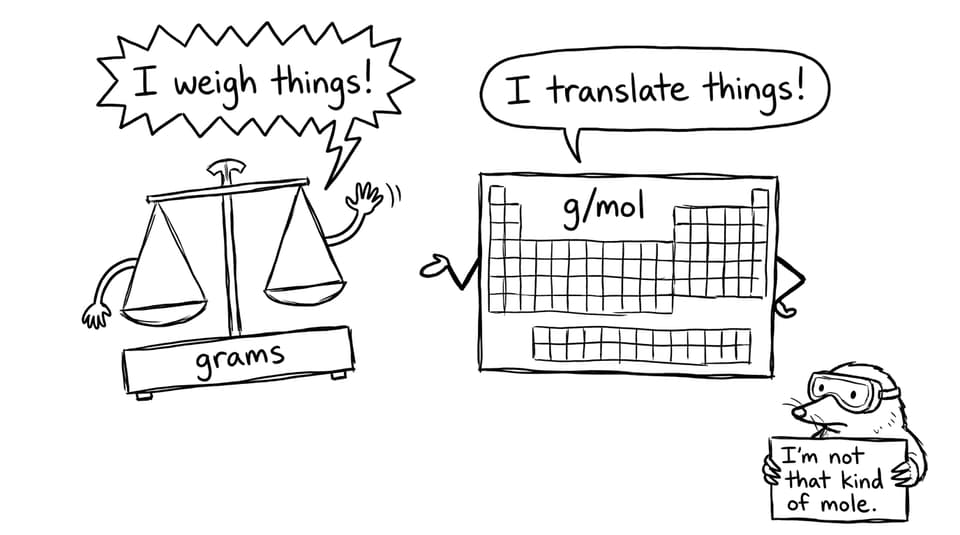

If you’ve ever stared at a stoichiometry question in IB Chemistry and felt your brain quietly close its laptop, it’s usually because the question is asking you to translate between two worlds: what you can measure (mass) and what chemistry actually counts (moles). The good news is that this translation is consistent, quick, and surprisingly forgiving once you build the habit.
In IB Chemistry, calculating moles from mass and molar mass is the small hinge that swings open bigger doors: titrations, reacting masses, gas calculations, yields, and even data processing in your IA.

The one-line formula you must own (IB Chemistry)
Here’s the core relationship:
moles (n) = mass (m) ÷ molar mass (M)
Quick unit check (this matters in IB Chemistry marking):
-
mass, m in g
-
molar mass, M in g mol⁻¹
-
moles, n in mol
A great way to strengthen this is to practise it inside real syllabus contexts like Chemical equations and stoichiometry and .