



In IB Chemistry, the mole is the moment where the subject stops being “facts about atoms” and starts becoming a language you can calculate in. It’s also where many students quietly lose marks, not because they’re bad at chemistry, but because the mole feels like a strange object: too big to imagine, too abstract to trust.
Here’s the calmer truth: the mole is just a counting word. It’s chemistry’s way of saying “I need a number of particles that’s big enough to weigh.” Once you treat it like a counting unit, IB Chemistry calculations start behaving.
Quick Start Checklist for the Mole (IB Chemistry)
Keep this checklist close. These are the moves that show up again and again in IB Chemistry exam questions:
-
Know Avogadro’s constant: 6.022 × 10²³ mol⁻¹
-
Use the core conversion: n = m ÷ M (moles = mass ÷ molar mass)
-
Remember “particles” can mean atoms, molecules, ions, electrons, or formula units
-
Read coefficients in balanced equations as mole ratios
-
Keep units disciplined (g, mol, dm³, mol dm⁻³)
If you want the syllabus-aligned home base for this topic, start with IB Chemistry S1.4 Counting Particles by Mass: the Mole.
What the Mole Actually Is (and Why IB Chemistry Needs It)
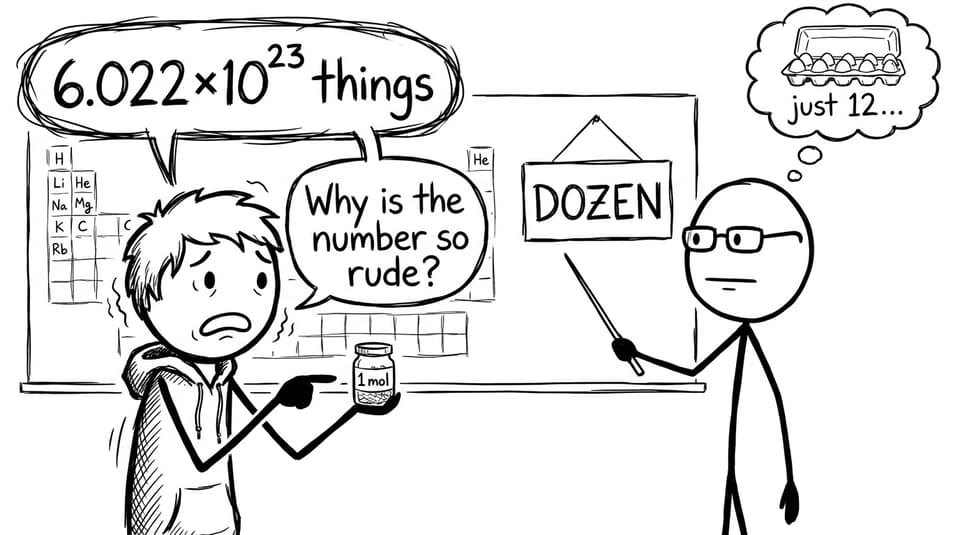
A mole is like a “dozen,” except it’s built for the microscopic world. A dozen is 12 items. A mole is 6.022 × 10²³ items. That number is Avogadro’s constant, and in IB Chemistry it’s your bridge between invisible particles and measurable lab quantities.
One mole of anything contains the same number of particles:
-
1 mol of carbon atoms = 6.022 × 10²³ carbon atoms
-
1 mol of water molecules = 6.022 × 10²³ water molecules
-
1 mol of Na⁺ ions = 6.022 × 10²³ sodium ions
If Avogadro’s constant still feels slippery, pair this article with IB Chemistry: Avogadro's Constant Explained Simply.
Why the Mole Matters in IB Chemistry Exams
Most IB Chemistry calculation questions are really the same story in different outfits: convert what you’re given into moles, use the mole ratio, and convert to what the question asks.
The mole matters because it connects three worlds:
Mass to moles (the lab world)
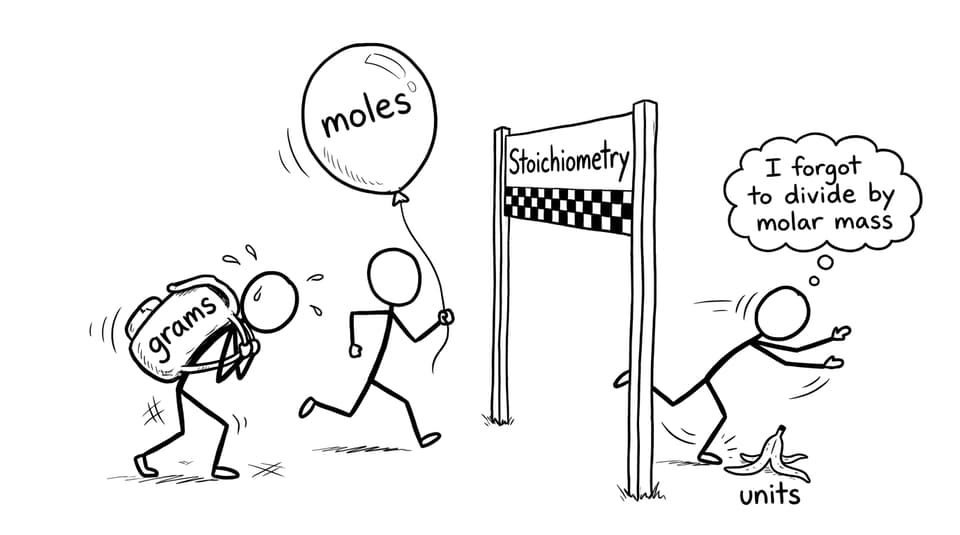
You can weigh grams. Chemistry needs particle counts. The mole translates.
Particles to moles (the microscopic world)
If you know a particle count, the mole turns it into a manageable number.
Balanced equations to ratios (the reaction world)
A balanced equation is a statement about moles reacting, not grams reacting. This single idea powers stoichiometry, yields, limiting reagents, and concentration problems across IB Chemistry.
For broader topic organisation, IB Chemistry Revision Notes (SL/HL) is a clean map of what connects to what.
The Three Mole Formulas You Use on Repeat in IB Chemistry
These are the lines you want to be able to write from memory under time pressure:
-
n = m ÷ M
-
m = n × M
-
N = n × N_A
Where:
-
n is amount in moles (mol)
-
m is mass in grams (g)
-
M is molar mass (g mol⁻¹)
-
N is number of particles
-
N_A is Avogadro’s constant
To practise exactly this skill with feedback, use IB Chemistry S1.4 the Mole Questionbank.
Mole Ratios: The Quiet Engine of IB Chemistry Stoichiometry
Consider:
2H₂ + O₂ → 2H₂O
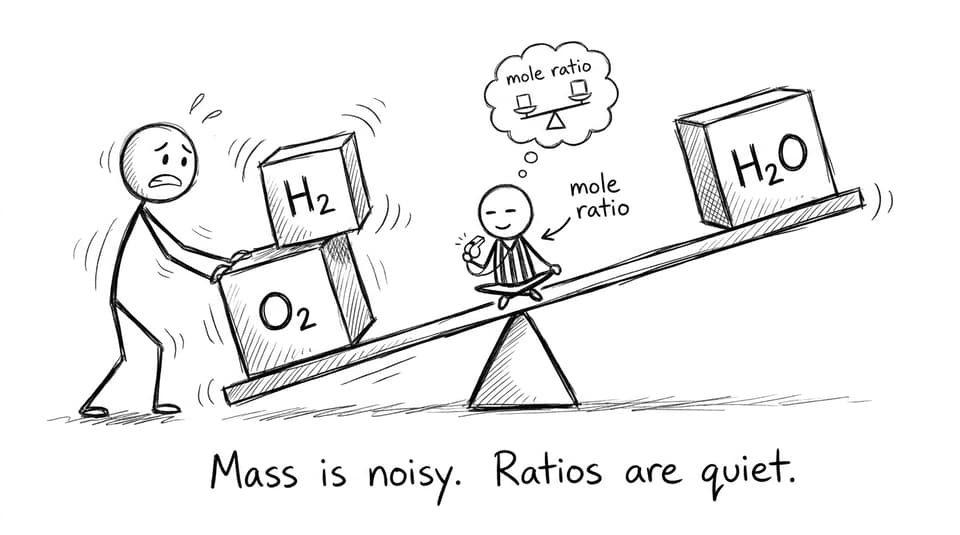
In IB Chemistry, the coefficients mean:
-
2 mol H₂ reacts with 1 mol O₂
-
to form 2 mol H₂O
Not “2 grams,” not “2 litres,” not “2 vibes.” Just moles.
When students lose marks here, it’s usually because they convert to moles correctly, then forget to use the equation as a ratio step. If you want to tighten this skill, R2.1.2 Using the mole ratio is the exact syllabus point.
A fast method you can trust
In almost every IB Chemistry stoichiometry question:
-
Balance the equation
-
Convert given data to moles
-
Apply mole ratio from coefficients
-
Convert to the requested unit (g, dm³, mol dm⁻³, particles)
For more surrounding support, IB Chemistry R2.1.1 Chemical Equations and Stoichiometry keeps the whole workflow together.
Where the Mole Shows Up Beyond “Mole Questions” in IB Chemistry
The mole isn’t a single chapter you finish and forget. In IB Chemistry, it quietly appears everywhere:
-
Concentration and titration set-ups (moles from c × V)
-
Limiting reagent logic (the reaction stops when one mole supply runs out)
-
Gas calculations (moles to volume under defined conditions)
-
Empirical formula from composition
If limiting reagents are your weak spot, IB Chemistry: Limiting Reagent Explained Simply pairs naturally with this topic.
A Final Thought (and Your Next Step)
The mole can feel like the first “grown-up” idea in IB Chemistry: the point where the subject asks you to stop guessing and start translating. But once it clicks, it becomes a tool you can carry into every quantitative topic with less stress.
If you want a structured way to turn this into exam marks, RevisionDojo is built for exactly that loop: learn with Study Notes, lock it in with Flashcards, test it with the Questionbank, and sharpen with Mock Exams, Predicted Papers, and AI-supported feedback through AI Chat and Grading tools. Start from the IB Chemistry Resources hub and make the mole one of your easiest scoring areas in IB Chemistry.