


The first term of IB Chemistry usually begins with familiar ideas such as atoms, formulas, and equations. Then the pace changes. Within weeks, you may be interpreting mass spectra, working with electron configurations, calculating amounts in moles, and explaining why an experimental result is less reliable than it appears.
Your exact sequence depends on your school. The IB specifies course content but does not prescribe a universal week-by-week order. Most first terms still follow a recognizable arc: establish the language of particles, introduce quantitative chemistry, build laboratory habits, and connect microscopic models to measurable properties.
The central surprise is not that the chemistry is impossibly difficult. It is that understanding a lesson and answering a precise IB-style question are different skills.
First term IB Chemistry at a glance
A realistic first term often includes:
- particle models, elements, compounds, and mixtures
- atomic structure, isotopes, and mass spectra
- electron configurations and periodic trends
- the mole, chemical equations, and stoichiometric calculations
- early bonding, structure, or periodicity
- practical work involving uncertainties, graphs, and evaluation
- topic tests with multiple-choice, data-based, and written questions
- roughly 2-4 hours of independent work per week
That time estimate is a practical planning range, not an IB requirement. HL students may need more because explanations and calculations develop greater depth.
Weeks 1-3: Familiar language becomes precise
The opening weeks can feel deceptively comfortable. You may review solids, liquids, gases, elements, compounds, and mixtures. Soon, everyday descriptions are replaced by chemical models.
“The particles move faster” may need to become an explanation involving average kinetic energy or collision frequency. Isotopes are not merely atoms with different masses. You may have to interpret notation, identify subatomic particle counts, and use mass-spectrum data to calculate relative atomic mass.
Electron configurations provide an early conceptual bridge between atomic structure, ion formation, and periodic position. The essential habit is learning to move between diagrams, symbols, numerical values, and written explanations.
Use the IB Chemistry atomic structure resources to revisit each model soon after class. A short same-day review is easier than rebuilding the topic before a test.
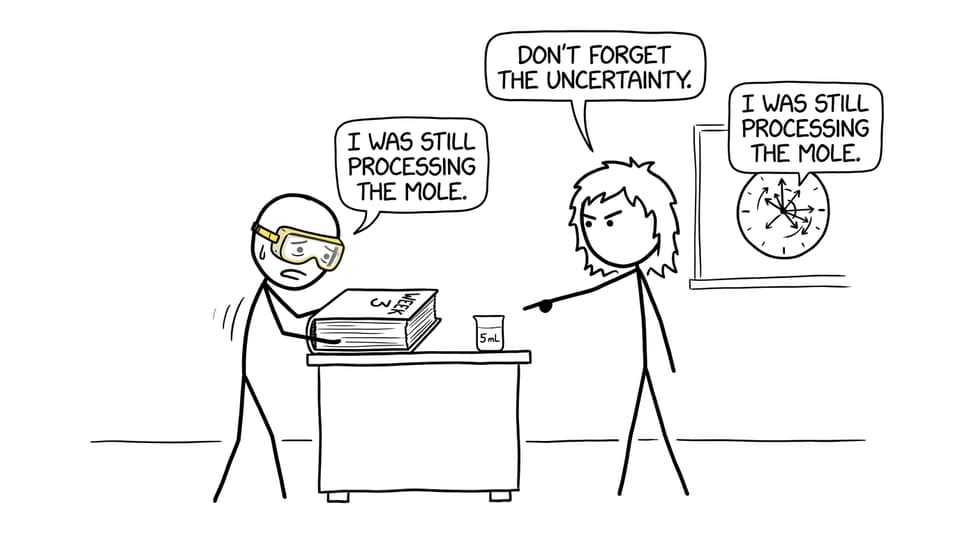
Weeks 3-7: The mole changes the pace
For many students, the mole is where the first term begins to feel distinctly like IB Chemistry.
The starting relationship looks manageable:
The difficulty is deciding what follows. A problem may require you to balance an equation, convert mass into moles, apply a mole ratio, identify a limiting reactant, and convert the result into concentration or product mass. Each step is modest. The chain creates pressure.
Use this routine:
- Write or identify the balanced equation.
- Convert the given information into moles.
- Apply the coefficient ratio.
- Convert to the requested quantity.
- Check units, significant figures, and plausibility.
The IB Chemistry stoichiometry guide explains the process, while the stoichiometric relationships Questionbank develops the decision-making that notes cannot provide alone.
Weeks 5-10: Laboratory work becomes part of the subject
Practical lessons are not breaks from theory. They teach how chemical knowledge is measured, interpreted, and questioned.
An early practical might involve separating a mixture, preparing a solution, measuring an enthalpy change, investigating reaction rate, or performing a titration. Beyond completing the experiment, you may need to:
- record raw data with units and appropriate precision
- state instrumental uncertainties
- distinguish observations from interpretations
- process results and construct a suitable graph
- explain limitations through their effects on the data
- propose improvements for specific weaknesses
“Human error” is normally too vague. A useful evaluation identifies a mechanism, such as heat transfer to the surroundings, parallax when reading a scale, or a delay in starting a timer. It then explains the likely effect on the result.
The scientific investigation contributes 20% of the final Chemistry result, although first-term practicals are normally preparation rather than the final investigation. RevisionDojo’s guide to improving IB Chemistry laboratory skills and its Chemistry coursework guides show where these early habits lead.
Weeks 8-14: Explanations become more important
Some schools continue from moles into gases and quantitative chemistry. Others move into periodicity or ionic, covalent, and metallic bonding.
This stage exposes the limits of memorized vocabulary. If asked why an ionic substance has a high melting point, “because it has strong bonds” lacks precision. A stronger answer identifies electrostatic attractions between oppositely charged ions and explains that substantial energy is required to overcome them.
Bonding questions often follow this chain:
structure → particles → attractions → energy → observable property
The chemical bonding and structure resources provide practice across ionic, molecular, network, and metallic models.
What the weekly workload feels like
The workload is usually an accumulation of small tasks rather than one enormous assignment.
| Task | Realistic weekly pattern |
|---|---|
| Lesson review | 15-25 minutes after each class |
| Calculation practice | 2-3 short sessions |
| Recall | 10 minutes on several days |
| Laboratory work | Preparation and occasional analysis |
| Test preparation | Mixed questions and error correction |
The dangerous pattern is passive familiarity. Notes can look obvious while open, yet the same ideas disappear when a question changes the context.
A stronger weekly cycle is:
- Learn the concept from class and IB Chemistry Study Notes.
- Close the explanation and reconstruct the idea from memory.
- Use Flashcards for definitions, trends, equations, and conditions.
- Complete a small set from the IB Chemistry Question Bank.
- Mark strictly and classify each error as knowledge, mathematics, interpretation, or communication.
- Use AI Chat or Grading tools to clarify the reasoning, then retry independently.
Chemistry compounds. Weak mole calculations return in energetics, equilibrium, acids and bases, and experimental analysis.
What surprises new students most
The course is organized through Structure and Reactivity, but teachers can connect those ideas in different sequences. A friend at another school may study bonding while your class studies stoichiometry.
Tests also demand transfer rather than repetition. You may recognize every fact but remain unsure how to combine them in an unfamiliar problem. Multiple-choice, data-based, short-answer, and extended-response practice should begin during the term.
Technical details matter too. Units, state symbols, significant figures, graph labels, chemical notation, and command terms show whether your reasoning is scientifically controlled.
HL differs through depth and pace. The IB recommends 150 teaching hours for SL and 240 for HL across the course. Several missed weeks are therefore harder to repair at HL, making brief, regular study particularly valuable.
How to finish the term in control
By the end of your first term, you do not need fluency across the whole subject. You should be able to identify what a question tests, show calculation steps clearly, explain models precisely, and evaluate practical data critically.
Keep one error log and retry weak questions after several days. Use RevisionDojo’s Questionbank, Study Notes, Flashcards, AI Chat, and Grading tools for weekly learning. Bring in Predicted Papers and Mock Exams once you have enough syllabus coverage for mixed timed work. The Coursework Library can guide future investigation planning, while Tutors can address conceptual gaps that persist after independent practice.
The first term of IB Chemistry is not a verdict on whether you are good at chemistry. It introduces a new way of working. Once that system becomes familiar, the pace begins to feel less like chaos and more like progress.