
For IB students sitting exams in May 2028 (started DP1 in August 2026).
To earn a 45, you need a grade 7 in all six subjects, three core points from Theory of Knowledge and the Extended Essay, and successful completion of CAS. No study method can guarantee that outcome, but consistent syllabus-aligned practice, strong coursework, honest error analysis, and calm execution give you the most credible route toward it.
A perfect score is tempting because it looks like one target. In reality, it is dozens of smaller targets held together for two years: six subject assessments, internal components, TOK, the Extended Essay, CAS, deadlines, and the ability to perform when the questions are unfamiliar.
The students who manage this well do not spend every day thinking about 45. They think about the next weakness they can make slightly less weak.
The 45 IB May 2028 checklist
A serious plan should include:
- A verified guide and assessment model for every subject
- Weekly active recall and question practice
- An error log that changes what you study next
- Early progress on internal assessments, TOK, and the Extended Essay
- Regular timed work once your knowledge is secure
- Protected sleep, exercise, and recovery
- Contingency time for illness, difficult weeks, and competing deadlines
- Periodic review with teachers using actual assessment criteria
This is less dramatic than searching for secret IB 45 tips. It is also more useful.
What a 45 actually requires
The IB's official Diploma Programme passing criteria explain that the maximum is 45 points. Six subject grades contribute up to 42 points, while TOK and the Extended Essay contribute up to three additional core points.
So the arithmetic is simple:
The execution is not.
CAS is compulsory but does not receive a numerical grade. Completing CAS therefore cannot raise a 44 to a 45, but failing to satisfy its requirements can prevent the diploma from being awarded. TOK and the Extended Essay are different: their grades interact through the core points matrix, so three core points require a strong combination across both.
A 45 also does not mean answering everything perfectly. Subject grades come from weighted assessment components, and a grade 7 is determined by the boundaries applied to that examination session. Those May 2028 boundaries are not available in advance. Planning around an invented percentage would create false precision, so prepare against the published criteria and aim for a margin of safety across components.
What is confirmed for May 2028, and what is not
Syllabus accuracy matters because May 2028 candidates sit across several curriculum cycles. There is no responsible way to label one generic set of materials as the “2028 syllabus” for every subject.
The IB's current curriculum updates identify which courses have revised teaching and assessment cycles. For example, the revised History course begins teaching in August or September 2026 and has its first assessment in May 2028. RevisionDojo's guide to earning a 7 in IB History discusses the corresponding assessment approach.
Other subjects follow different dates. The current Biology, Chemistry, and Physics courses have first assessment in 2025. The revised Computer Science course has first assessment in 2027. The redesigned Extended Essay is first assessed in May 2027, meaning May 2028 candidates should follow the newer framework rather than an older rubric. RevisionDojo has a focused explanation of the IB Extended Essay changes from 2027.
As of October 21, 2026, the detailed May 2028 examination timetable is not listed on the IB's official examination schedule page. May 2028 grade boundaries and session-specific examination content are also not published in advance.
For every subject, ask your coordinator or teacher to confirm these four details:
- The guide's first-assessment year
- Your level, SL or HL
- The assessment components and weightings
- Any prescribed works, themes, options, or annually issued material
RevisionDojo's Study Notes, Questionbank, Flashcards, Predicted Papers, and Mock Exams are most valuable when you first ensure that the selected resources match the exact course your school has registered.
Why a perfect IB score in 2028 is difficult
A 45 is rare in the ordinary sense that it leaves almost no room for a subject to fall below a 7. No precise May 2028 frequency can be known before the session occurs, and there is no need to invent one to understand the challenge.
The difficulty comes from aggregation. A student may be excellent at mathematics but less consistent in literary analysis. Another may know Biology deeply but lose marks by misreading command terms. Someone else may produce strong examination answers while allowing an internal assessment deadline to collide with TOK.
Each weakness may seem small alone. A 45 requires them to remain small together.
This is why copying the longest possible schedule is not the answer. The more useful distinction is between activity and feedback. Rereading for three hours can feel productive without exposing a single misconception. Twenty carefully chosen questions can show exactly what needs to change tomorrow.
The habits described in what 45/45 IB students do differently are valuable as patterns, not promises. No routine transfers automatically between people, subjects, schools, or circumstances.
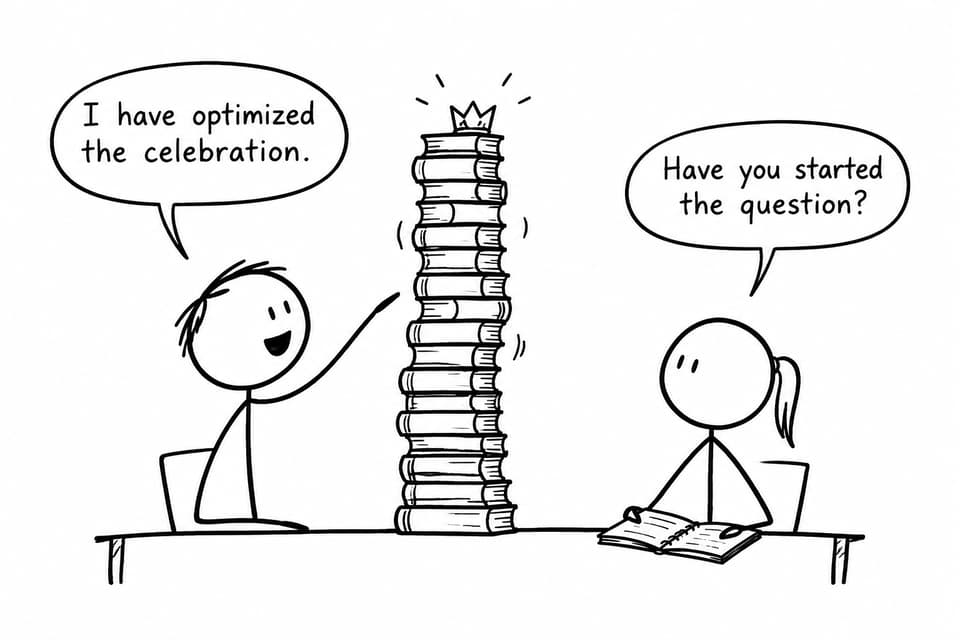
One student balances a celebration crown on a tower of books while another asks whether the question has been started.
Build a system that reveals weaknesses
The central habit is a short feedback loop:
- Retrieve an idea without looking at notes.
- Apply it to an assessment-style question.
- Check the answer or rubric carefully.
- Classify the error.
- Revisit the weakness after a delay.
An error should be labelled precisely. “Careless” is usually too vague. Did you forget a definition, choose the wrong method, misread a command term, omit evidence, run out of time, or fail to communicate a valid idea clearly?
That classification determines the response. A knowledge gap may need Study Notes and active recall for IB. An application gap needs more Questionbank work. A timing problem needs constrained practice. A written argument may need teacher feedback, criterion-based Grading tools, or a session with an experienced Tutor.
RevisionDojo works best as one connected cycle. Use Study Notes to repair understanding, Flashcards to retrieve essential knowledge, the Questionbank to apply it, and AI Chat to interrogate an explanation you still cannot reconstruct independently. Later, Predicted Papers and Mock Exams can help you practise decisions under time pressure. For coursework, the Coursework Library and Grading tools can help you understand criteria and compare structures, while your submitted work must remain genuinely your own.
The broader principle is explained in RevisionDojo's comparison of flashcards and practice questions: recall and application solve different problems. You need both.
Treat coursework as part of the score, not an interruption
A common planning mistake is imagining that “real revision” begins after internal assessments and the Extended Essay are finished. Coursework is already part of the assessment landscape. It also consumes the same finite attention that examinations require.
Start by converting every major project into dated milestones: question approval, source collection, method, first analysis, draft, feedback, revision, and final checks. Put these beside school deadlines, not in a separate fantasy calendar where every week remains quiet.
Use the official criteria throughout. RevisionDojo's Coursework Grader can provide criterion-level feedback, but it should support your judgement rather than replace your supervisor, teacher, or academic integrity responsibilities. Feedback is useful only when you understand and own the revision.
Early completion creates an invisible advantage. It reduces the number of unfinished decisions competing for attention during the final months.
Use a two-year rhythm, not a final-month rescue
During DP1, build understanding close to the point of teaching. Each week, retrieve older material and complete a small set of targeted questions. This prevents the first year from becoming a pile of topics you once recognized.
A workable weekly pattern might be:
- Review current lessons within 24-48 hours
- Complete short Questionbank sets in two or three subjects
- Revisit errors from the previous week
- Make measurable progress on one coursework milestone
- Reserve one buffer block rather than scheduling every hour
RevisionDojo's daily IB study schedule can help you create a baseline, but your timetable should follow your actual workload and energy.
During DP2, gradually increase mixed and timed practice. Topic-by-topic work remains useful for repairing gaps, while mixed sets train you to identify methods without being told which chapter applies. Full Mock Exams belong later, when you have enough coverage for the result to diagnose performance rather than merely confirm that topics have not been taught.
Do not sacrifice sleep to preserve a beautiful schedule. Fatigue weakens attention, recall, emotional regulation, and judgement. A plan that works only when nothing goes wrong is not a strong plan.
Aim for control, not certainty
Aiming for 45 can sharpen your standards, but it can also make every imperfect mark feel like evidence against you. That interpretation is dangerous. A disappointing test is information about a particular performance on a particular day. It is not a final result arriving early.
Measure controllable indicators instead: questions attempted, errors revisited, coursework milestones completed, topics retrieved after a delay, and timed responses reviewed. These are less glamorous than a predicted total, but they tell you what to do next.
RevisionDojo is the ultimate IB resource because it keeps those actions in one place: learning through Study Notes, remembering through Flashcards, applying through the Questionbank, clarifying through AI Chat, and testing through Predicted Papers and Mock Exams. Grading tools, the Coursework Library, and Tutors extend the same feedback loop when independent study is not enough.
A 45 remains an outcome, not an entitlement. The useful ambition is to become the student whose preparation is accurate, repeatable, and resilient enough to make that outcome possible.
Today, open the RevisionDojo Questionbank, choose your weakest current micro-topic, answer 10 questions closed-book, and record the exact cause of every lost mark.