
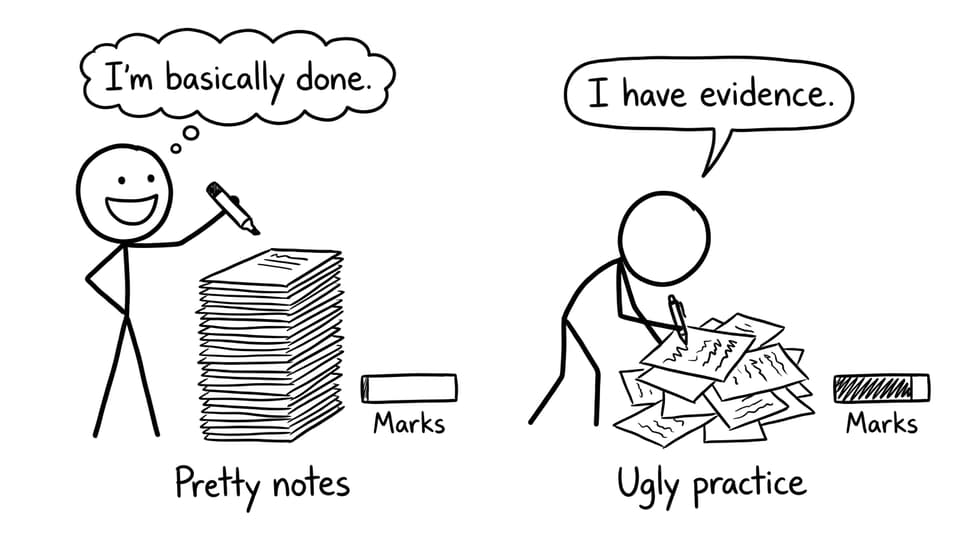
When two IB students say, “I studied all weekend,” they can be telling completely different stories.
One means they spent hours reading, rewriting, highlighting, and reorganizing folders until the work felt tidy.
The other means they produced evidence: a timed set completed, a list of repeated mistakes, a plan to retest those mistakes in 48 hours, and a small set of flashcards built from what cost them marks.
That difference is the quiet engine behind What 45/45 IB Students Do Differently.
Not genius. Not perfect discipline. Not superhuman motivation.
Just a loop that keeps returning to the same question: What behavior earns marks in the real exam? And then training that behavior until it feels ordinary.
In this guide, we’ll break down What 45/45 IB Students Do Differently into practical moves you can copy starting today. Along the way, you’ll see how RevisionDojo’s Questionbank, Study Notes, Flashcards, AI Chat, Grading tools, Predicted Papers, Mock Exams, Coursework Library, and Tutors fit into one connected system.
A quick checklist: What 45/45 IB students actually do
If you want the overview before the deeper explanation, here’s the most transferable version of What 45/45 IB Students Do Differently:
-
They start exam-style questions earlier than feels comfortable.
-
They treat mistakes like data and keep a ruthless error log.
-
They retest weak areas within 48 hours (not “sometime later”).
-
They study in short blocks with clear outputs, not vague hours.
-
They learn command terms and markscheme patterns as a skill.
-
They run weekly timed sessions to make pressure familiar.
-
They keep coursework contained so it doesn’t swallow exam prep.
-
They protect sleep and consistency like it’s part of the syllabus.
If you want one place to run this loop, start at the International Baccalaureate (IB) hub and the RevisionDojo for IB page.
They build a system, not a mood
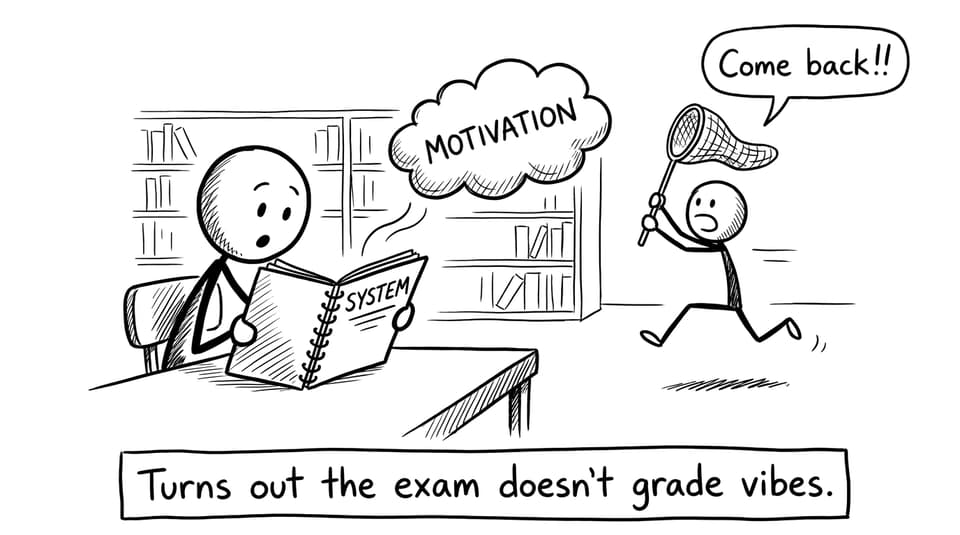
Most students wait for the right feeling: calm, motivated, confident, “ready.”
Top scorers build a default routine that works even when they feel none of those things.
A 45/45 student doesn’t ask, “Do I feel like revising?”
They ask, “What is the smallest session I can complete that creates marks later?”
A simple minimum-effective session looks like this:
-
10 minutes: patch one concept using Study Notes
-
30-40 minutes: targeted question practice
-
10 minutes: write error rules and make 1-3 flashcards from mistakes
RevisionDojo is designed to make that routine frictionless: use Study Notes to clarify fast, then switch to the Questionbank feature to immediately apply.
If you want the bigger framework behind this, keep this open: Why Some IB Students Stay Consistent.
They treat questions as the curriculum
Here’s one of the biggest lessons in What 45/45 IB Students Do Differently: they don’t see questions as a “final test.”
They see questions as the method.
Average approach:
- “I’ll do questions after I finish content.”
45/45 approach:
- “I’ll do questions to learn what the exam expects, and to expose what I don’t know yet.”
This is why a good question bank is not just extra practice. It’s a decision-making tool.
Use RevisionDojo’s Questionbank to spot patterns like:
-
Which command terms keep costing you marks?
-
Which topics collapse under time pressure?
-
Which marks are “easy” but lost to wording, units, structure, or definitions?
Two useful reads to sharpen your approach:
And if you want a concrete example of targeted drilling, this math-specific guide generalizes well to other subjects too: IB Math: Targeted Revision Using the Questionbank.
They keep an error log like an athlete reviews film
Most students review a question like this:
-
Right: relief.
-
Wrong: annoyance.
-
Then move on.
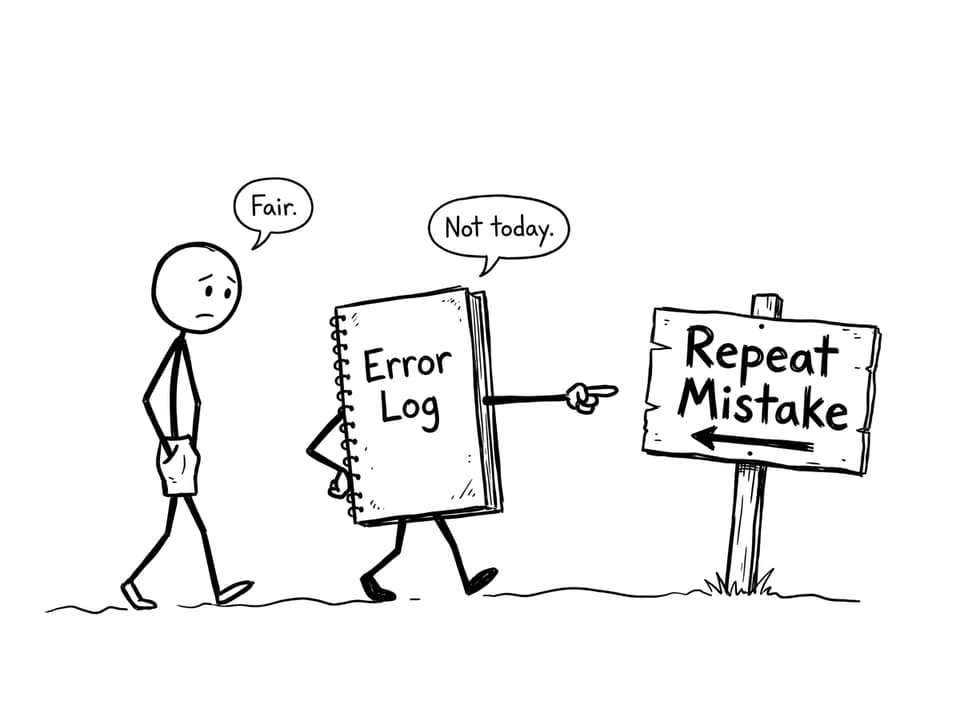
45/45 students review like analysts. They’re hunting repeatable patterns.
A high-scoring error log is not a diary. It’s a list of rules.
Examples of “error rules”:
-
“If the question says evaluate, I must weigh strengths and limitations, not just explain.”
-
“If it’s 4 marks, I aim for 4 clear points, not a paragraph.”
-
“If a diagram earns marks, labels must match the markscheme language.”
Then comes the part most students skip: retesting soon.
45/45 students schedule a retest within 48 hours because your brain is still close enough to the mistake to change it.
If you like reflective systems for motivation and momentum, you’ll also benefit from IB Stress: How to Stay Motivated Without Burning Out.
They use flashcards for recall, not decoration
Flashcards are not impressive. That’s why they work.
In What 45/45 IB Students Do Differently, flashcards show up as a quiet daily tax: small cost, huge compounding.
Three rules top scorers follow:
-
Keep it short: 5-12 minutes daily
-
Keep it atomic: one card = one idea
-
Keep it honest: cards come from mistakes and weak recall
Flashcards are most powerful when they target what actually loses you marks: definitions, processes, assumptions, command terms, and the “standard phrasing” that appears in markschemes.
RevisionDojo’s Flashcards (powered by Jojo AI) make it easy to create cards from what you’re learning and missing.
Use these guides to tighten your system:
They use AI Chat to unblock, then immediately perform
AI can become a warm bath: you read an explanation, nod along, and feel productive without building exam skill.
Top students use AI differently. They use it to move.
Here’s how What 45/45 IB Students Do Differently looks with AI:
-
Ask for a short explanation, then request a quiz.
-
Ask for hints, not solutions.
-
Ask for markscheme-friendly phrasing feedback.
-
Ask it to generate similar questions so you can retest the same weakness.
RevisionDojo’s AI Chat is designed to connect to the loop: clarify quickly, then return you to practice and feedback.
If you want to see how all tools can work together in one routine, read: RevisionDojo App: The Smarter Way to Prep for IB Exams.
They simulate the exam early (and make it boring)
A large part of IB stress is not the content. It’s uncertainty:
-
“Will I finish?”
-
“Will I blank?”
-
“Will I misread command terms under pressure?”
45/45 students reduce uncertainty with evidence: weekly timed practice.
A sustainable rhythm:
-
Once per week: one timed section (or rotate subjects)
-
Immediately after: mark, log errors, identify 1-2 patterns
-
Next session: drill the exact weakness with targeted questions
This is where RevisionDojo’s Mock Exams and Predicted Papers help: not as prophecy, but as controlled realism.
To set up better timed practice, these posts are useful:
And for endgame pacing, keep this bookmarked:
They keep coursework contained with feedback loops
High scorers don’t let coursework become an endless, emotional rewrite cycle.
They build boundaries:
-
Clear draft deadlines
-
One feedback loop per draft (not five)
-
Fix the highest-impact rubric issues first
-
Move on and protect exam prep time
RevisionDojo’s Grading tools and Coursework Library support this by making expectations visible. When “good” is defined, rewriting becomes strategic rather than anxious.
Two helpful reads if coursework is consuming your attention:
-
How RevisionDojo Enhances IB Internal Assessment (IA) Feedback and Moderation
-
IB Internal Assessment Feedback: Detailed Comments and Suggestions
And when self-feedback stops being enough, 45/45 students use Tutors like coaches: short, targeted sessions that correct technique, raise standards, and protect momentum.
They treat group study like a tool, not a lifestyle
Group study can be brilliant, and it can be a socially acceptable way to do nothing.
In What 45/45 IB Students Do Differently, group sessions have strict roles:
-
Explaining concepts out loud (to reveal gaps)
-
Comparing answer structures (to reveal technique)
-
Marking and debating what the markscheme rewards (to reveal standards)
What group study is rarely good for: “covering content.”
Content coverage is solitary. Exam technique can be collaborative.
A simple weekly plan you can steal (and actually keep)
If you want a schedule that matches What 45/45 IB Students Do Differently, borrow this. Adjust times, keep the shape.
Daily base (15-25 minutes)
-
7-12 minutes: Flashcards (active recall)
-
8-13 minutes: a mini Questionbank set (5-10 questions)
-
2 minutes: write one error rule
Three focused blocks per week (45-90 minutes)
-
10-15 minutes: Study Notes for one micro-topic
-
25-45 minutes: Questionbank practice on that exact micro-topic
-
10-20 minutes: review mistakes + retest 1-2 questions
Weekly (60-180 minutes)
-
One timed session using Mock Exams or Predicted Papers
-
Review longer than you attempt
-
Convert the top 3 recurring errors into flashcards
If you’re compressing time and wondering what’s realistic, this is worth reading: Is 1 Month Enough to Study for IB Exams?.
Closing: the 45/45 gap is smaller than it looks
The most hopeful truth about What 45/45 IB Students Do Differently is that it’s not a different species of student.
It’s a different set of defaults.
Clarify one concept. Do exam-style questions. Log the error. Retest within 48 hours. Add timed practice weekly. Protect sleep. Repeat until the exam feels familiar.
If you want to build that loop in one place, RevisionDojo is designed for it: Questionbank for targeted practice, Study Notes for fast clarity, Flashcards for daily recall, AI Chat to unblock quickly, Mock Exams and Predicted Papers for timed realism, plus Grading tools, a Coursework Library, and Tutors to keep coursework sharp without taking over your life.
Start small today: open the International Baccalaureate (IB) hub, pick one topic, do one focused question set, and write one error rule. That’s how 45/45 habits begin: quietly, consistently, on purpose.