
Water doesn’t look like much in a diagram. A small V-shape. Two hydrogens, one oxygen. Yet in IB Biology, that tiny bend quietly decides whether metabolism flows or stalls, whether proteins fold or fail, whether cells stay stable or swing wildly.
If you’ve ever stared at a markscheme thinking, I know what water is… why is this question worth 6 marks? this is why. Water’s polarity is one of those ideas that feels “basic” until you realise it connects almost every cell process you revise.
IB Biology quick checklist: what polarity explains
Use this as your fast IB Biology mental map:
-
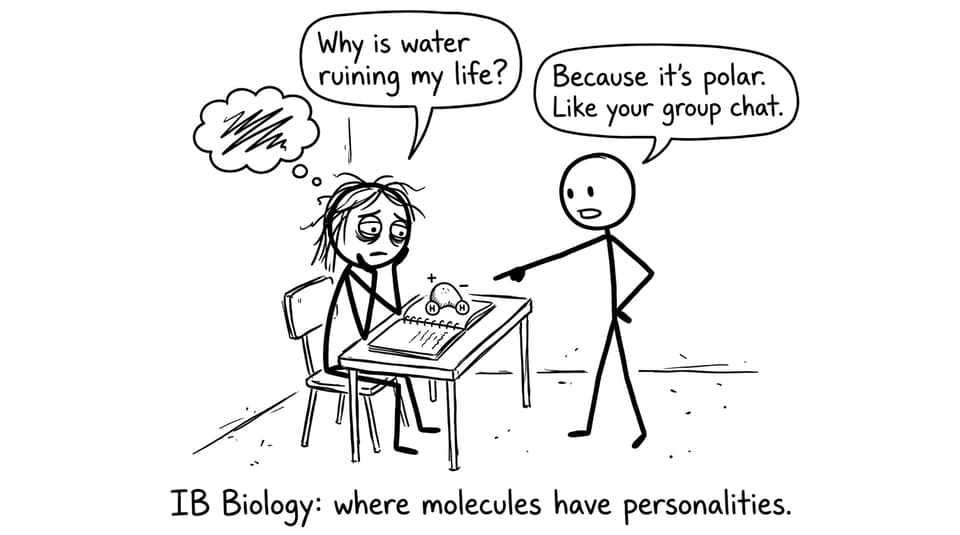
Water is bent (about 104.5°) and has unequal electron sharing.
-
This creates partial charges: δ- on oxygen, δ+ on hydrogens.
-
Polarity enables hydrogen bonding.
-
Hydrogen bonding and polarity explain:
-
Solvent properties (hydration shells)
-
Stable temperature (high specific heat)
-
Cohesion and adhesion
-
Hydrophobic effect (membranes, protein folding)
-
Osmosis and water movement across membranes
-
For syllabus-aligned support, the clearest hub is IB Biology Topic A1.1 Water Notes & Questions (SL/HL).
Water polarity in IB Biology: the “tiny magnet” idea
In IB Biology, polarity is essentially a permanent imbalance. Oxygen is more electronegative than hydrogen, so the shared electrons spend more time near oxygen. Because the molecule is bent, the partial charges don’t cancel out. You get a molecule with two “ends” that behave like a tiny magnet.
That tiny magnetism is why water forms hydrogen bonds with itself and interacts strongly with ions and other polar molecules. If you want a clean, exam-friendly explanation, pair these two:
IB Biology cells need polarity because cells run on dissolved chemistry
A cell is less like a “bag of organelles” and more like a crowded, moving solution. Enzymes, substrates, ions, and signalling molecules have to collide in the right way at the right time. Water’s polarity makes that possible by acting as a solvent.
Hydration shells: why ions don’t clump
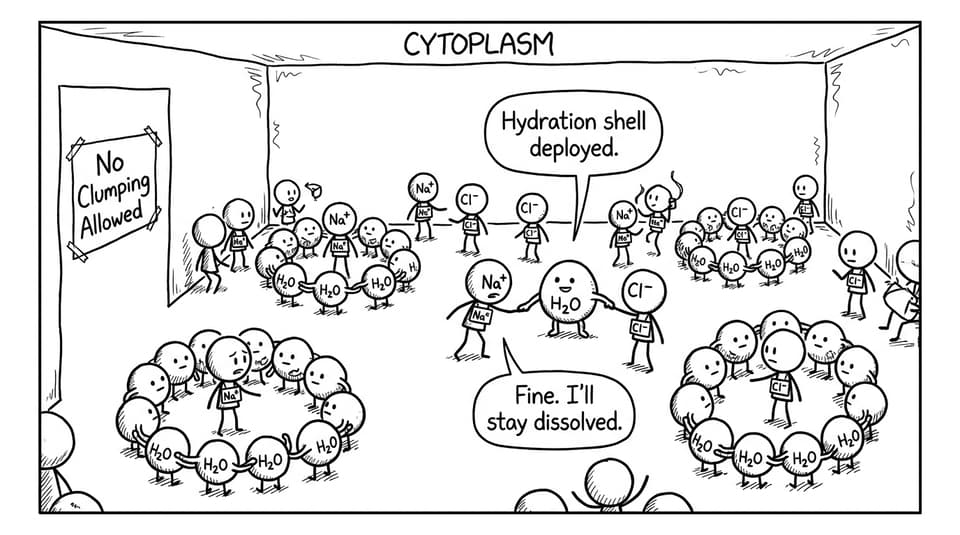
Because water has δ+ and δ- regions, it surrounds ions: oxygen (δ-) faces positive ions like Na+, and hydrogens (δ+) face negative ions like Cl-. This forms hydration shells that keep ions separated and mobile.
That’s not trivia. In IB Biology, it’s the reason respiration, photosynthesis, and transport systems can actually happen in the cytoplasm.
To revise this with targeted practice, use IB Biology Topic A1.1 Water Questionbank (SL/HL) and the focused notes page Solvent properties of water (A1.1.5) Notes.
Water polarity shapes structures: membranes, proteins, DNA
Here’s the subtle IB Biology story: water doesn’t just “allow” structures to exist; it actively pushes molecules into certain arrangements.
-
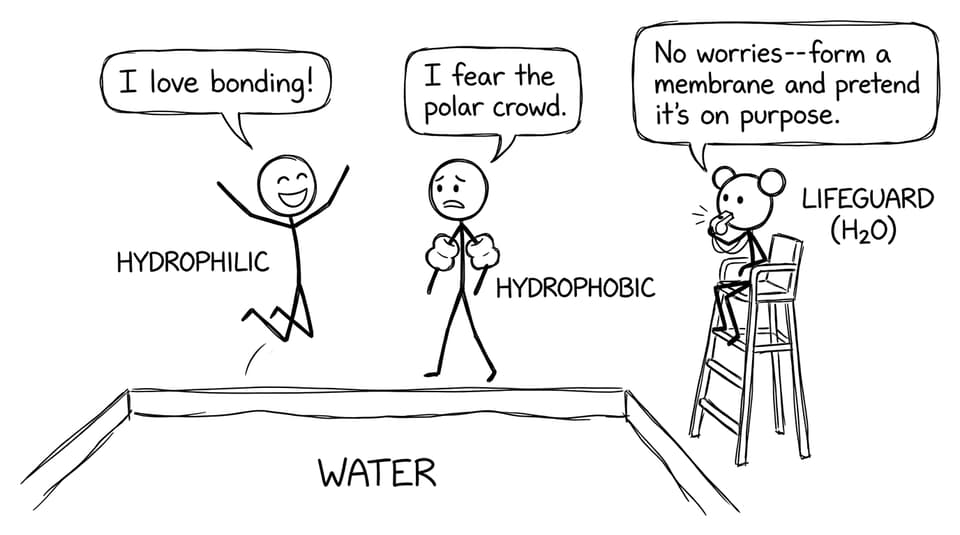
Membranes form because phospholipid heads are hydrophilic (comfortable near water), while tails are hydrophobic (uncomfortable). The bilayer is the compromise.
-
Proteins fold because some side chains prefer water and others avoid it. The hydrophobic effect helps drive a stable 3D shape.
-
DNA stability is supported by interactions with water and the environment around the helix.
When this links to transport questions, connect it to membrane behaviour and gradients. Revision paths that pair well:
Polarity and osmosis: how cells protect homeostasis
Water’s polarity also explains why osmosis is so powerful. Water associates with solutes; the more solute particles present, the fewer “free” water molecules are available to move. Across a partially permeable membrane, that imbalance drives net water movement.
In IB Biology, marks are often earned by precision: define osmosis correctly and link it to membranes and concentration differences. These pages make that easy:
-
Movement of water molecules across membranes by osmosis (B2.1.5) Notes
-
For the bigger-picture extension, Water Potential (D2.3) Notes
How to write it in an IB Biology exam (without rambling)
A strong IB Biology explanation is a chain:
Polarity (unequal electrons + bent shape) to partial charges to hydrogen bonding + hydration shells to solvent/structure/osmosis to cellular function.
If you practise that chain with timed questions, you stop “knowing the topic” and start scoring consistently.
The last-mile advantage for IB Biology revision
Water’s polarity is one of those IB Biology topics that quietly shows up everywhere: enzymes, membranes, transport, homeostasis, even experimental design. When you can explain it as a cause-and-effect chain, you’re not just memorising facts; you’re thinking like the examiner.
If you want that kind of calm, structured progress, RevisionDojo is built for it: use the Study Notes to lock the explanation, the Flashcards to keep it active in memory, the Questionbank and Grading tools to sharpen exam technique, and AI Chat when a definition still feels slippery. Add Mock Exams and Predicted Papers when you’re ready to train under pressure, and the Coursework Library plus Tutors when you want feedback that actually changes your score.
Start with water, and you’ll notice something reassuring: in IB Biology, the biggest topics often rest on the smallest bends.