

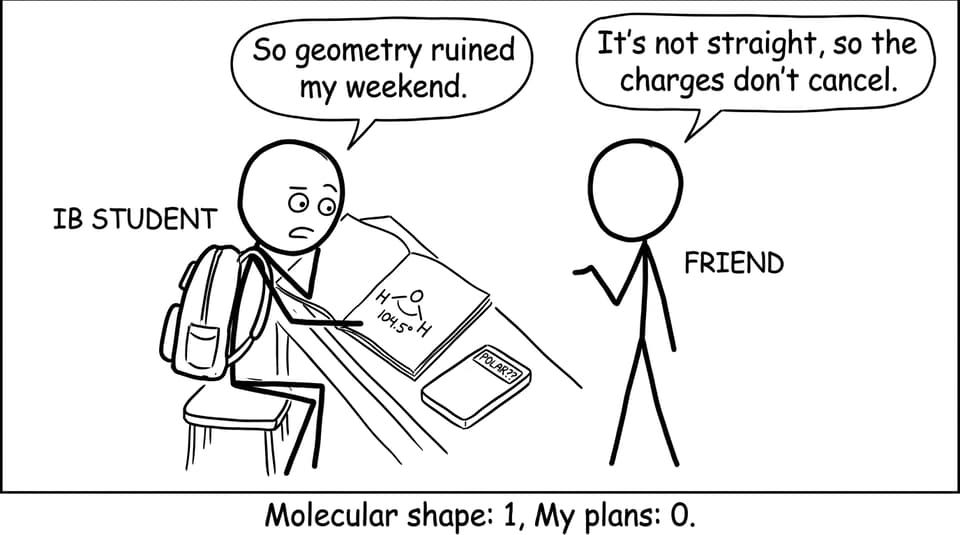
Water doesn’t look dramatic. It’s clear, it’s common, and it’s always there. But in IB Biology, water is the quiet character whose small design choice changes the whole story: it isn’t linear. That one detail--a bent molecular shape--creates polarity, and polarity quietly powers hydrogen bonding, solvent behavior, and half the explanations you’ll write in exams.
If you’ve ever lost marks because you wrote “water is polar” but didn’t explain why, this is the missing link.
Quick exam checklist for water polarity (IB Biology)
Use this mini script when you see water questions in IB Biology:
-
Water has polar covalent bonds (O--H).
-
Oxygen is more electronegative than hydrogen.
-
So oxygen becomes δ− and hydrogens become δ+.
-
Water is bent (~104.5°), so bond dipoles don’t cancel.
-
Result: net dipole (water is polar) -> hydrogen bonding -> cohesion, adhesion, solvent properties.
For syllabus-aligned practice, keep the topic hub open while you revise: IB Biology Topic A1.1 Water Notes & Questions (SL/HL).
The two-part reason water is polar: electrons + geometry
Polarity isn’t a vibe. It’s a combination of (1) how electrons are shared and (2) whether the molecule’s shape lets the pulls cancel.
Unequal sharing: oxygen pulls harder
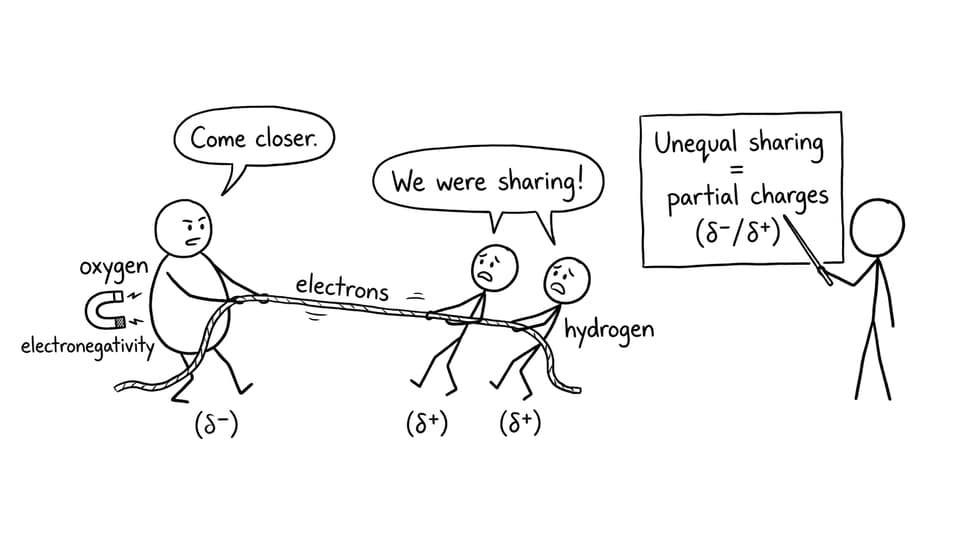
In a covalent bond, electrons are shared, but not always equally. Oxygen attracts the shared electrons more strongly than hydrogen does (higher electronegativity). That shifts electron density toward oxygen.
So even before we talk about shape, you already have partial charges:
-
Oxygen end: δ−
-
Hydrogen ends: δ+
RevisionDojo breaks this down cleanly in the syllabus language examiners expect: Hydrogen bonds as a consequence of the polar covalent bonds (A1.1.2 Notes).
The bent shape: why the dipoles don’t cancel
Here’s the part that turns “partial charges exist” into “the molecule is polar.”
Water’s geometry is bent (about 104.5°). The two hydrogens sit on one side, while oxygen (plus its lone pairs) dominates the other side. Because the molecule isn’t symmetrical, the two O--H bond dipoles point in directions that add up to a net dipole instead of cancelling.
In IB Biology exam terms: shape determines whether bond polarities cancel. Water’s shape prevents cancellation, so it has a permanent dipole.
If you want to reinforce this with exam-style questions, use: IB Biology Topic A1.1 Water Questionbank (SL/HL).
From polarity to hydrogen bonding (and why life cares)
Once water is polar, the rest of its “unusual” behavior becomes predictable.
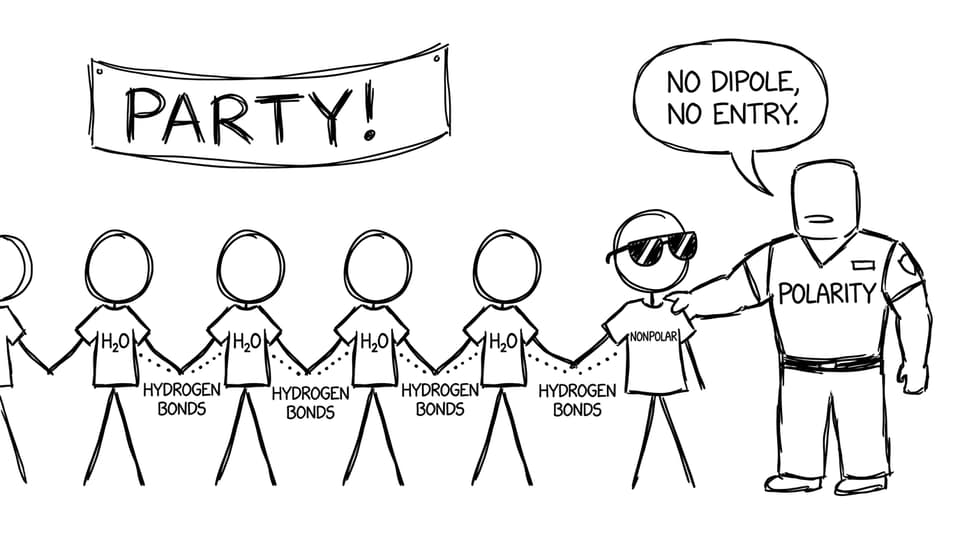
Because opposite charges attract, the δ+ hydrogen on one water molecule is attracted to the δ− oxygen on another. That attraction is a hydrogen bond (intermolecular, not covalent).
This network explains why water:
-
sticks to itself (cohesion)
-
sticks to other polar surfaces (adhesion)
-
stabilizes temperature change (high specific heat)
-
dissolves ions and polar molecules (solvent properties)
For a broader property overview, pair this post with: How Hydrogen Bonding Shapes Water's Properties.
Solvent behavior: the exam-friendly link
In IB Biology, polarity often shows up as “Explain why water is a good solvent.” The mark-scoring idea is hydration shells:
-
δ− oxygen ends attract cations (e.g., Na+)
-
δ+ hydrogen ends attract anions (e.g., Cl−)
-
water surrounds ions, keeps them separated, and prevents re-association
Use the wording and examples RevisionDojo expects you to apply: Solvent properties of water (A1.1.5 Notes) and Solvation with water as the solvent (D2.3.1 Notes).
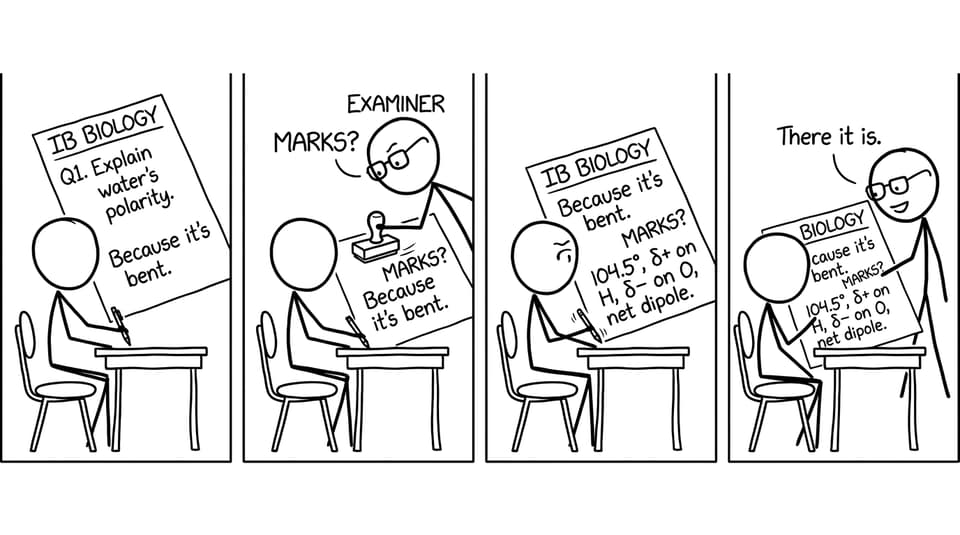
How to write the 6-mark answer in IB Biology
A strong IB Biology explanation is a chain, not a single statement:
-
Oxygen is more electronegative than hydrogen.
-
O--H bonds are polar covalent -> δ− on O, δ+ on H.
-
Water is bent (~104.5°), so dipoles do not cancel.
-
Water has a net dipole (polarity).
-
Polarity allows hydrogen bonds between molecules.
-
Hydrogen bonds explain properties relevant to life (cohesion, adhesion, solvent behavior, temperature stability).
To rehearse this under timed conditions, you can also use RevisionDojo’s full ecosystem: Study Notes, Flashcards, AI Chat, Grading tools, Predicted Papers, Mock Exams, Coursework Library, and Tutors. Start at the subject hub: IB Biology Resources.
Closing: the small bend that holds up the whole syllabus
In IB Biology, it’s tempting to treat water as “basic background.” But water’s bent shape is a structural decision with huge consequences: it creates polarity, which creates hydrogen bonding, which creates the conditions life depends on.
If you want this to feel automatic before exams, build the loop: read the exact syllabus notes, drill questions, convert misses into flashcards, and use AI Chat to tighten your phrasing. Start here: IB Biology Topic A1.1: Water Notes and then prove it to yourself with timed practice in RevisionDojo’s Questionbank and Mock Exams.