



Osmosis is one of those IB Biology ideas that feels obvious right up until you meet it in an exam question. You read “partially permeable membrane,” see a potato cylinder in a salt solution, and suddenly your brain tries to turn water into a conscious decision-maker.
The good news is that osmosis is simple. The hard part is being precise under pressure. And in IB Biology, precision is where marks live.
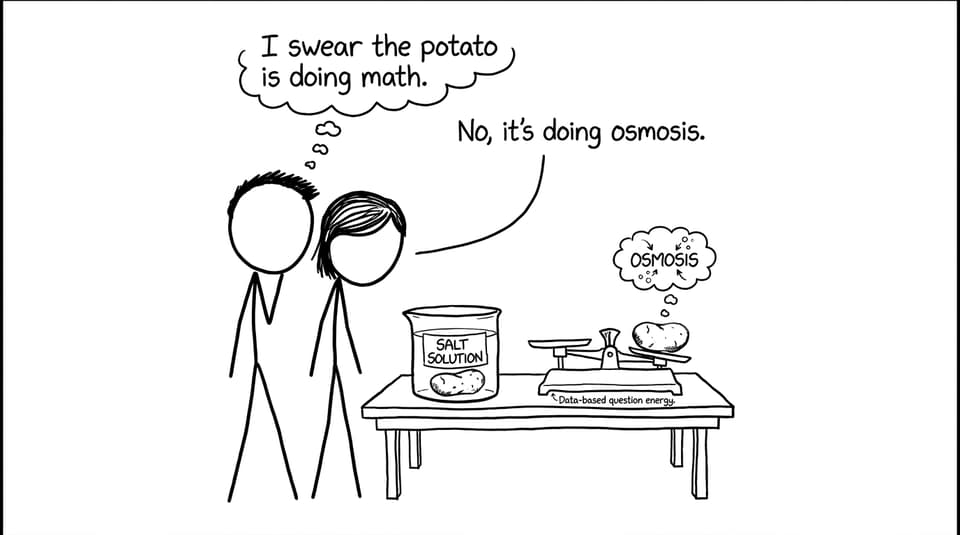
Osmosis in IB Biology: the exam-ready definition
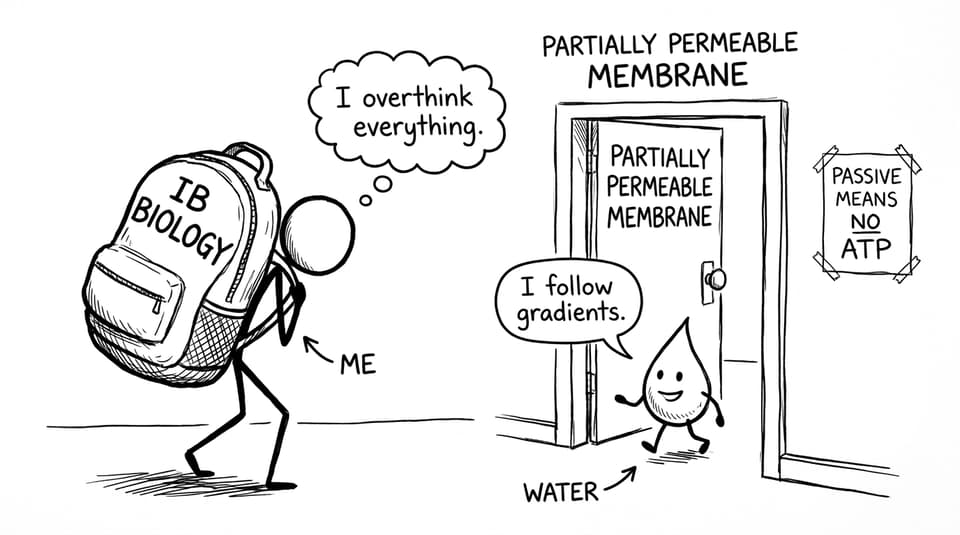
In IB Biology, you need a clean definition you can reproduce without improvising:
Osmosis is the passive movement of water molecules from a region of lower solute concentration to a region of higher solute concentration through a partially permeable membrane.
Keep these “non-negotiables” in your head:
-
Passive (no ATP; no pumping)
-
Water molecules move (not the solute)
-
A partially permeable membrane must be involved
-
Movement is driven by a gradient (often described using solute concentration or water potential)
If you want to tighten definition wording for marks, pair this with your command term technique from How to Understand IB Biology Command Terms for Exam Success.
A quick osmosis checklist (before you answer any question)
When an IB Biology question mentions cells in solutions, run this fast checklist:
-
What’s outside the cell: hypotonic, isotonic, or hypertonic?
-
Is there a partially permeable membrane (cell membrane, dialysis tubing, etc.)?
-
Which direction does water move?
-
What’s the cell outcome (turgid, plasmolysed, crenated, lysed)?
-
What evidence would you see (mass change, volume change, length change)?
This checklist is also how you avoid mixing up osmosis with diffusion or active transport.
How osmosis works in cells (hypotonic, hypertonic, isotonic)
Cells are wrapped in a membrane that controls what passes in and out. In IB Biology, the exam often frames osmosis as “what happens to the cell in different solutions.”
Hypotonic solution
A hypotonic solution has lower solute concentration than the cytoplasm.
-
Water moves into the cell.
-
Animal cells may swell and can lyse.
-
Plant cells become turgid (firm), because the cell wall limits bursting.
Hypertonic solution
A hypertonic solution has higher solute concentration than the cytoplasm.
-
Water moves out of the cell.
-
Animal cells may shrink (often described as crenation).
-
Plant cells can become plasmolysed (membrane pulls away from the wall).
Isotonic solution
An isotonic solution has equal solute concentration to the cytoplasm.
-
Water moves both ways, with no net movement.
-
Cell size stays about the same.
If you want syllabus-aligned reinforcement, RevisionDojo’s notes for B2.1.5 Movement of water molecules across membranes by osmosis are a strong anchor for IB Biology definitions and mechanisms.
Osmosis in plants: why leaves don’t “just wilt”
Plant questions are where IB Biology makes osmosis feel real. A plant standing upright is basically a physics story told with water.
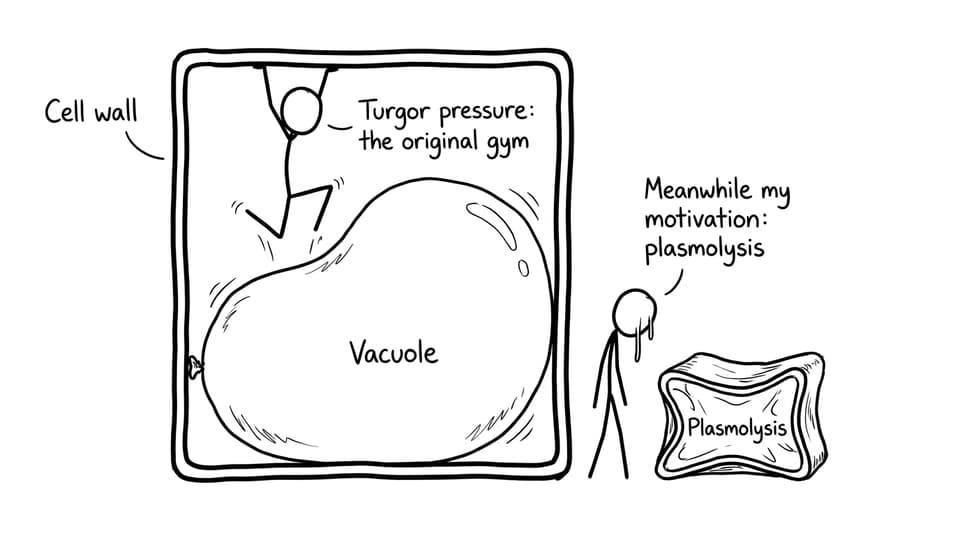
When water enters plant cells by osmosis, the vacuole expands and pushes the cytoplasm against the cell wall. This produces turgor pressure, giving tissues rigidity.
When water leaves plant cells (for example, salty soil conditions), the vacuole shrinks, turgor pressure drops, and cells become flaccid. With enough loss, cells can become plasmolysed, and the whole plant wilts.
For the “water potential” layer that sits behind these patterns, use IB Biology Topic D2.3: Water Potential and the matching Water Potential Notes.
Osmosis vs diffusion vs active transport (don’t lose easy marks)
A common IB Biology trap is writing a diffusion definition when the question clearly wants osmosis.
-
Diffusion: net movement of particles from high to low concentration (no membrane required).
-
Osmosis: diffusion of water through a partially permeable membrane.
-
Active transport: movement against a gradient using ATP and membrane proteins.
One practical fix: do mixed practice. The more you see “which process is occurring?” stems, the more automatic your sorting becomes. RevisionDojo’s IB Biology Resources hub is the fastest place to jump from notes to targeted Questionbank practice.
Osmosis for the IB Biology IA: simple experiment, serious marks
Osmosis experiments are popular in IB Biology because you can control variables and collect clean numbers.
Good IA directions include measuring change in:
-
mass of potato cylinders in different sucrose concentrations
-
length/volume of plant tissue before and after soaking
-
rate of change over time (if you standardize surface area and temperature)
Before you commit, use the structure guidance in IB Biology IA: 8 Essential Tips to Score a 7 (Expert Guide) and compare what a complete write-up looks like in Sample IB Biology IA: A Step-by-Step Advice to Guide Your Own Investigation. If you want a bank of workable topics, IB Biology IA Ideas: 2026 Topics That Actually Work can help you narrow quickly.
Bring it home with RevisionDojo
Osmosis is small in scale but huge in consequences, which is why IB Biology keeps returning to it in membranes, plants, homeostasis, and practical investigations. If you want this topic to feel effortless in exam conditions, build a loop: learn the definition, drill the comparisons, then practice questions until the phrasing becomes automatic.
RevisionDojo helps you do that in one place using Study Notes, Flashcards, the Questionbank, AI Chat, Grading tools, Predicted Papers, Mock Exams, and the Coursework Library (plus Tutors when you want feedback that’s human and specific). Start with the How to Pass IB Biology SL Exams: Proven Study Strategy, then lock in osmosis using the B2.1.5 notes and timed practice. That’s how IB Biology concepts stop being “things you kind of know” and become marks you can count on.


