


If you have ever stared at a membrane diagram and felt like the arrows were judging you, you are not alone. In IB Biology, membrane transport is one of those topics that seems simple until an exam question quietly asks, “Explain how direction, energy, and proteins differ.” Suddenly, diffusion and active transport blur together.
This post clears that up. You will walk away knowing the key differences between passive and active transport across cell membranes and how to phrase them the way IB markschemes like.
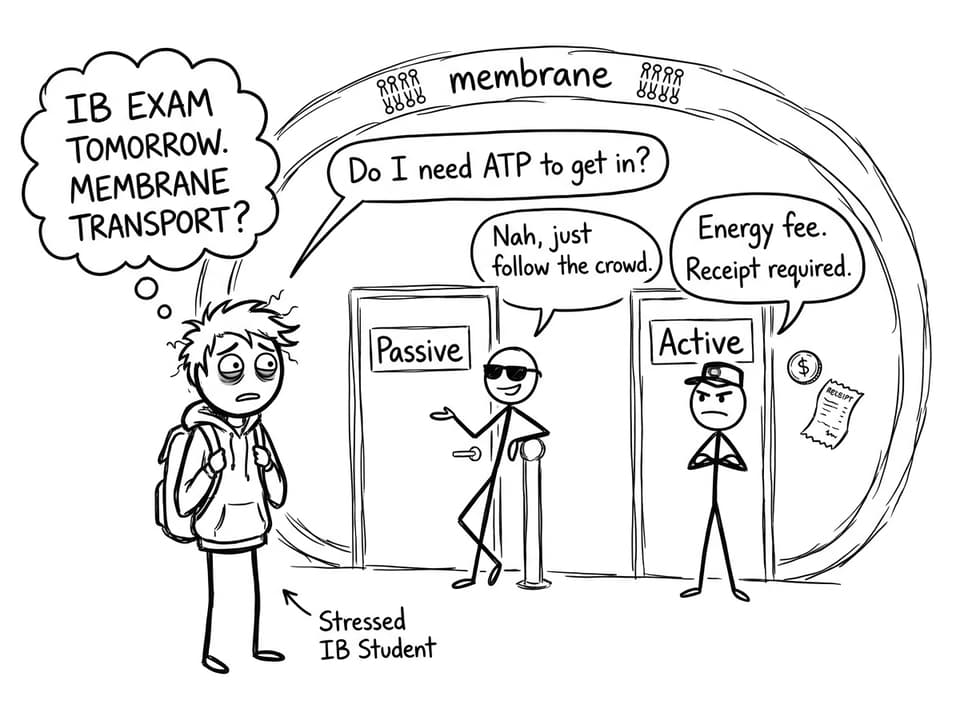
Quick checklist: passive vs active transport (IB Biology)
Use this as your fast exam filter in IB Biology:
-
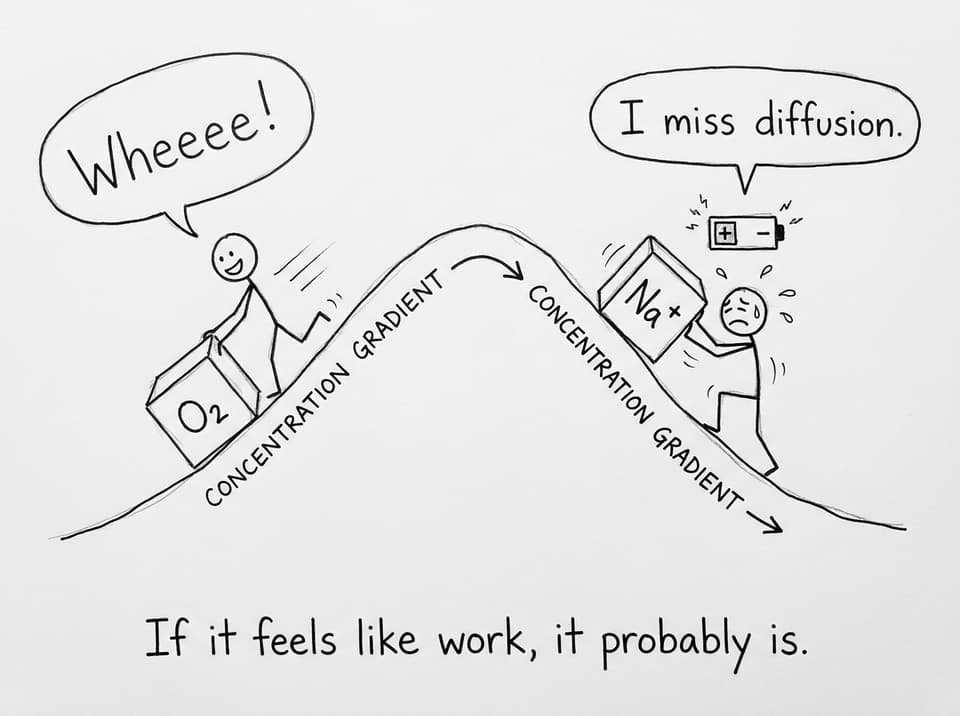
Direction: passive transport goes down a concentration gradient; active transport goes against it.
-
Energy: passive transport uses no ATP; active transport requires energy (often ATP).
-
Proteins: passive transport may use channels/carriers; active transport uses pump proteins or cotransporters.
-
Outcome: passive transport trends toward equilibrium; active transport can build and maintain gradients.
For syllabus-aligned practice, start with B2.1 Membranes and membrane transport.
Passive transport in IB Biology: letting physics do the work
In IB Biology, passive transport is about particles moving because random motion plus a gradient creates a net flow. No ATP. No “push.” Just probability doing its thing.
Simple diffusion
Small, nonpolar molecules move straight through the phospholipid bilayer. Oxygen and carbon dioxide are classic examples, and the phrase to remember in IB Biology is “down the concentration gradient.”
Revision help: Simple diffusion across membranes notes.
Facilitated diffusion
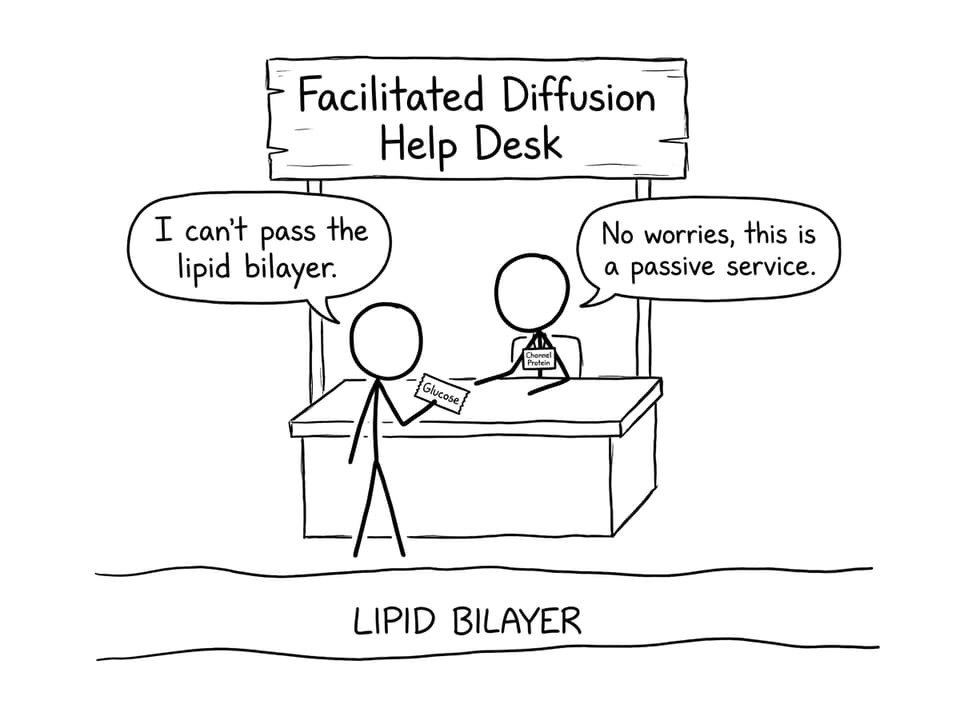
Some substances cannot cross the hydrophobic core, so they use membrane proteins (channels or carriers). It is still passive transport because movement remains down the gradient.
If you want exam-style practice on protein-mediated transport, try the B2.1 Questionbank.
Osmosis
Osmosis is the passive movement of water across a selectively permeable membrane, often via aquaporins. In IB Biology, precision matters: it is water moving, not solute.
Deepen the definition and common mistakes with What is osmosis?.
Active transport in IB Biology: paying for direction
Active transport is what cells use when “downhill” is not good enough. In IB Biology, the headline is simple: substances move from low to high concentration, so energy must be supplied.
Primary active transport (ATP directly)
ATP powers pump proteins that change shape and move ions or molecules across the membrane. The sodium-potassium pump is a famous example in animal cells.
Support your explanations with Pump proteins for active transport notes.
Secondary active transport (energy indirectly)
Here, one gradient (often built by primary active transport) provides the “payment” to move another substance against its gradient. In IB Biology, this is where students often forget to mention that ATP is used earlier to create the gradient.
The difference that earns marks: equilibrium vs control
Passive transport slows as equilibrium approaches. Active transport keeps going as long as energy is available. That distinction shows up everywhere in IB Biology: nutrient uptake, nerve impulses, and maintaining stable internal conditions.
To connect transport to broader cell biology, browse IB Biology Cell Biology resources and the full IB Biology revision notes hub.
Final takeaway: master transport with RevisionDojo
In IB Biology, the key differences between passive and active transport across cell membranes come down to gradient direction, ATP use, and the transport proteins involved. Once you can say those clearly, diagrams stop feeling like riddles.
To lock it in, use RevisionDojo’s Study Notes, Flashcards, and Questionbank for B2.1, then test yourself with AI Chat explanations and Grading tools. When exams get close, the Predicted Papers, Mock Exams, and Tutors can turn shaky definitions into confident marks. Start here: B2.1 Membranes and membrane transport.