
You can memorize every definition in IB Biology and still miss a mark because you answered the wrong question.
The examiner often isn’t asking, “What is transcription?” They’re asking something quieter: Why can transcription happen here, but not there? In other words, what about DNA structure makes a gene readable or effectively invisible?
In IB Biology, this is one of the cleanest “structure influences function” stories you’ll ever learn: the DNA code matters, but access to the code matters first.
IB Biology quick checklist: what structural features control transcription?
Use this as a fast exam scan. If the question says “influence,” mention at least three:
-
Chromatin state: euchromatin vs heterochromatin (accessibility)
-
Nucleosomes: positioning and remodeling around promoters
-
Epigenetic tags: DNA methylation and histone modifications
-
Promoter structure: sequence motifs and “strength”
-
Enhancers + DNA looping: 3D folding brings regulators together
-
Ease of unwinding: A/T rich regions open more easily than G/C rich ones
To ground the basics, revise transcription itself in 2.7 DNA replication, transcription and translation Notes.
Chromatin packing: the “door” to transcription
In eukaryotes, DNA isn’t left loose. It’s wrapped around histones, forming nucleosomes, and then folded into chromatin. This packaging isn’t just storage; it’s a gate.
-
Euchromatin is loosely packed, so RNA polymerase and transcription factors can physically reach the DNA.
-
Heterochromatin is condensed, so binding sites are blocked and transcription is unlikely.
If you need a crisp phrasing for essays, see How Chromatin Packing Controls Gene Expression and How Nucleosomes Control DNA Accessibility.
Nucleosomes and epigenetic tags: small changes, big consequences
A gene can have a perfectly good promoter and still be silent if nucleosomes sit in the wrong place.
Cells shift nucleosomes using remodeling complexes, and they “label” chromatin using epigenetic modifications:
-
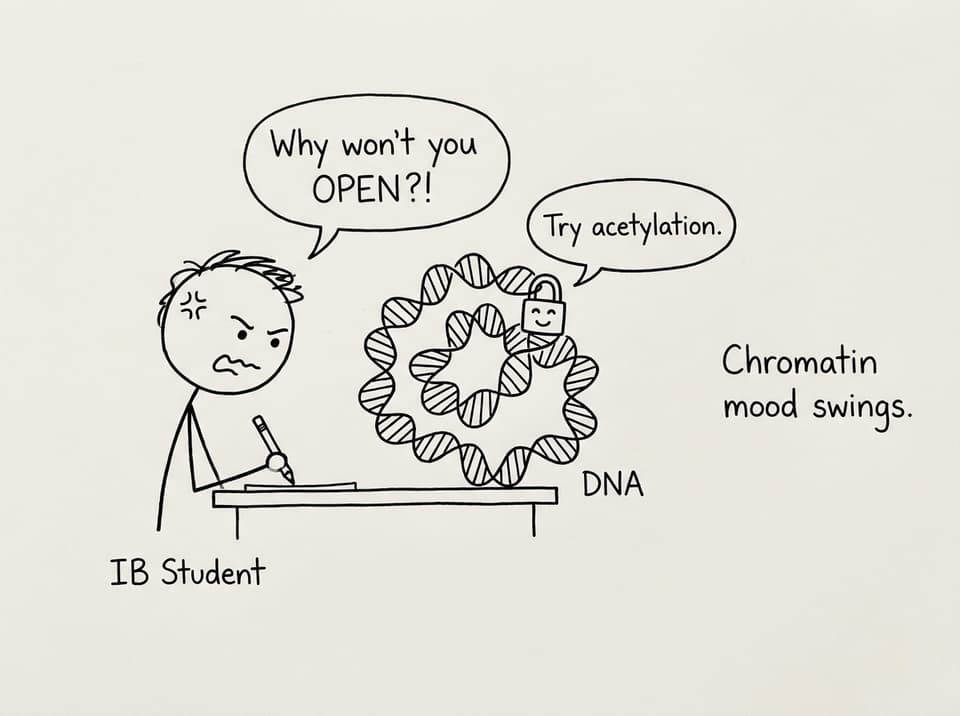
Histone acetylation reduces histone to DNA attraction (more open chromatin, more transcription).
-
DNA methylation (often at CpG islands near promoters) typically reduces transcription by tightening chromatin and interfering with binding.
For the IB wording and examples, revise D2.2.6 Methylation of the promoter and histones in nucleosomes and the histone wrap itself in A1.2.13 Structure of a nucleosome (HL only).
Promoters, enhancers, and looping: structure as a meeting invitation
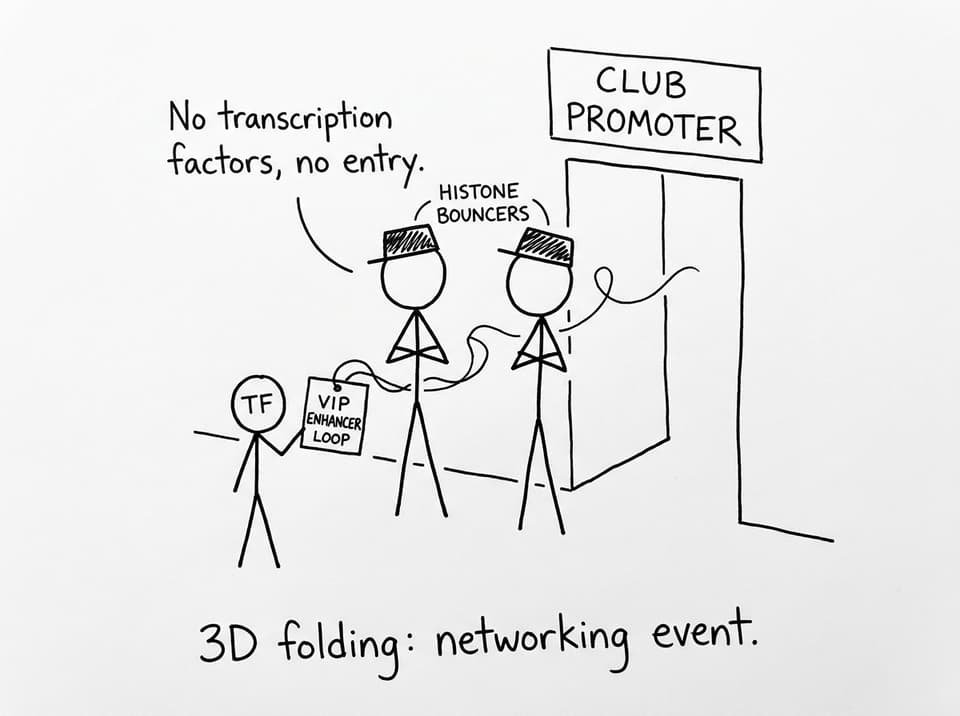
In IB Biology, treat the promoter as the start line. It’s a DNA region where RNA polymerase (plus transcription factors) assembles to begin transcription. Promoters vary in “strength” because their base sequence affects how easily proteins bind.
Enhancers add a structural twist: they can be far away on the DNA, but DNA looping brings enhancer-bound activators into contact with the promoter. This 3D folding is why distance on a linear diagram can be misleading.
Go deeper with How Promoters Control Transcription Start and IB Biology: How Activators & Repressors Control Genes. If you want the syllabus-aligned hub for HL gene expression, use D2.2 Gene expression (HL) Notes.
Unwinding the double helix: sequence affects “openness”
Even with a free promoter, transcription can’t start until the helix unwinds enough to expose the template strand.
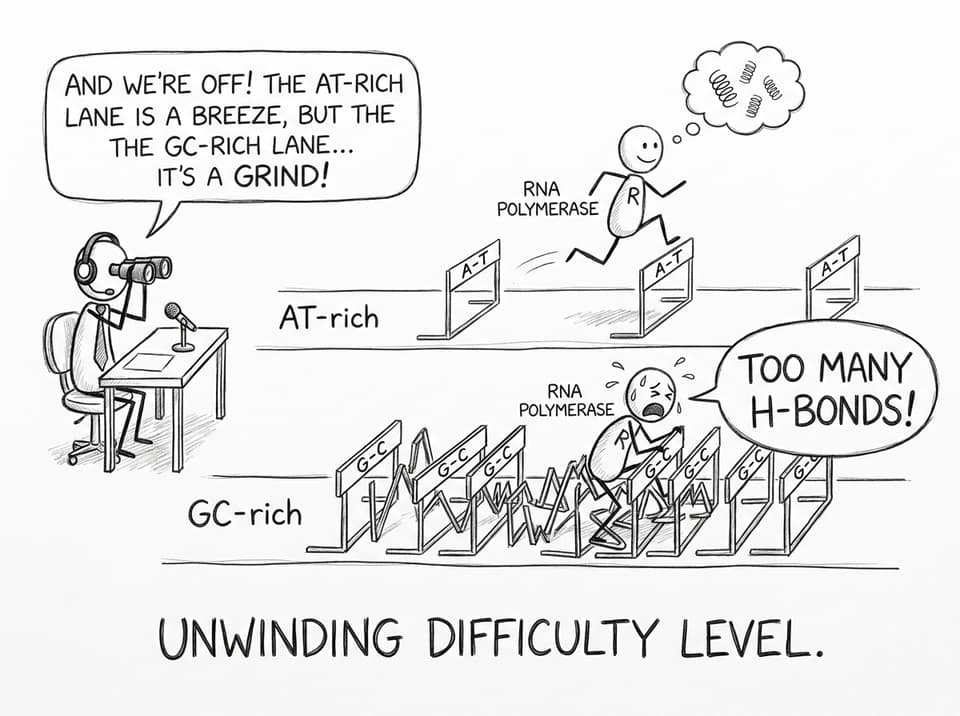
Here’s the structural detail examiners love: A/T pairs have 2 hydrogen bonds, while G/C pairs have 3, so A/T rich regions separate more easily. That makes local DNA opening (during initiation) energetically easier.
For DNA structure recap, use 2.6 Structure of DNA and RNA.
Bring it home: use structure to predict transcription
If you can look at a scenario and say, “This promoter is exposed in euchromatin, nucleosomes are shifted, acetylation is high, methylation is low, and looping brings enhancers close,” you’re thinking like an IB Biology examiner.
To train that skill quickly, RevisionDojo is built for it: reinforce concepts with the D2.2 Gene expression (HL) - IB Questionbank, tighten definitions with Flashcards for D2.2 Gene expression (HL), and use Study Notes, AI Chat, Grading tools, Predicted Papers, Mock Exams, and Tutors when you want feedback that actually mirrors exam pressure.
In IB Biology, DNA isn’t just a sequence. It’s architecture. And transcription happens where the architecture lets it happen.