
Water is the molecule you think you already understand--until an exam question asks why it behaves like it has opinions.
In IB Biology, hydrogen bonding in water isn’t just a definition to recite. It’s a story about tiny partial charges, a crowded liquid, and a constant cycle of bonds forming and breaking. When you truly see how hydrogen bonds form in water, several “random” properties of life suddenly feel connected: stable body temperature, capillary action in plants, and even the fact that lakes don’t freeze solid.
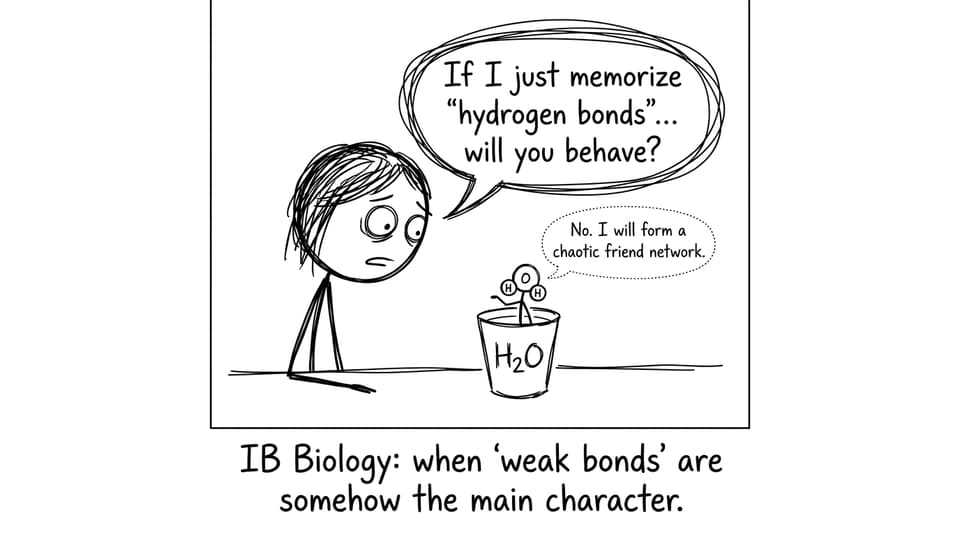
The quick exam checklist (what to say in 20 seconds)
If you’re revising IB Biology and want a fast structure for an explanation, use this:
-
Water has polar covalent bonds because oxygen is more electronegative than hydrogen.
-
Water is bent (about 104.5°), so dipoles don’t cancel.
-
Oxygen becomes δ- and hydrogens become δ+.
-
A hydrogen bond forms between δ+ hydrogen of one water molecule and a lone pair on δ- oxygen of another.
-
Each water molecule can form up to four hydrogen bonds (in a network).
-
Bonds are weak individually but strong collectively, shaping water’s properties.
For syllabus-aligned notes that match this exact phrasing, the A1.1 Water section is the most direct route: IB Biology Topic A1.1 Water Notes & Questions.
IB Biology: why water is polar in the first place
To understand how hydrogen bonds form in water, start one step earlier: polarity.
Oxygen pulls shared electrons closer because it is more electronegative. That unequal sharing makes the oxygen end partially negative (δ-) and the hydrogen ends partially positive (δ+). In IB Biology, this is the core cause-and-effect chain: unequal electron sharing --> partial charges --> intermolecular attraction --> hydrogen bonding.
The bent shape matters too. If water were linear, the charges might cancel more neatly. But the bent geometry creates a persistent dipole, like a tiny magnet that never quite turns off.
If you want a model answer for diagrams and labeling, RevisionDojo breaks it down cleanly here: A1.1.2 Hydrogen bonds as a consequence of polar covalent bonds (Notes).
How hydrogen bonds form in water (the mechanism)
A hydrogen bond is an intermolecular attraction (not a covalent bond). In water:
-
The δ+ hydrogen of one molecule is attracted to the δ- oxygen of a neighboring molecule.
-
Specifically, the attraction involves the oxygen’s lone pairs and the strong partial positive charge on hydrogen.
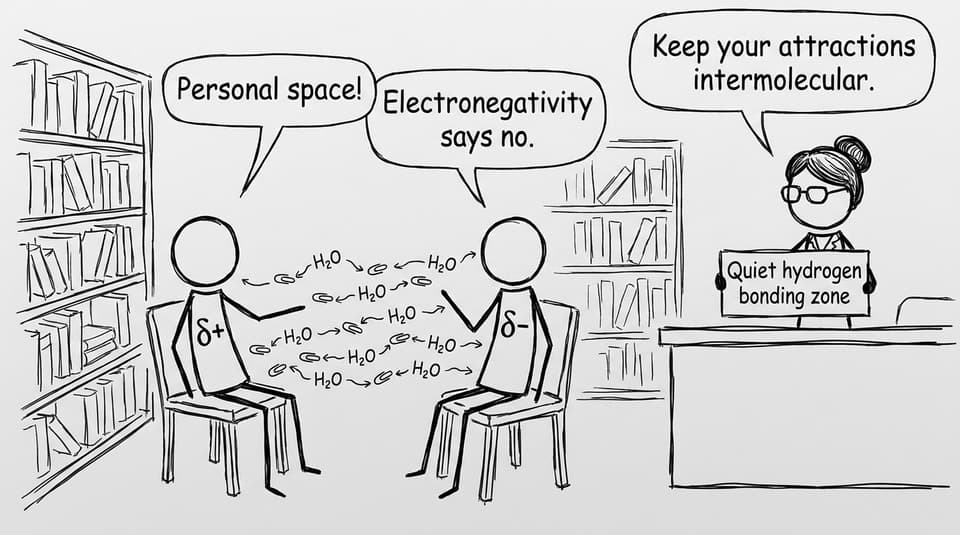
What makes water special in IB Biology is not that hydrogen bonding exists, but that it creates a network. In liquid water, molecules are close enough that these attractions happen constantly. The bonds break and re-form rapidly, but the overall structure behaves like a shifting lattice.
This “weak but everywhere” pattern is a common theme in biology: a single bond is unimpressive, but a crowd of them becomes a system.
What hydrogen bonding explains (and how to phrase it in IB Biology)
Once you know how hydrogen bonds form in water, you can explain several exam favorites with the same logic.
High specific heat capacity (temperature stability)
Water resists temperature change because heat energy is used to disrupt hydrogen bonds before it significantly increases molecular motion. In IB Biology, this connects to homeostasis: organisms and ecosystems benefit from thermal buffering.
RevisionDojo’s notes on water’s role as a life medium help you link bonding to biology (not just chemistry): A1.1.1 Water as the medium for life (Notes).
Cohesion, surface tension, and transport
Cohesion is water sticking to water. Hydrogen bonding makes molecules pull together, helping maintain continuous water columns in xylem and increasing surface tension.
To revise the exact syllabus language, use: A1.1 Water Notes and then test yourself with IB Biology Topic A1.1 Water Questionbank (SL/HL).
Adhesion and capillary action
Adhesion is water sticking to other polar or charged surfaces (like cellulose). Hydrogen bonding supports this by keeping water molecules linked as they interact with those surfaces.
Ice floats (density anomaly)
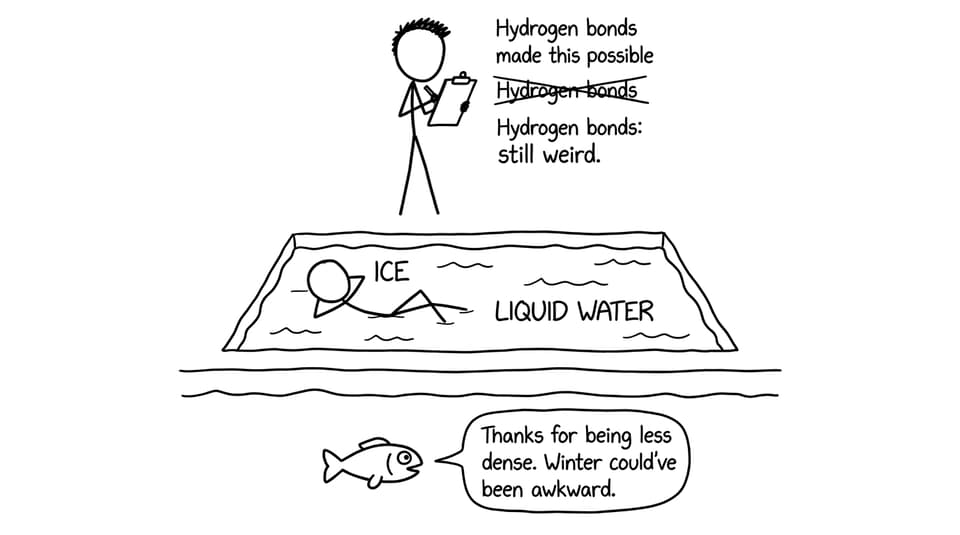
When water freezes, hydrogen bonds stabilize a more open crystalline arrangement. The molecules are held at distances that make solid ice less dense than liquid water, so it floats.
That one fact is quietly huge in IB Biology: floating ice insulates water below, protecting aquatic life.
A short RevisionDojo study workflow for this topic
If you’re preparing for IB Biology exams, here’s a simple loop that matches how exam questions are written:
-
Learn the explanation with IB Biology Topic A1.1 Water Notes & Questions.
-
Drill terms using IB Biology Topic A1.1 Water Flashcards.
-
Practice application questions in the A1.1 Water Questionbank.
-
If you keep mixing up cohesion vs adhesion or polarity vs hydrogen bonding, ask AI Chat to generate two exam-style prompts and mark your responses.
-
Use Grading tools and Mock Exams to train timing, then check weak areas with Study Notes.
If you prefer a visual overview, add this to your routine: Biology Cheatsheets -- Visual Study Guides.
Bringing it back to your exam (and your revision)
The best IB Biology answers on hydrogen bonding don’t just define the bond. They tell the chain: polarity leads to partial charges, partial charges create hydrogen bonding, and hydrogen bonding explains properties that life relies on.
If you want that chain to feel automatic, RevisionDojo is built for it: learn with Study Notes, lock it in with Flashcards, apply it in the Questionbank, and refine with AI Chat feedback. By the time you hit your Predicted Papers and Mock Exams, “how hydrogen bonds form in water” stops being a paragraph you memorize and becomes a mechanism you can use anywhere.
