

A gel that turns DNA into a story you can read
The first time most IB Biology students see a gel electrophoresis photo, it feels like looking at a barcode from another universe. A few glowing bands, a dark background, and suddenly you are expected to explain exactly why one band traveled farther than another. The good news: gel electrophoresis is less mystery, more physics with a biology accent. Once you understand the three ideas underneath it (charge, sieve, size), most exam questions become surprisingly predictable.
Quick exam checklist (what the marker wants)
For IB Biology, your best answers usually mention these points clearly:
-
DNA is negatively charged because of the phosphate backbone.
-
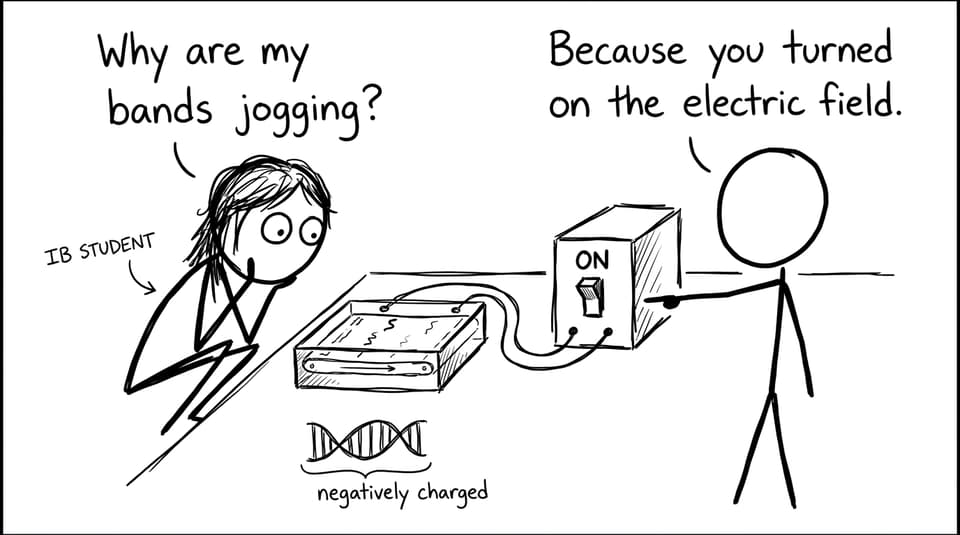
An electric field makes DNA move toward the positive electrode.
-
The agarose gel is a molecular sieve.
-
Smaller fragments move faster and travel farther than larger fragments.
-
Gel concentration changes pore size (higher % agarose == smaller pores).
-
A stain makes bands visible, and a DNA ladder helps estimate fragment size.
If you can explain those in calm, connected sentences, you are doing IB Biology at a high level.
Why DNA moves at all: charge and the electric field
DNA is loaded into wells at one end of an agarose gel, sitting in buffer. The key detail for IB Biology is that DNA carries a negative charge along its backbone. When the current is switched on, the electric field pulls the DNA toward the positive electrode. That directionality is why wells are placed near the negative end: you want fragments to migrate across the gel rather than out of it.
If you want the clean syllabus-aligned version, pair this article with RevisionDojo’s notes on PCR and electrophoresis: D1.1.4 Polymerase Chain Reaction and gel electrophoresis notes.
The gel is a sieve: how size becomes distance
Here is the heart of it: gel electrophoresis mainly separates DNA by size, not by charge. In IB Biology wording, DNA fragments have a broadly similar charge-to-mass ratio, so the gel’s physical resistance is what creates separation.
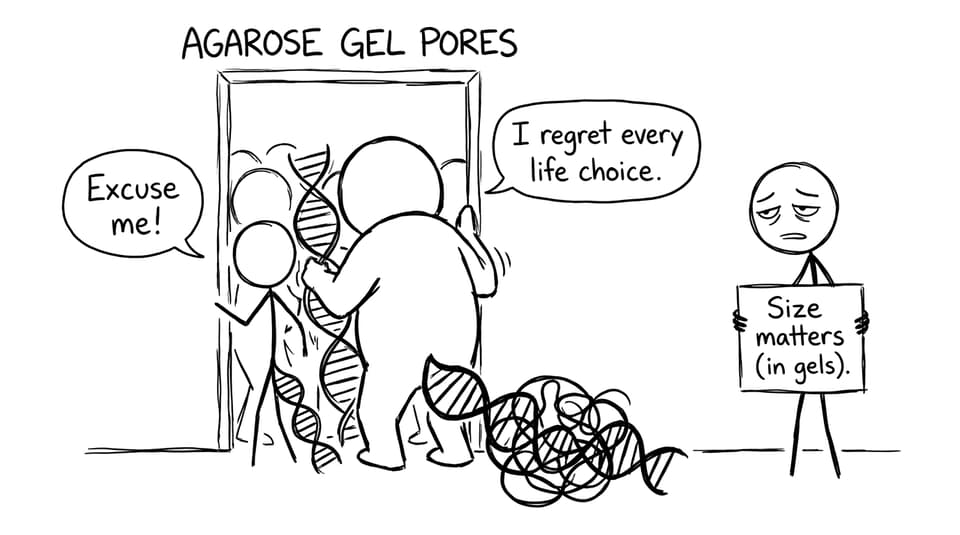
Agarose forms a mesh of pores. Small fragments slip through more easily, so they move faster and end up farther from the wells. Large fragments experience more friction and get slowed down. After enough time, the fragments spread out into discrete “bands” where many molecules of the same length cluster together.
Gel concentration: the hidden variable examiners love
A simple lever changes how well fragments separate: agarose percentage.
-
Higher agarose concentration creates smaller pores, improving separation of small fragments.
-
Lower agarose concentration creates larger pores, better for large fragments.
In IB Biology questions, this often appears as “suggest an improvement” or “explain why bands are too close together.” The fix is frequently: adjust gel concentration, voltage, or run time.
Seeing the bands: stains and ladders
DNA is not naturally visible in a gel, so labs use a stain that binds to DNA. Under UV or a digital imaging system, bands appear. Each band represents many copies of DNA fragments of the same length.
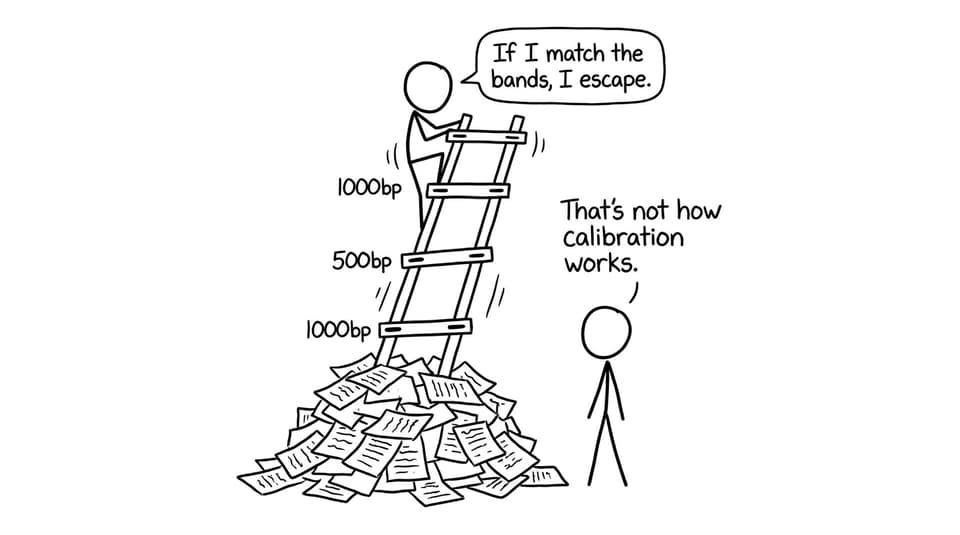
To estimate sizes, you compare your sample lanes to a DNA ladder (a set of known fragment sizes). On exams, it is enough to say the ladder provides reference bands so you can infer the approximate base-pair length of unknown fragments.
RevisionDojo has a useful vocabulary bank for tightening definitions like “gel electrophoresis,” “DNA ladder,” and “restriction enzyme”: IB Biology glossary.
Where exam questions connect: PCR, restriction enzymes, and profiling
In IB Biology, electrophoresis rarely appears alone. It is usually the “readout” step after you have created fragments using:
-
PCR (amplify a region so you have enough DNA to see)
-
Restriction enzymes (cut DNA at specific recognition sites)
To practice these connections:
-
Learn how restriction enzymes cut predictably: How restriction enzymes recognize and cut specific DNA sequences
-
See how electrophoresis fits into profiling workflows: How scientists use DNA profiling to compare individuals
-
Drill exam-style prompts in targeted sets: Molecular biology Questionbank
Bring it home: revise electrophoresis the smart way
Gel electrophoresis is one of those IB Biology topics that rewards clean thinking: charge explains movement, the gel explains separation, and the ladder explains measurement. If you want to turn that understanding into exam marks, RevisionDojo makes the process feel structured rather than overwhelming: use the D1.1.4 notes to lock in theory, the flashcards on applications to sharpen recall, and the Questionbank to practice how examiners phrase traps.
When your next IB Biology question shows a gel image, you should be able to read it like a calm, familiar map: smaller fragments went farther, for reasons you can explain in one breath.